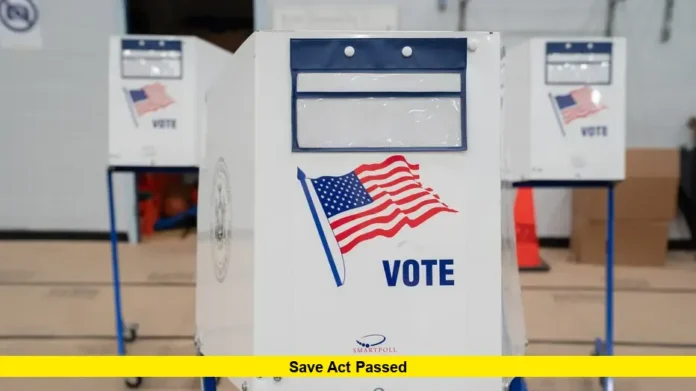

The political landscape on election laws shifted dramatically this week as the SAVE Act passed? question was answered with a resounding “yes” from the U.S. House of Representatives. The House narrowly approved the controversial Safeguard American Voter Eligibility Act — commonly known as the SAVE Act — in a closely watched vote Tuesday, setting up a fierce debate ahead in the Senate. The legislation’s advancement marks a pivotal moment in how federal elections could be regulated nationwide, with major implications for voter registration procedures and ballot access in future elections.
The House Vote and Where the SAVE Act Goes Next
In a tightly split vote, the Republican-controlled House approved the SAVE Act by a 218-to-213 margin, with only one Democrat crossing party lines to support the bill. The legislation now moves to the Senate, where its prospects are far less certain because Senate rules require a 60-vote threshold to overcome a filibuster. Republican leaders have indicated they may consider procedural tactics to advance the bill, but political analysts remain skeptical that the legislation will clear the Senate without bipartisan backing.
This significant legislative action comes just months ahead of the 2026 midterm elections, intensifying the stakes as lawmakers debate the balance between election security and voter accessibility.
What the SAVE Act Would Do
At its core, the SAVE Act aims to tighten federal voter registration requirements by mandating that individuals provide documentary proof of U.S. citizenship at the time they register to vote in federal elections. It would also implement a nationwide photo identification requirement for voting. Under the bill:
- Applicants would need to present a U.S. passport, a certified birth certificate with photo ID, or other specified government documentation to register.
- States would be barred from processing a federal voter registration application unless the required proof of citizenship is provided.
- Failure by an election official to enforce citizenship documentation could trigger criminal penalties.
Supporters frame the measure as a necessary bolstering of election integrity. They argue it prevents non-citizens from registering to vote and enhances public trust in electoral outcomes. However, there is no evidence that non-citizen voting is widespread in U.S. elections, and the current federal voter registration form already requires applicants to affirm their citizenship under penalty of perjury.
Critics Sound the Alarm Over Voter Access
Opponents of the SAVE Act warn that its stringent documentation requirements would make it harder for many eligible citizens to register and vote. Voting rights advocates point out that tens of millions of Americans do not have easy access to the specific documentation the legislation would require — such as a passport — which could disproportionately affect people in low-income communities, Black and Latino voters, elderly citizens, and those living in rural or underserved areas.
They also argue that the measure could undermine longstanding practices like online and mail-in voter registration, since applicants would often be required to present documentary proof of citizenship in person to local election officials.
Another key concern centers on federalism. Critics say the Act represents unwarranted federal interference in election administration, which is traditionally managed by states. Some state officials have stated that complying with the new requirements would strain election offices and potentially lead to confusion or delays during critical election periods.
Debate in the Senate and Legislative Odds
In the Senate, the SAVE Act faces significant resistance from Democrats and some moderate Republicans. The 60-vote requirement for ending debate means that without bipartisan support, the measure could stall. Senate Minority Leader and Democratic lawmakers have pledged to oppose the legislation, calling it a voter suppression effort that would disproportionately disenfranchise eligible voters.
Republican supporters have discussed procedural options — such as changing filibuster rules or using a “talking filibuster” strategy — to push the bill forward, but leadership has not indicated a formal plan. Some Senate Republicans have expressed reservations about drastic changes to election laws without broader consensus.
Nationwide Reactions and Political Implications
The House’s passage of the SAVE Act has sparked reactions across the political spectrum. Voting rights organizations and civil liberties groups immediately denounced the legislation, urging constituents to contact their senators to oppose the bill. Grassroots efforts are mobilizing around the clock, emphasizing the perceived threat to democratic participation.
Conversely, conservative groups and Republican officials praised the House vote as a meaningful step toward ensuring that only eligible citizens participate in federal elections. Many supporters tie the effort to broader goals of election security that have become central to conservative policy agendas.
How the Legislation Could Affect Voters
If the SAVE Act ultimately becomes law, its impact would be felt most acutely at the point of voter registration. For first-time voters and individuals updating existing registrations, the requirement to produce specific proof of citizenship could introduce new hurdles. For example:
- Voters without ready access to a passport or certified birth certificate might face difficulties completing registration.
- Election offices in rural areas could see increased in-person visits, raising logistical challenges.
Some analyses estimate that millions of eligible voters may lack the precise documents the bill would require, and election officials could face legal and administrative pressures in determining eligibility.
Looking Ahead: What Comes Next
The Senate’s handling of the SAVE Act will shape the national conversation on election law leading up to 2026. Should the bill fail in the Senate, Republicans may pivot to alternative approaches or reintroduce similar measures. If the Senate does take up the legislation, amendments and negotiations could further alter its final form.
In addition to the SAVE Act, other election-related bills — including proposals to limit mail-in voting or ban ranked-choice voting — are circulating in Congress. The broader legislative landscape suggests that battles over election rules will continue to be a central theme in U.S. politics throughout the year.
Your voice matters as this debate unfolds — share your thoughts and stay informed as lawmakers deliberate.