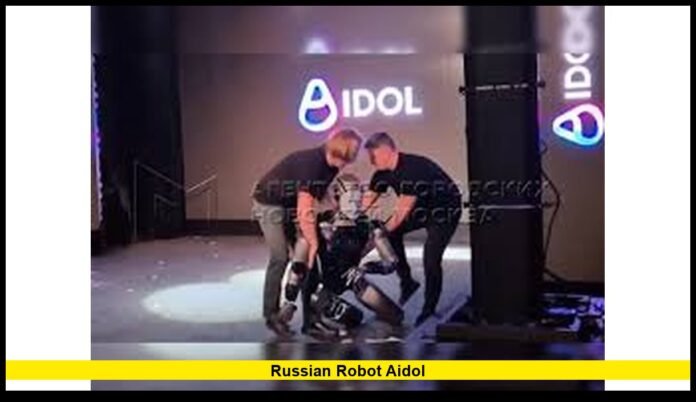

The Russian robot Aidol made headlines this week when the humanoid figure stumbled and fell during its public debut in Moscow. The moment has sparked fresh debate in the U.S. about the state of Russia’s robotics ambitions and how they stack up globally.
What is the robot Aidol?
The machine, known as AIDOL, is developed by a Russian startup named Artificial Intelligence Dynamic Organism Lab (AIDOL). The company describes the robot as Russia’s first anthropomorphic humanoid with artificial-intelligence capabilities, designed to walk, manipulate objects and interact in human-space environments.
According to its specifications:
- Height: ~6 ft 1 in (186 cm)
- Weight: ~209 lbs (95 kg)
- Top walking speed: ~3.7 mph (6 km/h)
- Load-carrying capacity: up to ~22 lbs (10 kg)
- Built with ~77% Russian-made components, with a goal of raising that to ~93% in future iterations
- Capable of expressing 12 basic emotions and hundreds of micro-expressions according to the developer
For U.S. audiences, the robot is noteworthy because its unveiling signals Russia’s intention to compete in humanoid robotics — a field that U.S. firms like Boston Dynamics, Tesla and Figure are actively pursuing.
What happened at the debut?
At a technology showcase in Moscow on November 11 2025, Aidol was led onto the stage under dramatic fanfare—complete with the “Rocky” theme song playing in the background. Moments after it attempted a wave, the robot lost balance and fell face-first onto the stage. Two handlers rushed in to pull it offstage and obscure the scene with a curtain.
Following the incident, the company released a brief statement acknowledging the fall, attributing it to a voltage fluctuation and the stage environment (lighting and floor surface) rather than a fundamental flaw in the design. On Twitter and Reddit, viewers reacted with a mixture of bemusement and skepticism, with one comment stating:
“Lol did they just demonstrate it with the torso because of the walking disaster?”
While the fall became a viral moment, the developers framed it as part of the iterative process of building advanced robotics.
Why this matters for U.S. tech and policy watchers
The spectacle provides a few key takeaways:
- Russia’s ambition in humanoid robotics: The event underscores Moscow’s push to develop domestic robotics capabilities, likely in response to sanctions and technology export restrictions. The component-localization goal (going from ~77% to ~93%) reflects this drive.
- Investment in humanoids globally: Humanoid robots are increasingly seen as strategic assets—not just for manufacturing, but for service, logistics, and even defense applications. In the U.S., firms like Tesla are betting big on this category. Comparing Aidol to U.S. efforts gives a benchmark of sorts.
- The “fail fast” reality of robotics: The incident reminds us that putting a humanoid robot in public view is still risky. The fall doesn’t necessarily mean the platform is dead—but it does highlight development hurdles in balance, stability and control systems.
- Perception and global competition: U.S. analysts noted that the public nature of the mishap may impact perceptions of Russia’s competitiveness in robotics. One commentator asked if this made Russia look “very far behind” in the robot race.
What we know about the platform’s current status
| Feature | Status / Developer Claim | Notes |
|---|---|---|
| Autonomy | Up to 6 hours of operation, offline or online modes supported | Whether full autonomy (in variable environments) has been validated remains open. |
| Mobility & Load-Capacity | Walks, manipulates objects, carries up to ~10 kg | The fall indicates that real-world stability is still under refinement. |
| Local component base | ~77% Russian-made; target ~93% | Reflects strategic autonomy goals. |
| Emotion / Expression | 12 basic emotions, hundreds of micro-expressions (via 19 facial motors) | “Expression” capabilities may be more for demonstration than operational utility. |
| Company / Funding | Independent startup with 14 team members; self-funded so far | No large corporate or government backing has been publicly disclosed yet. |
From the U.S. vantage point: the platform remains in early prototype phase. The debut did not yet demonstrate robust field-ready capability. The company acknowledges this by describing the event as part of the learning curve.
What’s next for Aidol – and what to watch
- Refinement & next public demo – The company plans to address calibration, stability and sensor/lighting mismatch issues. A follow-up demonstration will be key in assessing progress.
- International positioning – Will Russia seek partnerships, export versions, or compete domestically? U.S. observers should note if the platform moves from “proof-of-concept” to commercialization.
- Component-supply strategy – The push to increase Russian-made components suggests Kremlin interest in export resilience. The U.S. and allied nations monitor such moves for potential tech-export or dual-use implications.
- U.S. competitive response – As U.S. companies accelerate humanoid development, the Aidol incident may serve as a comparison benchmark. How quickly rivals iterate and scale will matter.
- Public perception & media narrative – The viral fall shapes how the world sees Russian robotics. Improving credibility will require more robust successes, not just viral moments.
Why U.S. readers should care
If you follow AI, robotics, industrial automation or defense tech in the U.S., the fate of Aidol matters because:
- It signals how rapidly other nations (in this case Russia) are trying to catch up in humanoid robotics.
- It illustrates how early-stage robotics still face real-world obstacles — stability, environment adaptation and component engineering matter.
- It foreshadows potential shifts in workforce automation, manufacturing competitiveness and even national strategy in autonomous machines.
In short, the story of Aidol is more than a robotic fall-flat moment—it’s a marker in the evolving global robotics race.
Final take
The key phrase “russian robot Aidol” frames a moment of ambition, misstep and potential in one. Russia’s unveiling of its humanoid robot Aidol offered promise, stumbled visibly, and now enters a phase where follow-through matters. As U.S. watchers track robotics innovation and competition, Aidol’s next moves will be worth a close look.
If you’ve got thoughts on where humanoid robotics are headed, or what the U.S. should do next—drop a comment below and stay tuned for the updates.