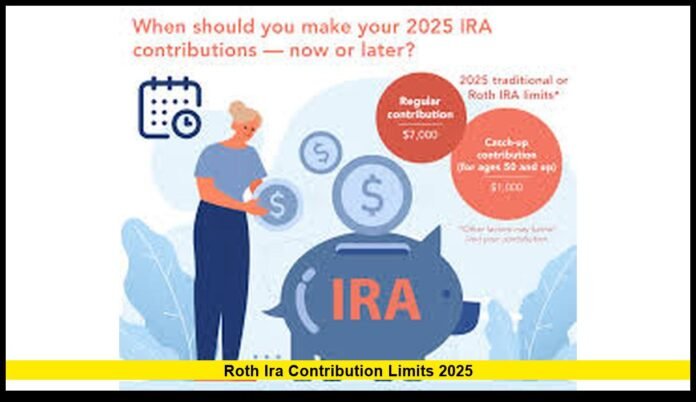
. Income thresholds rise, allowing more savers to qualify for tax-free.)
Roth IRA contribution limits 2025 are now confirmed, giving retirement savers clear guidance as they plan for the year ahead. For individuals under age 50, the maximum contribution remains $7,000, while those age 50 and older can take advantage of an additional $1,000 catch-up contribution, bringing their total annual limit to $8,000. These limits are unchanged from 2024, which means savers won’t see an increase in how much they can put aside directly into a Roth IRA this year.
While the contribution amounts stayed the same, the income thresholds for eligibility have shifted upward. This adjustment reflects inflation and allows more higher-earning individuals to participate, at least at a partial level. For example, single filers with incomes below $150,000 can still contribute the full amount, but once income moves into the $150,000–$165,000 range, the contribution allowance begins to phase out. Married couples filing jointly see a similar adjustment, with the full contribution available below $236,000 and a reduced contribution allowed up to $246,000. Beyond those limits, direct Roth IRA contributions are no longer permitted.
The combination of steady contribution caps and slightly expanded income ranges means that more middle- and upper-middle-income earners will be able to put money into Roth IRAs in 2025. This is good news for savers who may have been close to the income cutoff in prior years, as the adjustments give them a wider window of eligibility. For anyone looking to build long-term, tax-free retirement wealth, understanding these limits is essential to avoiding penalties and making the most of this powerful account.
Why Roth IRA Contribution Limits 2025 Matter
The Roth IRA continues to be one of the most popular retirement accounts in the United States because contributions are made with after-tax dollars and qualified withdrawals in retirement are tax-free. This unique benefit makes the Roth IRA especially valuable for younger workers, professionals expecting higher future tax rates, and retirees who want flexibility in managing taxable income later in life.
The annual contribution limits set by the IRS ensure fairness while preventing excessive tax sheltering. Staying up to date with these limits helps investors maximize their retirement savings without incurring penalties.
The 2025 Roth IRA Contribution Rules
For individuals under the age of 50, the maximum amount you can contribute to a Roth IRA in 2025 is $7,000. If you are age 50 or older, you are eligible for what is known as a catch-up contribution, which allows you to put in an additional $1,000. This means your total contribution limit rises to $8,000. The catch-up option is designed to give those closer to retirement an opportunity to save more aggressively in the years leading up to when they will need their funds.
The deadline to make contributions for the 2025 tax year is April 15, 2026, which coincides with the federal tax filing deadline. This gives you extra time beyond the calendar year to make your contributions, so even if you don’t contribute throughout 2025, you can still make a lump-sum contribution before the deadline.
It’s also important to understand that these limits are aggregate limits across all IRA accounts. This means the maximum applies to the total you put into both a Traditional IRA and a Roth IRA combined. For example, if you are under 50 and decide to contribute $4,000 to a Traditional IRA, you would only be able to contribute $3,000 to a Roth IRA for the same tax year. Similarly, if you’re over 50 and contribute $5,000 to a Traditional IRA, you can contribute only up to $3,000 more to a Roth IRA, for a combined maximum of $8,000. This rule ensures that taxpayers don’t exceed the annual IRA contribution limits by splitting funds between the two types of accounts.
Income Limits and Phase-Out Ranges
Eligibility to contribute to a Roth IRA depends not only on your age but also on your modified adjusted gross income (MAGI) and filing status. The IRS adjusts these numbers annually to reflect inflation. For 2025, the income ranges have increased slightly, giving more people the chance to make contributions.
Here’s how it looks:
| Filing Status | Full Contribution Allowed | Partial Contribution Phase-Out Range | Ineligible If MAGI At Or Above |
|---|---|---|---|
| Single or Head of Household | Below $150,000 | $150,000 – $165,000 | $165,000 |
| Married Filing Jointly | Below $236,000 | $236,000 – $246,000 | $246,000 |
| Married Filing Separately | Not eligible if MAGI ≥ $10,000 | N/A | $10,000 |
This means that if you earn under the lower threshold, you can contribute the full amount. If your income falls within the phase-out range, your contribution limit is reduced. Once your income exceeds the upper threshold, you are not eligible to contribute directly to a Roth IRA.
Strategies if You Exceed Income Limits
Many high earners still want the long-term tax-free growth and tax-free withdrawals that a Roth IRA offers, even if their income levels prevent them from contributing directly. Fortunately, there are several strategies to work around these limits.
One of the most widely used options is the backdoor Roth IRA. This strategy involves first making a non-deductible contribution to a Traditional IRA and then converting those funds into a Roth IRA. Because the IRS does not place income restrictions on Roth conversions, this method allows high-income earners to still gain access to Roth benefits. However, it’s important to recognize that the backdoor Roth comes with potential tax implications, especially if you already hold pre-tax funds in a Traditional IRA. The pro-rata rule may apply, which can create unexpected taxable income. For that reason, it’s best to carefully plan the timing of contributions and consult a financial or tax advisor before executing this strategy.
Another effective approach is to maximize contributions to employer-sponsored retirement plans, such as a 401(k), 403(b), or 457(b). These plans not only come with higher annual contribution limits than IRAs, but many employers now also offer a Roth 401(k) option, which allows after-tax contributions that grow tax-free, similar to a Roth IRA. For 2025, the 401(k) contribution limits are significantly higher than IRA limits, making this a valuable way for high earners to save more on a tax-advantaged basis. Additionally, some employer plans allow in-plan Roth conversions, giving participants another avenue to shift pre-tax contributions into Roth status.
By combining these strategies, individuals who exceed the Roth IRA income thresholds can still build meaningful Roth savings, but it requires intentional planning and awareness of tax consequences.
Benefits of Maximizing Roth IRA Contributions in 2025
Contributing as much as possible to your Roth IRA in 2025 can provide a wide range of long-term financial benefits that go beyond simple retirement savings. Unlike other retirement accounts, a Roth IRA offers unique features that make it one of the most powerful tools for building wealth and financial flexibility. Here are the key advantages of fully funding your Roth IRA this year:
1. Tax-Free Withdrawals in Retirement
One of the most appealing benefits of a Roth IRA is the ability to take qualified distributions completely tax-free in retirement. Since contributions are made with after-tax dollars, you won’t owe federal income tax on withdrawals of both contributions and earnings, provided certain conditions are met (such as being over age 59½ and having held the account for at least five years). This can be especially valuable if you expect to be in a higher tax bracket later in life, as it allows you to lock in tax-free income when you’ll need it most.
2. No Required Minimum Distributions (RMDs)
Traditional IRAs and 401(k)s require you to start taking required minimum distributions (RMDs) beginning at age 73 (or 75 for younger generations under current law). These mandatory withdrawals can increase your taxable income in retirement, even if you don’t need the funds. A Roth IRA, however, has no RMDs during your lifetime, allowing your investments to continue growing tax-free for as long as you want. This makes it an excellent vehicle for those who want to maintain control over when and how they access their retirement savings.
3. Estate Planning Advantages
Roth IRAs also provide a powerful tool for passing wealth to heirs. Because the account grows tax-free and withdrawals are not subject to federal income tax, beneficiaries can inherit an account that continues to generate tax-advantaged growth. While heirs are typically required to draw down the account within 10 years under current rules, they can still benefit from years of additional growth without tax erosion. This makes a Roth IRA an attractive option for those looking to leave a financial legacy.
4. Flexibility and Liquidity
Unlike many other retirement accounts, Roth IRAs provide a degree of flexibility and accessibility. Contributions (but not earnings) can be withdrawn at any time without taxes or penalties. This means if you face an unexpected expense or financial emergency, your Roth IRA can serve as a back-up source of liquidity without derailing your retirement savings. While it’s generally best to leave contributions untouched to maximize growth, having this option offers peace of mind and financial security.
5. Hedge Against Future Tax Increases
Another often-overlooked benefit of maximizing Roth IRA contributions is the ability to protect yourself from future tax rate hikes. Since tax laws can change and future rates are unpredictable, having a portion of your retirement income in a tax-free account ensures stability regardless of policy changes. This diversification of tax treatment can give you greater flexibility in retirement income planning.
6. Long-Term Compounding Power
By contributing the maximum in 2025, you give your money more time to grow tax-free. Even modest contributions can compound into significant sums over decades. For example, maxing out contributions consistently each year could result in hundreds of thousands of dollars in tax-free retirement savings, especially if invested wisely in growth-oriented assets.
👉 By maximizing your Roth IRA contributions in 2025, you not only take advantage of current contribution limits but also set yourself up for greater financial freedom, flexibility, and security in retirement.
Penalties for Over-Contributing
While contributing to a Roth IRA is an excellent way to build long-term wealth, it’s equally important to make sure you don’t contribute more than the annual limits. Exceeding the allowed amount comes with real consequences, and the IRS has strict rules in place to enforce them.
If you contribute more than the maximum allowed for 2025—$7,000 if you are under 50 or $8,000 if you are 50 and older—the IRS imposes a 6% excise tax on the excess amount. This penalty is applied every year the excess contribution remains in the account, which means the longer the mistake goes uncorrected, the more costly it becomes. For example, if you accidentally over-contribute by $1,000 and don’t correct it, you would owe $60 in penalties each year until it’s resolved. Over time, this can significantly eat into your savings.
To avoid this issue, savers should carefully track their contributions throughout the year. This is especially critical if:
- You contribute to both a Traditional IRA and a Roth IRA, since the combined contributions cannot exceed the annual limit.
- Your income is close to the Roth IRA phase-out threshold, as your contribution eligibility may be reduced or eliminated partway through the year.
If you discover that you’ve accidentally contributed too much, the good news is that the IRS allows you to fix the mistake without long-term penalties. The most straightforward way to correct an over-contribution is by withdrawing the excess amount, along with any earnings generated by those funds, before the tax filing deadline (April 15, 2026, for the 2025 tax year). Doing so ensures that the 6% excise tax will not apply. Keep in mind that any earnings withdrawn may be subject to income tax and, if you’re under age 59½, an additional 10% early withdrawal penalty could also apply.
Another option is to apply the excess contribution toward the following year’s limit if you expect to contribute less in the next tax year. However, the 6% penalty may still apply for the current year, so this strategy should be used cautiously.
Ultimately, the best way to prevent penalties is to plan contributions carefully and monitor them closely. By staying organized and double-checking your totals, you can avoid unnecessary taxes and keep your retirement savings on track.
What Stayed the Same from 2024
While tax laws and retirement rules often evolve from year to year, many of the core Roth IRA rules for 2025 remain unchanged from 2024. This consistency can make it easier for savers to plan ahead without worrying about major surprises.
- Contribution Limits Remain the Same
For 2025, the maximum contribution limits are unchanged: $7,000 for individuals under age 50 and $8,000 for those 50 and older, which includes the additional $1,000 catch-up contribution. Even though the IRS adjusts certain retirement account limits annually for inflation, the Roth IRA contribution cap did not increase this year. - Catch-Up Contribution Still Fixed
The $1,000 catch-up contribution for individuals age 50 and older continues to remain fixed. Unlike other retirement savings limits, this particular provision is not indexed to inflation. This means that unless Congress changes the law, the catch-up contribution will stay at $1,000 regardless of rising costs or future adjustments to base contribution limits. - Withdrawal and Penalty Rules Are Consistent
The rules governing withdrawals from Roth IRAs also remain consistent with prior years. Contributions can still be withdrawn at any time without taxes or penalties, while earnings require you to meet the five-year rule and be at least age 59½ for tax-free, penalty-free access. Early withdrawals of earnings may still trigger both income taxes and a 10% penalty, unless you qualify for an exception (such as first-time homebuyer expenses or qualified education costs). - No New RMD Requirements
Unlike Traditional IRAs, Roth IRAs continue to have no required minimum distributions (RMDs) during the original owner’s lifetime. This makes them especially valuable for long-term planning and estate transfers, and this rule has not changed for 2025. - Only Change: Income Eligibility Adjustments
The most notable update for 2025 is a slight adjustment to the Roth IRA income eligibility ranges. These phase-out thresholds are typically indexed to inflation, which means some higher-earning individuals may now have a bit more room to contribute directly to a Roth IRA. While the increase isn’t dramatic, it could provide an opportunity for certain savers who were previously phased out to now qualify—at least partially—for contributions.
In short, 2025 looks very similar to 2024 when it comes to Roth IRA rules, making it easier for individuals to continue their savings strategies with confidence.
Comparison chart of Roth IRA rules for 2024 vs 2025
| Rule | 2024 | 2025 |
|---|---|---|
| Contribution Limit (Under 50) | $7,000 | $7,000 |
| Contribution Limit (Age 50+) | $8,000 (includes $1,000 catch-up) | $8,000 (includes $1,000 catch-up) |
| Catch-Up Contribution | $1,000 (fixed) | $1,000 (fixed) |
| Deadline for Contributions | April 15, 2025 | April 15, 2026 |
| Withdrawal & Penalty Rules | Same rules apply (contributions anytime, earnings subject to 5-year rule & age 59½) | Unchanged from 2024 |
| Required Minimum Distributions (RMDs) | No RMDs during account owner’s lifetime | Unchanged from 2024 |
| Income Eligibility Ranges |
Key Takeaways for Roth IRA Contribution Limits 2025
- Maximum contribution: $7,000 under age 50, $8,000 age 50+.
- Contributions apply across all IRAs combined.
- Income eligibility thresholds have risen slightly in 2025.
- Deadline to contribute for 2025 is April 15, 2026.
- Over-contributions may result in a 6% penalty each year until corrected.
Final Thoughts
The Roth IRA remains one of the most powerful retirement savings vehicles available. While the Roth IRA contribution limits 2025 did not increase, the inflation-adjusted income thresholds give more Americans the ability to participate. Whether you’re just starting to save or are close to retirement, understanding and using these limits wisely can strengthen your long-term financial security.
What are your thoughts on this year’s Roth IRA contribution limits? Share your perspective or questions in the comments below—your insights may help others planning for retirement.
FAQs
Q1: What is the Roth IRA contribution limit for 2025 if I’m 55 years old?
A1: If you are 50 or older, you can contribute up to $8,000, which includes the $1,000 catch-up contribution.
Q2: Can I still contribute to a Roth IRA if my income is too high?
A2: You cannot make direct contributions if your income exceeds the upper phase-out limit, but strategies like the backdoor Roth IRA may still allow access.
Q3: What happens if I put more than the limit into my Roth IRA in 2025?
A3: Excess contributions are subject to a 6% tax penalty each year until corrected. You can fix this by withdrawing the extra amount before the tax filing deadline.