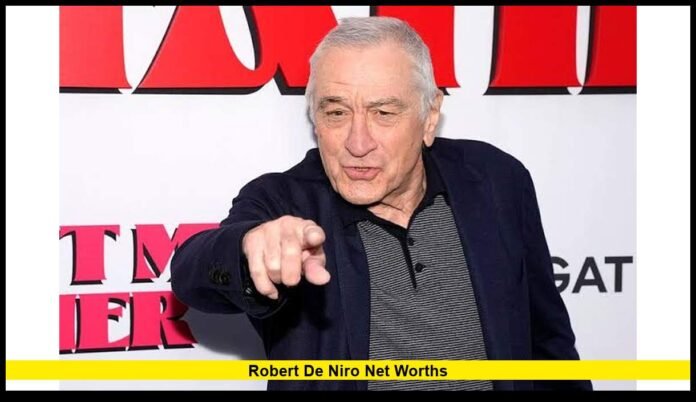

Robert De Niro has spent more than five decades at the center of American cinema, building a reputation as one of the most respected actors of his generation while also developing a substantial business portfolio. Robert De Niro net worth is estimated at approximately $500 million in 2026, according to widely reported celebrity wealth estimates. His fortune reflects much more than movie salaries, with restaurants, hotels, production work and real estate playing important roles in his financial story.
At 83, De Niro remains professionally active. His recent work includes the Netflix political thriller Zero Day, the 2025 film The Alto Knights, and The Whisper Man in 2026. He is also attached to upcoming projects including Focker-in-Law, After Exile and Mr. Natural. His continued activity in entertainment gives the actor another source of income while his business interests operate on a much larger scale.
How Much Is Robert De Niro Worth in 2026?
Robert De Niro’s estimated fortune stands at roughly $500 million in 2026.
That figure should be viewed as an estimate rather than a confirmed personal financial statement. De Niro has not published a complete breakdown of his wealth, and private holdings, taxes, debts, investment structures and business arrangements are not fully available to the public.
Nevertheless, his decades of work provide a clear explanation for why his wealth has reached such a level.
De Niro’s income has come from several distinct areas:
- Acting in major films and television productions
- Producing movies and television projects
- Restaurant businesses
- Luxury hotels and hospitality
- Real estate
- Long-term business investments
- Licensing and entertainment-related income
The combination has allowed De Niro to build a financial empire that extends well beyond his status as an Oscar-winning actor.
Robert De Niro’s Early Life and Acting Breakthrough
Born on August 17, 1943, in New York City, De Niro grew up in an artistic environment. His parents were painters, and he eventually developed an interest in acting.
Rather than following a conventional academic path, he focused heavily on acting training. He studied under respected teachers, including Stella Adler, and began appearing in theater productions before moving into film.
His earliest screen work came before he became a household name, but the 1970s transformed his career.
De Niro gained wider recognition through Bang the Drum Slowly and Mean Streets. His collaboration with director Martin Scorsese became particularly important.
The two eventually worked together on a series of films that became landmarks of American cinema.
The Role That Changed Everything
De Niro’s breakthrough to major Hollywood recognition came with The Godfather Part II.
He portrayed the younger Vito Corleone, a role that required him to embody the character previously played by Marlon Brando. De Niro’s performance earned him the Academy Award for Best Supporting Actor.
The victory established him as a major dramatic performer.
He followed that success with another defining role in Taxi Driver, playing Travis Bickle. The film became one of the most influential American movies of the 1970s, and De Niro’s performance remains among his most famous.
His second Academy Award came for Raging Bull, in which he portrayed boxer Jake LaMotta.
For the role, De Niro underwent a dramatic physical transformation, reinforcing his reputation for intense preparation and commitment to difficult characters.
From Prestige Cinema to Commercial Success
Although De Niro became famous for serious dramas, his career eventually expanded into mainstream commercial entertainment.
This transition proved important financially.
Films such as Heat, Cape Fear, Casino, Goodfellas and The Untouchables strengthened his reputation, while comedies such as Analyze This and Meet the Parents introduced him to a broader audience.
The Meet the Parents franchise was particularly significant because it combined De Niro’s established dramatic reputation with mainstream comedy.
The franchise eventually became a major box-office success, with De Niro also receiving producer credits on the films.
His ability to move between serious drama, comedy, action and family-oriented entertainment helped keep him commercially relevant across multiple generations.
Movie Salaries Became a Major Source of Wealth
De Niro’s earnings changed dramatically as his reputation grew.
Like many actors, his early career salaries were relatively modest. His compensation increased as his status changed from emerging performer to internationally recognized star.
By the later stages of his career, De Niro was capable of commanding substantial compensation for major projects.
His reported earnings from films have varied considerably depending on the production, his role, production responsibilities and contractual arrangements.
One important factor is that an actor’s compensation is not always limited to an upfront salary. Depending on individual contracts, performers may receive bonuses, producer fees or other forms of participation.
That makes it difficult to determine exactly how much De Niro has earned from any individual movie.
His Filmography Continues to Generate Value
De Niro’s career includes more than a hundred acting credits, giving him an unusually large body of work.
Movies such as Taxi Driver, Raging Bull, Goodfellas, Casino, Heat, The Godfather Part II, Meet the Parents and Meet the Fockers remain widely recognized.
Several of his films have also performed strongly commercially.
His role in Joker introduced his work to another generation of moviegoers. The 2019 film became a billion-dollar worldwide box-office phenomenon.
De Niro’s continued visibility across different generations has helped preserve the commercial value of his name.
Nobu Became a Second Career
Perhaps the most important financial development outside acting was De Niro’s relationship with Nobu.
De Niro became involved with chef Nobu Matsuhisa after discovering his cuisine and encouraging him to open a restaurant in New York.
That relationship eventually produced Nobu, a luxury restaurant brand that grew into an international hospitality business.
The company expanded beyond restaurants into hotels and residential developments.
For De Niro, this represented a major shift from earning money as an entertainer to participating in a global consumer and hospitality business.
The Nobu brand has developed a presence across multiple international markets, turning the actor’s restaurant interest into a significant business venture.
Nobu’s Global Expansion
Nobu continues to develop new properties, demonstrating that De Niro’s business interests remain active in 2026.
One of the notable current developments is Nobu Beach Inn in Barbuda. The project is planned as a luxury resort and residential destination and is expected to include 36 bedrooms across 17 villas, alongside restaurants, wellness facilities, recreational amenities and beachfront residences.
The development also includes 25 beachfront residences, with reported starting prices of $12 million.
Such projects illustrate the scale of the hospitality business associated with the Nobu name.
For De Niro, the significance is not simply that he owns or operates restaurants. His association with the brand connects him to a much broader luxury hospitality ecosystem.
Restaurants and Hospitality
De Niro has maintained strong connections to New York’s restaurant scene.
His hospitality interests have included Nobu-related ventures as well as restaurants associated with the Tribeca area.
The restaurant industry has provided him with a second professional identity.
Instead of being known exclusively as a film actor, De Niro became an entrepreneur whose interests extend into dining, hotels and luxury travel.
That diversification is an important reason his financial position has remained strong even when individual film projects have slowed.
Real Estate Adds Another Layer to His Wealth
Real estate has also played a major role in De Niro’s financial story.
His property interests have included homes in New York City, the Hamptons and upstate New York.
One of the most notable properties associated with him is a large estate in Gardiner, New York. The property covers more than 100 acres and has been reported to include a private ski slope and other facilities.
De Niro has also maintained a strong connection to the Hamptons.
Real estate can be particularly valuable for long-term wealth preservation because properties in desirable markets can appreciate substantially over time.
His property portfolio therefore represents both lifestyle assets and potentially significant stores of value.
Tribeca and His Influence Beyond Acting
De Niro’s connection with Tribeca is another important part of his professional legacy.
He was involved in establishing the Tribeca Film Festival in the aftermath of the September 11 attacks. The event became an important cultural institution in Lower Manhattan.
His involvement with Tribeca Productions also allowed him to participate in the business side of entertainment.
Production provides a different financial model from acting. Rather than simply being paid to appear on screen, a producer can have a role in developing, financing and overseeing a project.
That broader involvement helped De Niro establish himself as an entertainment businessman.
Robert De Niro’s Television Success
For much of his career, De Niro was primarily associated with movies.
That changed with Zero Day, his first major starring television role.
The Netflix political thriller placed De Niro in the role of George Mullen, a former U.S. president dealing with the aftermath of a devastating cyberattack.
The series gave him a new platform while demonstrating the growing importance of streaming television for major film stars.
De Niro also served as an executive producer on the series, further showing how his career combines acting with production responsibilities.
His Recent and Upcoming Projects
De Niro has shown no indication of completely stepping away from entertainment.
His recent screen work includes The Alto Knights and The Whisper Man. His upcoming credits also include Focker-in-Law, After Exile and the television project Mr. Natural.
The continuation of his career matters financially because De Niro remains capable of generating income through new productions even after decades of success.
His longevity is unusual in Hollywood, where many actors see their commercial opportunities decline with age.
De Niro has instead continued moving between theatrical movies, streaming productions and television.
How De Niro’s Wealth Is Different From a Typical Actor’s
De Niro’s financial story is unusual because his fortune is not dependent on one industry.
A traditional actor may earn most of their money from film and television salaries. De Niro has developed several additional sources.
His financial interests can be viewed across four major categories:
Entertainment
His acting, producing and long-term film career form the foundation of his wealth.
Hospitality
Nobu gives him exposure to a global restaurant and hotel business.
Real Estate
Properties in New York and surrounding areas represent substantial tangible assets.
Business and Production
His production activities and other ventures provide additional sources of income.
This diversification has helped De Niro maintain financial strength while the entertainment industry has undergone major changes.
Why His $500 Million Estimate Can Change
Celebrity net worth figures are never static.
The value of real estate can rise or fall. Private businesses can become more or less valuable. Film and television income changes according to new projects. Investments can also affect an individual’s overall financial position.
Taxes and expenses are another major consideration.
For that reason, a $500 million estimate should not be interpreted as a precise figure sitting in a bank account.
Instead, it represents an estimated value of assets and financial interests after considering publicly available information.
Robert De Niro’s Legacy
De Niro’s financial success is closely connected to his extraordinary career.
He went from relatively small acting roles to becoming a two-time Academy Award winner and one of the most recognizable performers in American cinema.
His partnership with Martin Scorsese produced several landmark films. His commercial comedies introduced him to an even larger audience. His production work gave him greater control over projects, while Nobu created a business empire outside Hollywood.
The result is a career that combines artistic recognition with entrepreneurship.
Final Look at His Wealth in 2026
Robert De Niro’s estimated $500 million fortune reflects decades of disciplined career expansion.
His acting career remains the most visible part of his public identity, but his business interests have become equally important to understanding his finances.
From Oscar-winning performances to international restaurants, luxury hotels, real estate and production, De Niro has built multiple income streams.
His continued work in 2026 also demonstrates that the Hollywood veteran remains active. With new films and television projects in development and Nobu continuing to expand internationally, his professional and financial story is still evolving.
For a performer whose career began in the 1960s, maintaining this level of influence more than half a century later is one of the most remarkable aspects of his legacy.