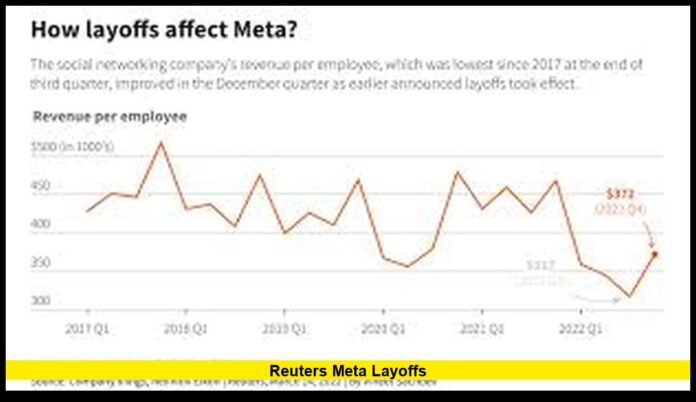

Reuters Meta layoffs are drawing widespread attention after a report revealed that Meta Platforms is evaluating significant workforce reductions while dramatically increasing investment in artificial intelligence and advanced computing infrastructure.
The reported discussions highlight how the company is reshaping its priorities in 2026. Meta is shifting resources toward AI development, high-performance data centers, and next-generation machine learning systems, prompting leadership to reassess staffing levels across parts of the organization.
While no final decision has been publicly confirmed, the report indicates that internal conversations about possible job cuts are underway as Meta attempts to balance rising technology spending with operational efficiency.
What the Reuters Meta Layoffs Report Indicates
The Reuters Meta layoffs report suggests that company executives have been reviewing workforce structures as part of a broader cost and efficiency strategy.
The potential layoffs are tied directly to the company’s evolving focus on artificial intelligence and automation.
Key points emerging from the report include:
- Meta leadership is reviewing staffing levels across multiple divisions.
- Workforce reductions could occur as part of broader restructuring efforts.
- Rising AI investment is putting pressure on budgets and operational costs.
- The company is seeking efficiency improvements across departments.
Meta has not confirmed a specific timeline or number of potential job cuts. However, the discussions reflect how quickly the company’s strategic direction is shifting toward AI-driven technologies.
Meta’s Strategic Shift Toward Artificial Intelligence
Artificial intelligence now sits at the center of Meta’s long-term growth strategy.
The company is investing heavily in systems designed to support large-scale AI models, advanced algorithms, and new consumer products powered by machine learning.
Several major initiatives are shaping Meta’s AI push:
- Development of advanced generative AI systems
- Expansion of high-capacity data centers
- Creation of specialized AI hardware and chips
- Recruitment of leading AI engineers and researchers
These investments require significant financial resources. As a result, the company is reviewing expenses and workforce structures across its global operations.
Earlier Restructuring Inside Meta
Before the latest Reuters Meta layoffs report emerged, Meta had already taken steps to streamline parts of its business earlier in 2026.
One of the most notable restructuring efforts occurred within Reality Labs, the division responsible for virtual and augmented reality technologies.
Reality Labs has been central to Meta’s long-term vision of immersive computing. However, the division has also faced financial pressure due to high development costs and slower consumer adoption.
A previous restructuring phase affected roughly 10 percent of employees in the division, representing more than 1,000 roles.
| Division | Impact | Reason |
|---|---|---|
| Reality Labs | Around 10% workforce reduction | Shift toward AI-focused development |
The restructuring helped Meta redirect resources toward emerging technologies with stronger growth potential.
Why Workforce Reductions Are Being Considered
Meta’s internal review of staffing levels is closely linked to the rapid expansion of AI technologies.
Several factors are driving the company’s evaluation of workforce needs.
Rising Technology Costs
Artificial intelligence development requires massive computing power. Meta is building large-scale data centers and investing billions of dollars in infrastructure capable of training complex AI models.
These costs are forcing leadership to reassess spending priorities across the company.
Automation and Productivity Gains
AI tools can automate tasks that once required large teams.
From software development assistance to data analysis and operational workflows, automation allows companies to streamline processes and reduce labor-intensive operations.
This shift often leads organizations to reconsider staffing requirements.
Industry-Wide Competitive Pressure
The global race to dominate artificial intelligence has intensified among major technology firms.
Meta is competing with other large technology companies to develop the most powerful AI models and platforms.
To stay competitive, the company continues to increase investment in talent, computing power, and research programs.
Challenges Facing Meta’s AI Development
Despite rapid progress in AI research, building advanced machine learning systems remains complex.
Meta engineers continue working on several large-scale AI models designed to power future products across the company’s platforms.
However, development timelines for some projects have extended longer than originally expected as teams refine system performance and reliability.
These technical challenges are common in cutting-edge AI development and highlight the scale of resources required to compete in the field.
Even with these hurdles, Meta leadership remains focused on expanding its AI capabilities.
Tech Industry Layoffs Continue Across Silicon Valley
The Reuters Meta layoffs discussion also reflects a broader transformation happening across the technology sector.
Many major companies have recently adjusted their workforce structures as artificial intelligence begins to reshape business operations.
Common drivers behind industry layoffs include:
- Rapid automation through AI tools
- Increased infrastructure spending
- Corporate restructuring initiatives
- Shifting technology priorities
Companies are moving resources away from traditional projects and redirecting them toward artificial intelligence research and development.
This transition is redefining how technology companies build teams and allocate budgets.
What Happens Next for Meta
For now, Meta has not announced finalized layoffs tied to the latest report.
Internal planning discussions may continue as executives evaluate how the company’s workforce should evolve to support its expanding AI ambitions.
Employees, investors, and analysts are watching closely for updates about potential restructuring.
Several key questions remain:
- Which teams could be affected if layoffs occur?
- How large could workforce reductions become?
- When might any changes be implemented?
Meta’s long-term strategy suggests the company will continue prioritizing artificial intelligence development, even as it reshapes its organizational structure.
A Turning Point for Meta’s Future
The reported workforce discussions highlight a pivotal moment for Meta as it transitions into a more AI-focused technology company.
Artificial intelligence is expected to power many of Meta’s future innovations, including smarter social platforms, advanced digital assistants, and new forms of immersive computing.
Balancing those ambitions with operational efficiency will likely shape the company’s workforce decisions in the months ahead.
What are your thoughts on the reported changes at Meta? Join the conversation below and stay tuned for further updates as the story continues to unfold.