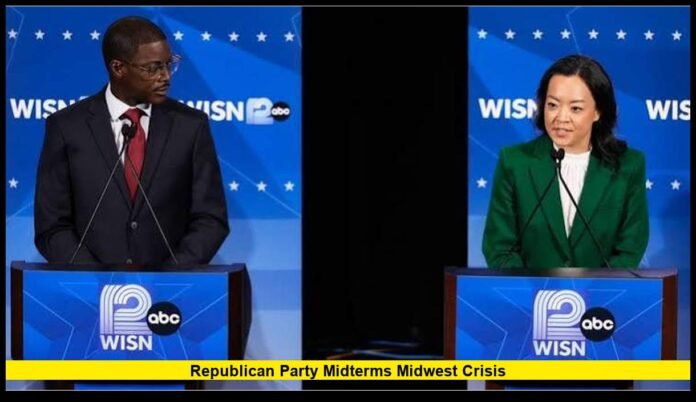

The republican party midterms midwest crisis is taking shape as Republicans face increasingly competitive races across Michigan, Wisconsin and Iowa, with economic concerns and voter enthusiasm emerging as major factors before November.
The Midwest has become one of the most important battlegrounds of the 2026 election cycle. Several Republican candidates entered the year with strong political advantages, yet a series of close contests now threatens to make the region central to the fight for control of Congress and key state governments.
Michigan’s Senate race has become especially important. Republican Mike Rogers is facing Democrat Abdul El-Sayed in a contest that has already attracted national attention. Iowa’s Senate race between Republican Ashley Hinson and Democrat Josh Turek is also drawing significant campaign activity. In Wisconsin, Republican Tom Tiffany is competing against Democrat David Crowley for governor.
These races share one major characteristic: none can be treated as an easy Republican victory.
Why the Midwest Has Become So Important
The Midwest has long been crucial to national elections, but the 2026 political map gives the region an even larger role.
Michigan, Wisconsin and Iowa have different political identities. Yet each state contains large numbers of voters who can move between parties from one election to another.
That makes the region especially valuable to both parties.
Republicans want to maintain the political gains they made in recent presidential elections. Democrats are trying to regain ground among working-class and suburban voters while rebuilding their position in competitive states.
The Senate map makes the stakes even higher.
Republicans are defending a narrow Senate majority, meaning a small number of competitive races could change the balance of power in Washington. Iowa and Michigan are among the contests receiving significant attention, while Wisconsin’s statewide race could influence the broader political environment.
The Midwest is therefore not simply another collection of swing states.
It is becoming one of the main arenas where the national political battle will be decided.
Michigan Senate Race Becomes a Major Republican Test
Michigan represents perhaps the clearest example of the pressure facing Republicans.
Former Republican Rep. Mike Rogers is challenging Democrat Abdul El-Sayed for the Senate seat. Rogers has already run statewide in Michigan, giving him experience with the state’s political landscape.
El-Sayed emerged from a contentious Democratic primary and immediately became a major national target for Republicans.
His primary victory also created challenges for Democrats. He now needs to unite voters who supported other candidates while appealing to independents who may not share his progressive positions.
Republicans have focused heavily on El-Sayed’s political record and associations.
El-Sayed, meanwhile, has emphasized economic issues. His campaign has repeatedly focused on affordability, healthcare, gasoline and grocery costs.
That contrast could define the general election.
Rogers can argue that voters need Republican leadership in Washington. El-Sayed can argue that household costs should be the central measure of political performance.
Neither argument guarantees victory.
Michigan remains one of the states where relatively small shifts among independent and moderate voters can change the result.
New Controversies Add Pressure in Michigan
The Michigan Senate race has also developed several political controversies.
El-Sayed recently apologized for comments he made after an attack on a Michigan synagogue earlier this year. He said he never intended to justify the attack and expressed regret over the comments.
The controversy has created another challenge for the Democratic nominee as he attempts to consolidate support within his party.
At the same time, Rogers has faced scrutiny over a fundraising claim about seeing the body of Osama bin Laden.
Reports have questioned the wording of the claim because Rogers was not present during the operation in Pakistan. He was serving as chairman of the House Intelligence Committee in Washington when he received information about the operation.
The dispute has given Democrats another issue to use against him.
Both campaigns therefore enter the fall with vulnerabilities.
Michigan voters will have to decide which issues matter most as the contest develops.
Iowa Senate Race Is Tighter Than Republicans Would Like
Iowa remains more favorable territory for Republicans than Michigan, but the Senate race is attracting increasing attention.
Republican Ashley Hinson is running against Democrat Josh Turek for the seat being vacated by Republican Sen. Joni Ernst.
Hinson has built a campaign around her record in Congress and her ties to Iowa voters.
Turek is attempting to make the race competitive by focusing on economic concerns and his own background.
Recent polling has shown Hinson with an advantage, but the margin remains close enough to keep the contest on the national radar.
That explains why Republican leaders are spending time in Iowa.
Sen. Ted Cruz visited the state on August 29 to campaign with Hinson. His appearance highlighted the importance Republicans are placing on the race.
Cruz also described Iowa as a battleground for control of both chambers of Congress.
The Republican campaign is attempting to portray Turek as too liberal for Iowa while emphasizing issues such as public safety, taxes, agriculture and government spending.
Democrats are seeking to make the contest a referendum on Republican leadership and economic conditions.
Hinson Intensifies Attacks on Turek
The Iowa campaign has recently become more aggressive.
Hinson’s campaign launched advertisements criticizing Turek over missed votes during his time in the Iowa Legislature.
The Republican campaign has continued releasing examples of votes Turek allegedly missed. Those messages are designed to question his record and readiness for the Senate.
Turek faces a different challenge.
He needs to convince voters that he can compete in a state where Republicans have built a strong statewide organization.
His campaign must also persuade voters that the election is not simply a choice between political parties.
The result could depend heavily on turnout in smaller communities, suburban areas and population centers.
Iowa’s political identity has shifted significantly over the past decade. Republicans now hold a strong position in statewide politics, but close races can still emerge when national conditions change.
That is why the Senate contest remains important to Republican strategists.
Wisconsin Creates Another Difficult Environment
Wisconsin presents a different kind of challenge for Republicans.
The state’s 2026 governor’s race pits Republican Tom Tiffany against Democrat David Crowley.
Tiffany won the Republican primary and entered the general election with strong support from the party’s conservative base.
Crowley won the Democratic nomination after defeating progressive state Rep. Francesca Hong.
The primary result surprised some observers because Hong had led several surveys during the campaign.
Crowley’s victory changed the general election dynamic.
He is now positioned as a more pragmatic Democratic candidate, while Tiffany is attempting to consolidate Republican voters across the state.
Early general-election polling has given Crowley an advantage among likely voters.
That does not make the race settled.
Wisconsin has a long history of competitive statewide elections, and campaign dynamics can change quickly once advertising intensifies.
Data Centers Become a Major Wisconsin Issue
One unusual issue has emerged in Wisconsin’s governor’s race: artificial intelligence data centers.
Large data-center projects have generated concerns among Wisconsin residents about electricity use, environmental effects, local control and government incentives.
The issue became particularly important during the Democratic primary.
Hong supported a temporary moratorium on new AI data centers. Crowley did not support a moratorium.
Neither Crowley nor Tiffany supports a broad moratorium, although both candidates have supported additional safeguards.
Tiffany has attempted to use the issue against Crowley by arguing that his position could allow large developments to expand.
Crowley has defended his approach while supporting stronger rules.
The debate demonstrates how local economic issues can disrupt traditional party messaging.
Data centers are not normally a central midterm issue.
In Wisconsin, however, they have become important enough to feature prominently in the governor’s race.
Economic Pressure Is Central to the Midwest Battle
Economic concerns may ultimately have the greatest influence on the Republican Party’s performance.
Voters across the Midwest continue to pay close attention to gasoline prices, grocery costs, healthcare expenses and household budgets.
Those issues affect voters regardless of political affiliation.
Republicans have argued that their economic policies can strengthen domestic production, support businesses and reduce government burdens.
Democrats are attempting to argue that voters should judge the current political leadership by what they pay for everyday necessities.
The debate is particularly important in states with large manufacturing, agricultural and transportation sectors.
A voter who supports Republican positions on immigration or public safety may still be dissatisfied with the economy.
Likewise, a voter who usually supports Democrats may have concerns about taxes or government spending.
This creates opportunities for candidates who can separate themselves from national political arguments.
It also creates risks for candidates who become too closely associated with unpopular national positions.
Trump Remains a Major Factor for Republican Candidates
Republican candidates across the Midwest cannot ignore President Donald Trump.
Trump remains the dominant figure within the Republican Party, and his support can provide candidates with access to conservative voters and national campaign resources.
However, his political standing also creates challenges.
Candidates running in competitive states need to maintain strong Republican turnout while also attracting independent voters.
That creates a delicate balance.
A Republican candidate who moves too far away from Trump could struggle with the party’s core supporters.
A candidate who embraces every national Republican position could alienate voters who are more focused on local concerns.
This tension is particularly important in Michigan and Wisconsin.
Both states have large Republican bases, but both also contain substantial numbers of independent voters.
The candidates who successfully bridge that divide could have a significant advantage in November.
Republican Enthusiasm Could Still Help the Party
The GOP’s situation is not uniformly negative.
Republican voters remain highly motivated in several Midwest contests.
Strong turnout could protect candidates even if national polling remains difficult.
That matters because midterm elections often depend on which party can mobilize its most reliable voters.
Republicans have traditionally benefited from strong support among older and rural voters.
Democrats have advantages among younger voters and many urban communities.
The final outcome may therefore depend on whether either party can improve participation among less reliable voters.
A small turnout difference can matter enormously in a closely divided state.
Republicans are likely to concentrate heavily on rural counties and smaller cities, while Democrats will focus on metropolitan areas and suburban communities.
House Races Add Another Layer of Risk
The Midwest’s importance extends beyond the Senate and governor’s races.
Competitive House districts could also determine whether Republicans maintain control of Congress.
Michigan has several districts where the national political environment could become decisive.
Iowa also contains races that Democrats believe can become competitive.
The party that wins close congressional districts will have a major advantage in shaping the next Congress.
This creates a difficult situation for Republican leaders.
They must defend Senate seats while also protecting House incumbents.
Campaign money, volunteers and national attention must be distributed across multiple races.
A strong Republican performance in one state may not be enough if the party loses several House districts elsewhere.
What the Republican Party Needs to Watch
Several developments could determine whether Republican problems grow or fade during the final stretch.
Michigan Senate race: The Rogers-El-Sayed contest remains one of the most important Republican defenses.
Iowa Senate race: Hinson holds an important advantage, but Democrats are working to make the race competitive.
Wisconsin governor race: Crowley’s early advantage puts pressure on Tiffany to strengthen his statewide campaign.
Economic conditions: Gasoline, groceries and healthcare remain major voter concerns.
Republican turnout: Strong conservative participation could offset weaknesses among independents.
Independent voters: Their decisions could determine the closest Midwest contests.
Candidate controversies: Recent disputes in Michigan demonstrate how quickly individual controversies can dominate campaign coverage.
Local issues: Wisconsin’s data-center debate shows that state-specific concerns can reshape a statewide race.
Can Republicans Reverse the Midwest Pressure?
Republicans still have several advantages.
The party has strong organizations in many Midwest states. Republican voters remain engaged. Candidates such as Hinson are running in states where the GOP has a strong electoral foundation.
But the current environment demands more than a traditional Republican turnout strategy.
Candidates must appeal to voters who may support Trump but remain unhappy about household expenses.
They must also prevent Democratic candidates from turning economic frustration into a broader rejection of Republican leadership.
Michigan presents the toughest test because the Senate race is highly competitive and both candidates have attracted controversy.
Iowa offers Republicans a better starting position, but Democrats are working to narrow the gap.
Wisconsin presents another difficult challenge because the governor’s race has quickly become competitive.
Taken together, these contests explain why the Midwest is receiving so much attention heading into the 2026 midterms.
The Road to November
The coming weeks will be crucial for Republican candidates.
Campaign advertising will increase. National party organizations will devote more money to competitive races. Candidates will spend more time traveling through the states and attempting to define their opponents.
Voters will also receive more information about the candidates’ records.
For Republicans, the goal will be to keep conservative voters engaged while expanding support among independents.
For Democrats, the strategy will center on affordability, healthcare and opposition to Republican policies.
The political environment can still change before Election Day.
Polling margins remain relatively narrow in several important contests. Candidate debates, economic developments and campaign controversies could all influence voters.
The Midwest will therefore remain one of the most closely watched regions in American politics.
The Republican Party has not lost its strength in the region. Yet the combination of competitive races, economic concerns and changing voter preferences has created an unusually demanding environment.
That pressure is especially clear in Michigan, Iowa and Wisconsin.
The Republican Party enters the final stretch with important Midwest races still within reach, making every voter, issue and campaign decision increasingly important—share your thoughts and stay updated as the 2026 contests unfold.