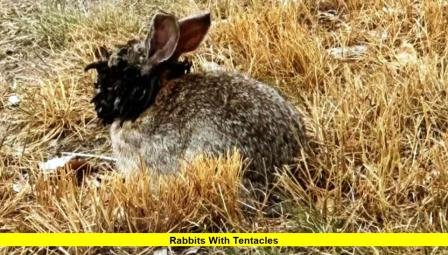

Rabbits with tentacles have been spotted in Fort Collins, Colorado, leaving residents both startled and concerned. Several locals have reported seeing wild rabbits with horn-like, tentacle-shaped growths protruding from their heads and faces. Wildlife experts have confirmed that these unusual protrusions are not the result of mutation or fantasy creatures but are caused by a virus that specifically affects rabbits.
The culprit is known as the Shope papilloma virus. This virus causes wart-like, keratinous tumors to form around the rabbit’s head, ears, eyes, or mouth. The dark, spiky growths can give the appearance of black quills or twisted horns, and in some cases, they extend outward in a way that resembles tentacles.
Unsettling sightings across Fort Collins
Reports began increasing when homeowners in southeast Fort Collins noticed rabbits repeatedly returning to their yards, each time with more prominent growths. In one case, a resident described seeing the same rabbit over two years, with the protrusions becoming larger and more twisted over time. Others have said the animals appear to have “black toothpicks” sticking out from their faces.
Some initial sightings raised fears of other animal diseases, but wildlife officials quickly reassured the public that the condition is confined to rabbits and does not pose a threat to humans or pets.
What experts say — and what to do
Colorado Parks and Wildlife has explained that the Shope papilloma virus spreads primarily among rabbits and is not transmittable to other species. While these growths can look frightening, they are generally benign. However, in some cases, they can interfere with a rabbit’s ability to eat, see, or breathe, and occasionally the tumors can become cancerous.
Officials advise the public:
- Do not touch, capture, or attempt to treat infected rabbits.
- Keep pets and children away from any affected animals.
- Observe from a distance and report sightings if requested by wildlife services.
Because the virus is spread through biting insects such as mosquitoes and ticks, it can be difficult to prevent in wild rabbit populations.
The science behind these “tentacles”
The Shope papilloma virus was first identified in the 1930s and is also called cottontail rabbit papillomavirus. It affects both wild and domestic rabbits, though it is more common in wild cottontails. Once a rabbit is infected, tumors begin to grow around the facial area, often giving the appearance of horns or tentacles. These growths are made of keratin — the same protein that makes up hair and nails — and may persist for months.
Transmission usually happens when biting insects carry the virus from one rabbit to another, although close physical contact between infected and healthy rabbits can also spread it. In some cases, the tumors will eventually fall off as the rabbit’s immune system suppresses the virus. In others, the growths remain until the animal’s health deteriorates.
Why it’s drawing attention now
While this virus is not new, the dramatic visual effect it creates has made it the focus of renewed attention. Social media posts and neighborhood discussions have fueled curiosity, with some people comparing the rabbits’ appearance to mythical creatures like the jackalope. The strange look — horns combined with tentacle-like protrusions — has made them seem like something from a horror movie.
Wildlife authorities stress that these animals are not dangerous and should be left alone. They also caution against trapping or moving them, as this can cause unnecessary stress and potentially spread the virus to other rabbit populations.
Quick fact summary
| Detail | Information |
|---|---|
| Location | Fort Collins, Colorado |
| Cause | Shope papilloma virus (cottontail rabbit papillomavirus) |
| Appearance | Dark, horn-like or tentacle-shaped keratinous growths on the head and face |
| Contagious to humans/pets | No |
| Risk to rabbits | Usually benign, but may interfere with eating or breathing; can rarely become cancerous |
| Spread | Mainly via biting insects like mosquitoes and ticks |
| Advice | Do not touch; keep pets away; report sightings if requested |
Living with the mystery
For now, these rabbits continue to roam parts of Fort Collins, startling those who encounter them for the first time. While they may look like something out of folklore, the explanation lies in virology rather than myth. Authorities continue to monitor the situation, but because this is a naturally occurring virus in wild populations, the focus remains on public awareness rather than eradication.
It’s a reminder that nature often produces creatures stranger than fiction — and sometimes, those creatures are hopping through our own backyards.
If you’ve seen anything unusual in your neighborhood, share your experience in the comments and join the conversation.