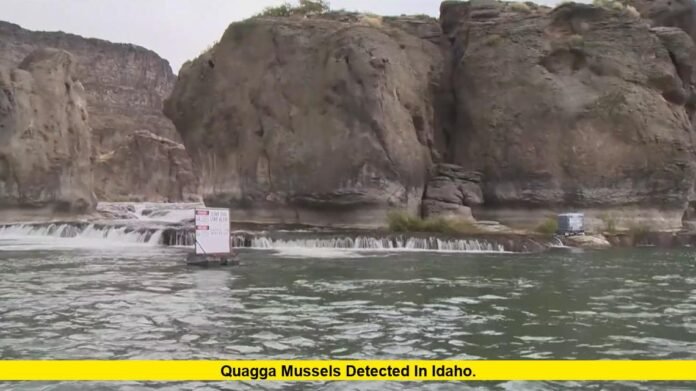

Quagga mussels detected in Idaho is again a major concern as state officials begin another targeted effort to eliminate the invasive species from the Snake River near Twin Falls. The latest monitoring shows the infestation remains contained, while the number of microscopic quagga mussel larvae has fallen sharply compared with last year.
The Idaho State Department of Agriculture (ISDA) says extensive 2026 sampling has found 77% fewer quagga mussel veligers than in 2025. Despite that progress, officials have continued detecting the invasive species and are moving ahead with a new multiphase treatment beginning this week.
Quagga Mussels Detected in Idaho for a Fourth Consecutive Year
Quagga mussels were first confirmed in Idaho’s Mid-Snake River in September 2023, when ISDA identified quagga mussel veligers, the microscopic larval stage of the species.
The latest detections mark the fourth consecutive year that quagga mussels have been found in the Snake River near Twin Falls. Recent reporting based on comments from ISDA Director Chanel Tewalt said the latest detection included eight veligers and seven adult mussels.
Although the continued detections mean Idaho has not yet achieved eradication, the overall population has declined substantially. ISDA’s latest official sampling update says the number of detected veligers is down 77% from 2025.
Officials say the known infestation remains isolated to the Snake River section from just upriver of Twin Falls Dam to Shoshone Falls.
Idaho Starts Another Quagga Mussel Treatment
The latest eradication push begins as Idaho moves into another phase of its long-term response.
ISDA says a multiphase treatment is scheduled to begin during the last week of August, allowing officials to act while the infestation remains limited. The agency has emphasized that the 2026 strategy is being shaped by new sampling information and a better understanding of the Snake River’s complex flow patterns and refuge areas.
The current treatment is more targeted than previous efforts. Recent local reporting said officials plan to concentrate treatment in areas above Shoshone Falls and above Twin Falls Dam, including deeper rocky areas where mussels may be harder to reach.
The state’s treatment information identifies copper-based products as part of the response. ISDA has used chelated copper treatments in 2023, 2024 and 2025, with previous treatments reducing and containing the infestation.
Why Are Quagga Mussels Still Being Detected?
The continued detections do not necessarily mean previous treatments failed.
ISDA says the Snake River presents unusual challenges because of its changing flows, deep holes, spring inputs and natural refuge areas. These conditions can make some mussels difficult to detect and treat.
As the infestation becomes smaller, finding the remaining mussels can also become more difficult. State officials are therefore increasing diving operations and using more targeted approaches to locate earlier-stage detections.
The agency describes the eradication effort as an ongoing, science-driven process rather than a single treatment. Its goal remains complete elimination of quagga mussels from Idaho waters.
Where Are the Quagga Mussels in Idaho?
According to the latest state information, the known infestation remains confined to a limited portion of the Mid-Snake River near Twin Falls.
ISDA says the affected area extends from just upriver of Twin Falls Dam to Shoshone Falls. The agency says treatments, extensive monitoring and mandatory watercraft inspection and decontamination requirements have helped keep the infestation contained.
That containment is especially important because quagga mussels can spread through watercraft and equipment that come into contact with infested water.
Idaho’s invasive-species officials warn that boats, kayaks, paddleboards, fishing equipment, waders, life jackets, duck decoys and other equipment can potentially transport invasive mussels if they are not properly cleaned and decontaminated.
Snake River Access Restrictions Begin August 27
The latest state access information includes temporary restrictions associated with the 2026 treatment.
The Twin Falls Boat Launch is scheduled to be closed from August 27 through September 5, while the Shoshone Falls Boat Launch is scheduled to be closed from September 6 through September 13. ISDA says these temporary closures are intended to allow treatment crews to work safely and efficiently. The dates are subject to change.
ISDA is also recommending that people stay out of the treatment dissipation area, including livestock and pets, from Hansen Bridge to the Highway 46 Bridge from August 27 through September 16. The agency says the copper-based treatment application rate is below the drinking-water standard.
People using the Mid-Snake River should therefore check the latest state access information before entering the area.
Mandatory Watercraft Decontamination Remains in Place
A mandatory inspection and decontamination requirement continues for watercraft entering and leaving the Snake River between Broken Bridge, also known as Yingst Grade, and Hansen Bridge.
Watercraft must be inspected before launching and decontaminated after leaving the river. ISDA says the inspection and decontamination stations are located at Centennial Waterfront Park, Shoshone Falls and Twin Falls Reservoir. The service is free to the public.
The requirement applies broadly to equipment that may have contacted the water, including boats, kayaks, paddleboards, fishing equipment, waders, life jackets and duck decoys.
The state’s broader guidance also urges people to clean, drain and dry watercraft and equipment before moving them to another water body.
Why Quagga Mussels Are Such a Serious Threat to Idaho
Quagga mussels are small freshwater bivalves, but their potential impact is enormous.
The invasive species can attach to hard surfaces and reproduce rapidly. Large established populations can clog pipes used for drinking water, agriculture, irrigation and hydropower operations.
They can also alter aquatic ecosystems by filtering plankton from the water. Because plankton forms an important part of the food web, heavy quagga mussel populations can reduce food availability for native fish and other aquatic species.
ISDA estimates that an established infestation could create hundreds of millions of dollars in direct and indirect costs for Idaho. The agency says more than 1,700 water users depend on Snake River water between Twin Falls and Lewiston, including irrigation providers and municipal drinking-water systems.
ISDA has also estimated that failing to control the infestation could eventually require annual treatment of irrigation systems, hydropower facilities and other water infrastructure.
Idaho Has Increased Monitoring Across the State
The state’s response is not limited to the known infestation.
During 2026, ISDA says it has collected more than 420 samples in the infested Snake River area and more than 3,000 samples statewide. Monitoring includes veliger sampling, environmental DNA testing and diving operations.
The extensive monitoring is intended to detect any possible expansion beyond the known infested section as quickly as possible.
The state has also expanded its watercraft inspection program since quagga mussels were first detected in Idaho. ISDA reported that more than 173,000 watercraft inspections were conducted in 2025, with statewide inspections increasing by 67% since the Snake River detection in 2023.
Previous Treatments Have Reduced the Infestation
Idaho’s latest results build on several years of treatment.
ISDA treated the affected Snake River area in 2023, 2024 and 2025 using chelated copper. The agency says those treatments reduced the quagga mussel population and helped contain the infestation.
In early 2025, Idaho also treated certain ephemeral ponds outside the river with potassium chloride.
The agency’s latest assessment says the 2026 decline in veliger detections demonstrates that the overall eradication strategy is progressing, although the presence of remaining mussels means the response must continue.
What Happens Next in Idaho’s Quagga Mussel Fight?
The immediate focus is the current multiphase treatment and continued monitoring.
ISDA says treatment decisions are based on ongoing sampling and an evaluation of the Snake River’s flow characteristics and site-specific conditions. The agency also monitors copper concentrations before, during and after treatments, while the Idaho Department of Environmental Quality conducts additional monitoring.
The state says its long-term objective has not changed: full eradication of quagga mussels from Idaho waters.
The 77% decline in veliger detections is an encouraging development, but it does not mean the problem has been eliminated. The latest adult and larval detections demonstrate why Idaho officials are continuing aggressive monitoring and targeted treatment.
For residents, boaters and visitors, preventing the spread remains an important part of the response. Proper inspection, decontamination, cleaning, draining and drying of watercraft and equipment can help keep quagga mussels from reaching other Idaho waterways.
Quagga Mussels Detected in Idaho: Latest Update
As of August 27, 2026, Idaho officials continue to report a substantially reduced but still active quagga mussel infestation in the Mid-Snake River near Twin Falls. State sampling shows 77% fewer veligers than in 2025, while the known infestation remains contained between the Twin Falls Dam and Shoshone Falls area.
A new multiphase eradication treatment is now underway, with temporary boat-launch closures and additional precautions in place during the treatment period. Mandatory watercraft inspection and decontamination requirements also remain in effect.
The latest developments show that Idaho’s eradication campaign is making measurable progress, but officials are not declaring victory. With adult mussels and veligers still being detected, continued treatment, monitoring and public cooperation will remain critical to determining whether Idaho can ultimately eliminate quagga mussels from the Snake River.
What do you think about Idaho’s ongoing quagga mussel eradication effort? Share your thoughts and stay tuned for the latest verified updates as the treatment continues.