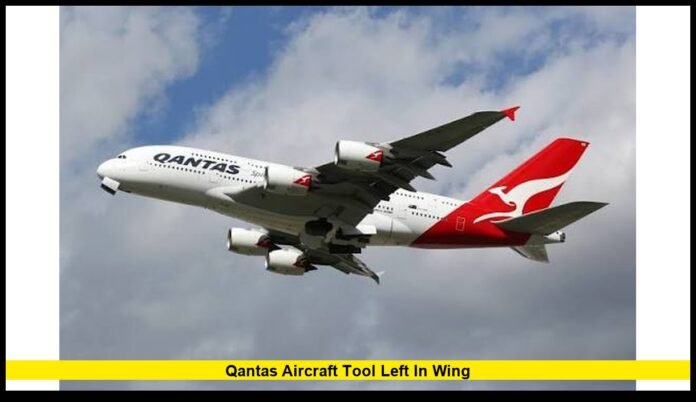

The qantas aircraft tool left in wing incident has raised fresh questions about aircraft maintenance controls after an Airbus A380 flew from Sydney to Dallas and back with a portable work light still inside its left wing. The Australian Transport Safety Bureau released its findings on August 17, 2026, concluding that the incident resulted from a breakdown in foreign-object control and tool-accountability procedures.
The aircraft involved was Qantas Airbus A380-842 VH-OQK. Maintenance workers had been working on the aircraft’s air-conditioning system at Sydney Airport on January 7, 2026. The job required access to an internal section of the left wing.
A portable LED work light was used during the maintenance task. Workers later completed their inspections and returned their equipment, but the light remained inside the wing.
The aircraft was then cleared for service and flew to Dallas Fort Worth International Airport. It returned to Sydney on January 9, where the missing light was finally traced and recovered.
The ATSB found no injuries, structural damage or system disruption from the incident. However, investigators identified several failures in the maintenance process that allowed an unaccounted tool to remain undetected.
What Happened During the Qantas A380 Maintenance
The incident began after VH-OQK arrived at Sydney Airport from Los Angeles on January 7, 2026.
The aircraft had 26 crew members and 485 passengers on board when it arrived. Maintenance personnel subsequently worked on the aircraft’s air-conditioning system.
The task involved changing an outlet temperature sensor on an air-generation unit inside the left wing. Because of the location of the component, engineers needed access to an internal area of the wing.
A portable work light was used to illuminate the work area.
The light was not a small personal flashlight. Investigators identified it as a portable LED work light measuring about 33 centimeters, or roughly 13 inches, in length.
After the maintenance task, the engineers conducted foreign-object clearance inspections.
Those inspections were supposed to establish that no tools, equipment or other objects had remained inside the aircraft.
The work light was missed.
That single oversight then moved through several additional layers of the maintenance process.
How the Light Was Left Behind
The ATSB investigation found that the maintenance engineers did not notice the light during their foreign-object inspections.
The circumstances surrounding the maintenance work also contributed to the confusion.
The team had been dealing with a temperature-sensor replacement and subsequent troubleshooting involving the auxiliary power unit. During the process, the maintenance engineer returned tools to the tool crib.
The engineer did not realize that the work light was still signed out.
This created a mismatch between the physical location of the light and the tool-control records.
The equipment system showed that the light had not been returned, but the maintenance personnel did not recognize the discrepancy at the time.
The problem therefore was not limited to one missed visual inspection.
The tool-control process also failed to turn the missing item into an effective warning before the aircraft was released.
The Aircraft Was Cleared to Fly
The most important part of the investigation concerns how the aircraft received its release to service.
An aircraft cannot simply leave a maintenance facility because technicians have finished their work. Authorized personnel must confirm that required maintenance has been completed and that the aircraft is suitable for operation.
In this case, a licensed aircraft maintenance engineer issued the certificate of release to service even though the work light remained unaccounted for.
The ATSB found that the operator’s maintenance information system did not provide a prompt or control that would have alerted the certifying engineer to the unreturned tool or an outstanding unreturned-tool report before the release was issued.
That meant the digital process did not provide an effective final barrier.
The missing light remained physically inside the wing, while the aircraft was treated as ready for its next scheduled operation.
The Qantas A380 Flew to Dallas
Later on January 7, VH-OQK departed Sydney on its scheduled flight to Dallas Fort Worth International Airport in Texas.
The aircraft crossed the Pacific with the work light still inside the left wing.
On January 8, the A380 arrived at Dallas Fort Worth.
Maintenance was performed there by a contracted external maintenance organization. That work was conducted under a separate maintenance approval and did not use the Qantas tool-control system.
The aircraft subsequently departed Dallas as QF8 and began its return journey to Sydney.
It arrived back at Sydney International Airport at 6:55 a.m. on January 9.
The light was still inside the aircraft.
How the Missing Light Was Finally Found
The discovery happened after the aircraft returned to Sydney.
Later on January 9, a tool-crib operator reviewed a report showing equipment that remained signed out.
That review revealed that a work light had been signed out against VH-OQK two days earlier.
The operator notified the duty maintenance manager.
The manager then contacted the maintenance engineer who had signed out the equipment.
A lost-tool search was launched.
The search eventually located the work light inside the A380’s left wing.
The discovery established that the light had remained in the aircraft throughout the Sydney-Dallas-Sydney operation.
The ATSB determined that the aircraft had flown two sectors with the object inside the wing.
Read More – Trump Catering Truck: Secret Aircraft Switch in Turkey Revealed
No Damage Was Found
Despite the seriousness of the maintenance-control failure, investigators found no adverse consequences from the light remaining inside the wing.
There was no reported structural damage.
No system disruption occurred.
No injuries were recorded.
The ATSB also did not report a flight-control problem or emergency connected to the light.
That does not mean the situation was considered harmless.
Foreign objects inside an aircraft can create safety risks if they interfere with components, wiring, airflow, moving parts or other systems. The investigation therefore treated the event as a foreign-object debris occurrence.
The absence of damage represents the outcome of this particular incident. It does not remove the safety significance of the maintenance failure.
Why the Tool-Control Failure Matters
Aircraft maintenance depends heavily on accountability.
Every tool taken into an aircraft should be accounted for when a task ends. If something is missing, the discrepancy should trigger a search before the aircraft returns to service.
That process is particularly important inside aircraft wings and other enclosed areas.
Once a maintenance worker closes an access area, a forgotten object can become difficult to locate. The longer the aircraft remains in operation, the harder it may become to establish when and where the object was left.
In this case, the work light passed through several stages without being recovered.
The engineers did not see it during their inspection.
The tool-return process did not identify the problem.
The end-of-shift check did not detect the outstanding item.
The release-to-service process also did not stop the aircraft.
The ATSB therefore described the occurrence as a breakdown in foreign-object control and tool-accountability processes.
Three Important Safeguards Failed
The investigation identified several opportunities to catch the missing equipment.
The first was the physical inspection of the maintenance area.
Workers checked the area after completing the maintenance, but they did not see the light.
The second was the return of tools to the tool crib.
The engineer returned the equipment without realizing that the work light remained signed out.
The third was the end-of-shift tool check.
That check also failed to identify the missing light.
These failures occurred before the aircraft’s departure.
The release process created another opportunity to prevent the aircraft from flying with the unaccounted item.
However, the maintenance information system did not provide an effective alert to the certifying engineer.
As a result, the aircraft was released for service.
What the ATSB Found About the Maintenance System
The ATSB did not simply attribute the event to an individual mistake.
Its findings examined the broader system surrounding tool control.
The investigation identified a safety issue involving the procedural defenses that were supposed to prevent an aircraft from being released while a tool remained unaccounted for.
The maintenance information system did not provide a prompt or control that would force attention to an unreturned tool or an outstanding unreturned-tool report before the certificate of release to service was issued.
That distinction is important.
A maintenance organization can have procedures on paper, but those procedures need effective controls behind them.
If a missing tool is recorded somewhere in a system but the information does not reach the person responsible for releasing the aircraft, the digital record alone may not provide sufficient protection.
The Qantas incident demonstrated that gap.
Qantas Strengthened Its Tool-Control Procedures
Qantas responded to the incident by changing its tooling-control procedures.
The airline established a working group and introduced a mandatory pre-clearance check designed to confirm that all tooling has been accounted for before an aircraft is cleared following maintenance.
The change provides an additional layer between the completion of maintenance and the aircraft’s return to service.
The objective is straightforward.
If a tool remains signed out, the discrepancy needs to be identified before the aircraft leaves the maintenance environment.
The response addresses one of the central weaknesses identified in the investigation.
It also reinforces a wider principle in aircraft maintenance: procedures should provide multiple opportunities to catch human errors.
The Dallas Connection Makes the Incident Notable for U.S. Travelers
For American readers, the incident is notable because the A380 operated a scheduled international flight to Dallas Fort Worth International Airport.
The aircraft did not remain at Sydney after the maintenance work.
It flew across the Pacific, arrived in Texas and later returned to Australia.
The aircraft completed those sectors without reported injury, structural damage or system disruption.
Dallas was therefore not the location where the light was discovered. The object was found only after the aircraft completed the return journey to Sydney.
The U.S. connection also demonstrates why maintenance controls matter across international operations.
An aircraft can travel thousands of miles after leaving a maintenance base. A missed tool-control problem can therefore cross borders before it is discovered.
The Aircraft Involved Was VH-OQK
The aircraft at the center of the investigation was Airbus A380-842 VH-OQK.
It is important to distinguish this aircraft from another Qantas A380 involved in a separate maintenance incident in 2023.
The 2026 event involved VH-OQK and a portable work light inside the left wing.
The earlier incident involved VH-OQI and a different tool left inside an engine during maintenance at Los Angeles International Airport.
The two cases were separate occurrences.
The current investigation concerns the January 2026 wing incident and the failures surrounding foreign-object clearance and tool accountability.
A Previous Qantas A380 Incident Adds Context
Qantas has previously faced another A380 maintenance-tool incident.
In December 2023, a different A380, VH-OQI, underwent scheduled maintenance at Los Angeles International Airport.
A large nylon turning tool was left inside the aircraft’s left engine inlet during maintenance.
The tool was not discovered until January 1, 2024, after the aircraft had completed multiple international operations.
The ATSB investigated that occurrence as well.
The earlier incident is separate from the 2026 wing event. However, both investigations involved tools remaining in aircraft after maintenance.
The latest report again highlights the importance of tool accountability and foreign-object inspections.
The Work Light Did Not Cause a Flight Emergency
It is important to separate the confirmed facts from assumptions about what might have happened.
The ATSB did not report that the A380 suffered a flight emergency because of the work light.
There was no reported structural damage.
There was no reported system disruption.
No injuries occurred.
The aircraft completed its scheduled operation to Dallas and its return to Sydney.
The safety concern came from the maintenance-control failure that allowed the object to remain inside the wing.
That is the factual basis for the investigation.
What This Means for Aircraft Maintenance
The incident demonstrates why aviation maintenance uses several overlapping safety measures.
A technician can miss an object during a visual inspection.
A tool-return process should then catch it.
If that does not happen, an end-of-shift check should identify the discrepancy.
If the item remains unaccounted for, the aircraft release process should prevent departure until the issue is resolved.
In this case, those layers did not work as intended.
The ATSB’s findings show that the problem involved the interaction between people, procedures and information systems.
The result was an aircraft that departed with an unaccounted maintenance item still inside its wing.
Latest Status of the Investigation
The ATSB released its report on August 17, 2026.
Its findings state that the occurrence resulted from a breakdown in foreign-object control and tool-accountability processes during and after maintenance.
The bureau also identified contributing factors involving the foreign-object inspections, the return of tools, the end-of-shift check and the release-to-service process.
Qantas has already strengthened its tooling procedures following the occurrence.
The confirmed outcome remains that the work light was recovered after the A380 returned to Sydney on January 9, 2026.
No adverse consequences, structural damage or system disruptions resulted from the object remaining inside the wing.
Key Facts About the Qantas A380 Incident
- Aircraft: Airbus A380-842
- Registration: VH-OQK
- Operator: Qantas Airways Limited
- Maintenance location: Sydney Airport
- Maintenance date: January 7, 2026
- Maintenance task: Air-conditioning system work
- Object: Portable LED work light
- Location: Internal area of the left wing
- U.S. destination: Dallas Fort Worth International Airport
- Return to Sydney: January 9, 2026
- Discovery: After the aircraft returned to Sydney
- Flights operated with the object aboard: Two sectors
- Reported injuries: None
- Reported aircraft damage: None
- Reported system disruption: None
- ATSB finding: Breakdown in foreign-object control and tool accountability
- Qantas response: Additional tooling-control measures and a mandatory pre-clearance check
Why the Incident Remains Important
The qantas aircraft tool left in wing case is significant because the object was not discovered immediately after maintenance.
Instead, the aircraft completed an international round trip before the missing equipment was identified.
The investigation found that the problem involved more than one missed check. Multiple safeguards failed to detect the unreturned light before departure.
Qantas has since introduced an additional pre-clearance measure aimed at preventing a similar occurrence.
The case therefore provides a clear example of why aircraft maintenance relies on strict tool accountability, physical inspections and system-based controls.
The work light caused no reported damage, but its presence inside the wing exposed weaknesses that the airline has now taken steps to address.
What are your thoughts on the Qantas A380 maintenance findings? Share your view in the comments and stay informed as aviation safety developments continue.