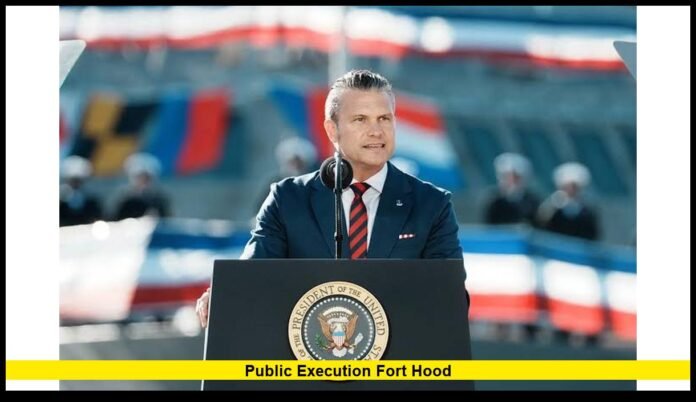

The Public execution Fort Hood case has drawn renewed national attention after the Pentagon confirmed plans to livestream the scheduled execution of Nidal Malik Hasan, the former Army major convicted in the 2009 Fort Hood shooting. The Army has set December 3, 2026, for his execution by firing squad at Fort Hood, Texas. The announcement has sparked debate about military justice, capital punishment, public access, and the government’s decision to broadcast an execution.
The case has entered a significant new stage because the planned broadcast could change how Americans experience a military execution. Defense Secretary Pete Hegseth has supported making the event public, arguing that people should be able to see the consequences of Hasan’s crimes. However, the government has not released every detail about the livestream or its distribution.
Hasan’s case dates back to one of the deadliest shootings on a U.S. military installation. The attack killed 13 people and wounded 32 others. A military jury convicted him in 2013 and sentenced him to death.
The execution remains scheduled for December 3. As of October 9, 2026, the Army has announced its plans, but the execution has not taken place. Legal developments and official procedural updates remain important to the case.
Latest Developments in the Fort Hood Execution Case
The biggest recent development is the Pentagon’s confirmation that it intends to livestream Hasan’s execution. The announcement has moved the case beyond the usual discussion of a death sentence and its implementation.
The Army had already announced the execution date and method. The new broadcast plan has introduced questions about public access, online distribution, and the treatment of graphic material on digital platforms.
Hegseth has publicly supported the decision to make the execution viewable. His comments indicate that the administration wants the event to carry a public message about the consequences of the 2009 attack.
However, a confirmed intention to livestream an execution does not establish every practical detail. Officials have not publicly finalized all the information about the broadcast’s platform, viewing arrangements, or possible restrictions.
Major online services have also faced questions about whether they would carry such a broadcast. Their existing policies on graphic violence create potential complications, and a government’s decision to stream an event does not automatically require a private platform to host it.
Readers should therefore distinguish between the Pentagon’s announced plan and a confirmed public viewing link. No unverified website or social media post should be treated as an official source for accessing the event.
Who Is Nidal Malik Hasan?
Nidal Malik Hasan is a former U.S. Army major who worked as a psychiatrist before the Fort Hood shooting. His military career ended after he carried out the attack on November 5, 2009.
Hasan opened fire at the Soldier Readiness Processing Center at Fort Hood, Texas. Military personnel used the facility while completing administrative and medical requirements connected to their service.
The attack killed 13 people and injured 32. The victims included soldiers whose lives were interrupted during what should have been a routine period of military processing.
Authorities arrested Hasan after the shooting. He survived the encounter and faced prosecution under the military justice system.
His court-martial began several years later. Hasan represented himself during the proceedings, and a military jury convicted him in August 2013.
The jury found him guilty of 13 counts of premeditated murder and 32 counts of attempted premeditated murder. It sentenced him to death.
The conviction established the legal basis for the execution now scheduled by the Army. Hasan’s case subsequently moved through the military appellate system, where the courts considered challenges to his conviction and sentence.
The recent execution announcement has brought the case back into national attention. It has also renewed discussion about the victims, the military’s response to the attack, and the role of capital punishment in military law.
When Will the Fort Hood Execution Take Place?
The Army has scheduled Hasan’s execution for December 3, 2026, at Fort Hood, Texas. Officials have identified a firing squad as the method.
President Donald Trump approved the death sentence before the Army announced the execution date. Defense Secretary Pete Hegseth supported carrying out the sentence.
The December date is significant because the military has not executed a prisoner since 1961. A military firing-squad execution would also mark the first use of that method by the U.S. military since 1945.
These historical milestones explain why the case has attracted attention well beyond Texas. The planned event would be an unusually rare action within the modern American military justice system.
Nevertheless, a scheduled date does not guarantee that every step will proceed without change. Legal proceedings, court orders, or other formal developments could affect the timetable.
As of October 9, the Army has not announced that it has completed the execution. The event remains scheduled for a future date.
Why Is Fort Hood the Chosen Location?
Fort Hood is the military installation where Hasan carried out the 2009 shooting. Holding the planned execution at the same installation connects the sentence directly to the location of the crime.
That connection has symbolic importance for the military community. The shooting affected service members, their families, and people who worked at the installation.
The location also makes the execution announcement especially significant for people who remember the attack. The planned event returns attention to a tragedy that took place more than 16 years ago.
However, announcing Fort Hood as the location does not mean that the public will be allowed to attend the execution in person. Military installations maintain access controls, and the government’s livestream plan represents a separate means of public viewing.
Officials have not publicly disclosed every detail about the precise execution facility or all arrangements for witnesses.
The distinction matters because an event can be publicly discussed or broadcast without opening the physical site to unrestricted attendance.
For the Army, the case involves both the administration of a death sentence and the handling of a highly sensitive event at a military installation.
Why Has the Pentagon Chosen a Firing Squad?
The Army has announced that Hasan will face a firing squad if the execution proceeds as scheduled.
The method has become a major part of the public discussion because it is rarely used in modern American executions. Military capital punishment follows rules that differ from those governing civilian executions in individual states.
A firing squad uses designated personnel to carry out the sentence. The Army has not released every operational detail concerning the planned procedure.
The method’s history also distinguishes the case from most recent U.S. executions, which have generally relied on lethal injection.
The last U.S. military execution occurred in 1961. The last military firing-squad execution took place in 1945, making the proposed method an unusual return to an earlier practice.
Some states have also authorized firing squads for civilian death sentences. Their decisions have generated debate about execution methods, legal requirements, and the practical challenges associated with lethal-injection drugs.
However, state-level procedures do not automatically govern a military execution. Hasan’s sentence falls under the military justice system and the applicable federal requirements.
The choice of method has added another layer to the debate. Critics question whether firing squads belong in modern capital punishment, while supporters of the sentence emphasize the gravity of the crimes for which Hasan was convicted.
Will the Public Be Able to Watch the Execution Online?
The Pentagon has confirmed plans to livestream the execution, but several important details remain unresolved.
Officials have not established a complete public set of instructions for accessing the broadcast. The government also has not confirmed every detail about the distribution platform and viewing restrictions.
This distinction is important for anyone searching online for information about the event. A website claiming to offer a live feed should not be considered legitimate without confirmation from an authorized government source.
The same caution applies to claims that a particular social media platform will carry the execution. Private services have their own content policies, including restrictions on graphic violence and depictions of death.
The Pentagon’s plan does not automatically settle how those platforms will respond.
A livestream would also create questions about recording and redistribution. Viewers could potentially capture footage and circulate it beyond the original broadcast, depending on the technical arrangements and platform rules.
Officials have not provided a complete public explanation of how they would address those issues. Age restrictions, moderation, and the possibility of copied footage remain important questions surrounding the proposal.
For now, the confirmed development is the government’s stated intention to broadcast the execution. The precise public access arrangements await further official information.
Why Is the Livestream Controversial?
The proposed broadcast has triggered a broader debate about the purpose of public executions.
Supporters of public access may view a broadcast as a form of transparency. They argue that the government should be accountable for how it carries out a legally authorized sentence.
Hegseth has also presented public visibility as a way to demonstrate the consequences of Hasan’s actions.
Critics question whether livestreaming an execution serves that purpose. They argue that broadcasting a person’s death could turn a legal proceeding into a spectacle rather than improve public understanding of military justice.
Human dignity is another central concern. Opponents of the plan believe the government should consider whether public exposure of an execution is appropriate, even when a court has imposed the death penalty.
The broadcast could also affect viewers in different ways. Some may find it distressing, particularly those with personal connections to military violence or previous traumatic experiences.
Online distribution introduces additional concerns. Graphic footage can spread rapidly, appear without warning, or reach people who did not intend to see it.
These issues make the planned broadcast different from simply releasing a written account of the execution. A livestream could show the event as it happens, while recordings could remain available after the original transmission ends.
The controversy therefore concerns both capital punishment and the government’s role in presenting an execution to a potentially large audience.
How Does the Case Compare With America’s History of Public Executions?
Public executions once attracted large crowds in the United States. Communities gathered to watch hangings and other forms of capital punishment, and authorities sometimes treated the events as public demonstrations of criminal justice.
Over time, the country moved away from that practice. Concerns about disorder, spectacle, and the dignity of condemned prisoners contributed to the shift toward executions conducted inside controlled facilities.
Rainey Bethea’s 1936 hanging in Owensboro, Kentucky, is widely recognized as the last public execution in the United States. Thousands of people reportedly attended.
The event became part of the historical discussion about why authorities moved executions out of public spaces.
Since then, American executions have generally taken place in restricted settings. Authorized witnesses may attend under applicable rules, but governments have not ordinarily invited the general public to watch the physical act.
The Fort Hood livestream plan would create a different form of access. Rather than gathering a crowd at the installation, the government proposes to transmit the event digitally.
That distinction is significant. Online broadcasting can reach people far beyond the execution site, and recorded material can circulate long after the original event.
The proposed broadcast would therefore represent a major departure from the established practice of conducting executions privately, even though the exact access arrangements remain unconfirmed.
Could Legal Proceedings Change the Execution Schedule?
Hasan’s conviction and sentence have passed through significant stages of the military appeals process. The U.S. Supreme Court declined to review his conviction in March 2025, and the government later approved the death sentence.
However, the possibility of further legal action remains relevant to the scheduled execution.
A condemned military prisoner may seek relief in federal civilian courts under applicable legal procedures. Such proceedings can raise questions about the legality of the conviction, the sentence, or the way officials plan to carry it out.
Whether a particular challenge succeeds depends on its legal basis and the evidence presented. Filing a petition does not automatically establish that an execution must be delayed.
Procedural compliance has also drawn attention following the announcement. Observers have raised questions about notification and the steps required before the Army carries out the sentence.
Those questions should not be treated as proof of a violation. A formal court decision or official finding would be needed to establish whether a specific requirement was breached.
The Army’s current schedule remains December 3, 2026. Any significant change would need to come through an official announcement or a relevant legal development.
What the Victims and Their Families Mean to This Case
The 2009 shooting remains central to the execution debate because of the lives lost and the injuries suffered by survivors.
Thirteen people died in the attack, while 32 others were wounded. Their families and the wider military community have carried the consequences of the shooting for years.
The execution announcement has renewed attention to those affected. It has also raised questions about how the proposed broadcast might influence the experience of victims’ relatives and survivors.
People connected to the victims may hold different views about capital punishment and public access to an execution. Their positions should not be assumed or generalized without direct confirmation.
The government’s decision to livestream the event does not establish that every family supports the broadcast or wants to watch it.
The distinction between carrying out a sentence and displaying the event publicly remains important. The former concerns the implementation of a court’s judgment; the latter raises separate questions about dignity, transparency, and public interest.
As the scheduled date approaches, the victims and survivors remain an essential part of the story. Their losses explain why the case continues to matter, regardless of disagreements about the execution method or broadcast plan.
What Happens Next in the Fort Hood Case?
The next major milestone is the Army’s scheduled execution date of December 3, 2026. Until then, the public can expect attention to focus on several unresolved matters.
Key developments to watch include:
- Legal status: Any court filings or rulings that affect the death sentence or execution date.
- Army procedures: Official clarification about how the execution will be carried out.
- Broadcast access: Confirmed information about the livestream platform and viewing arrangements.
- Content policies: Decisions by digital platforms about whether they will carry or restrict the broadcast.
- Schedule changes: Any official notice that postpones or otherwise changes the planned execution.
The most reliable updates will come from formal government announcements and verified reporting. Unconfirmed social media claims should not be treated as evidence that the schedule has changed or that a public viewing link exists.
The case brings together several significant issues: a deadly attack on a military installation, a death sentence imposed by a military jury, the rare use of a firing squad, and a proposed livestream of the execution.
Each issue has its own legal and ethical questions. The announcement has made public access a central part of the debate, but it has not resolved every practical detail.
As of October 9, 2026, the execution remains scheduled for December 3. The government has confirmed its intention to livestream the event, while further information about the broadcast and any legal developments remains important.
Follow the latest verified developments in the Fort Hood case and share your views on whether the government should livestream an execution.
Frequently Asked Questions
What is the latest update on the public execution at Fort Hood?
The Pentagon has confirmed plans to livestream Nidal Malik Hasan’s scheduled execution. The Army has set December 3, 2026, for the execution by firing squad at Fort Hood, Texas.
Who is Nidal Malik Hasan?
Hasan is a former Army major and psychiatrist who was convicted of the 2009 Fort Hood shooting. A military jury sentenced him to death in August 2013.
How many people died in the Fort Hood shooting?
The November 5, 2009, attack killed 13 people and wounded 32 others.
When is the execution scheduled?
The Army has scheduled Hasan’s execution for December 3, 2026. The date remains subject to any developments that legally or administratively affect the proceedings.
Will the execution be livestreamed?
The Pentagon has confirmed plans to livestream the event. However, officials have not released every detail about the platform, access arrangements, or restrictions.
What execution method has the Army announced?
The Army has announced that Hasan will face a firing squad if the execution proceeds as scheduled.
Could a court delay the execution?
Further legal proceedings or court orders could affect the schedule. The existence of a possible legal challenge does not, by itself, mean that the execution will be delayed.
Has the United States livestreamed a military execution before?
The planned broadcast would be an unprecedented development in modern U.S. military execution practices. American executions have generally taken place in controlled settings rather than through unrestricted public livestreams.
Is the Fort Hood execution open to in-person spectators?
Officials have announced Fort Hood as the execution location and confirmed plans for a livestream. They have not established that the general public will have unrestricted in-person access.
Where can readers find a legitimate viewing link?
A public viewing link should only be trusted if the government confirms it through an authorized channel. Unverified links and social media claims should not be treated as official.