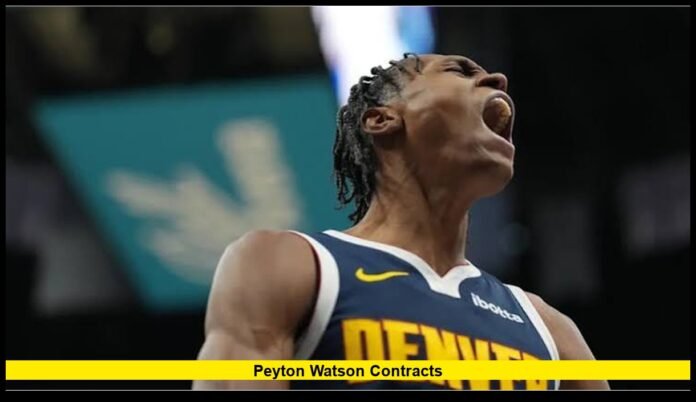

The Peyton Watson contract has become one of the notable NBA offseason developments after the young forward agreed to a four-year, $88 million deal with the Cleveland Cavaliers. The agreement represents a major financial milestone for Watson following his emergence as an increasingly important two-way player and brings an end to his time with the Denver Nuggets.
Watson enters Cleveland with considerable momentum after producing the best statistical season of his NBA career. His combination of size, athleticism, defensive versatility and improving perimeter shooting has made him an intriguing long-term player. The new agreement gives him financial security while placing greater expectations on him heading into the 2026-27 season.
Watson’s New Four-Year Agreement
The Cleveland deal is worth $88 million over four seasons, giving Watson an average annual salary of $22 million.
The projected salary structure is:
| Season | Projected Salary |
|---|---|
| 2026-27 | $20.47 million |
| 2027-28 | $21.49 million |
| 2028-29 | $22.51 million |
| 2029-30 | $23.53 million |
The final season includes a player option, meaning Watson will have control over whether he remains under the contract for the fourth year.
The structure gives the forward an immediate increase in compensation while also preserving flexibility later in his career. If he continues developing at his current pace, the option could become an important decision point when he reaches the later stages of the agreement.
For Cleveland, the contract represents a significant investment in a player the organization believes can contribute on both ends of the floor.
From Denver Prospect to Major Free-Agent Investment
Watson’s journey to a $88 million contract has been relatively rapid.
He entered the NBA after being selected in the first round of the 2022 NBA Draft. His draft rights eventually landed with Denver, where the organization gradually developed him rather than immediately placing him in a major offensive role.
His early NBA seasons were largely about learning the defensive responsibilities of an NBA forward, adjusting to the pace of professional basketball and finding ways to contribute without dominating the ball.
That approach changed as Watson became more comfortable.
His minutes increased, his offensive confidence improved and his defensive tools became increasingly valuable. By the 2025-26 season, he had established himself as a much more prominent part of the rotation.
A Breakout 2025-26 Campaign
Watson’s performance during the 2025-26 season was a major factor behind his increased market value.
He averaged approximately 14.6 points, 4.9 rebounds and 2.1 assists per game while also providing more than a block per contest. He appeared in 54 games and made 40 starts.
The scoring increase was particularly important.
Earlier in his career, Watson was primarily viewed as a defensive-minded player who could provide energy, athleticism and length. His offensive development changed that perception.
He demonstrated a greater ability to attack the basket, finish around the rim and make shots from the perimeter.
His three-point shooting was another encouraging development. Shooting around 41% from three-point range during the season gave him an additional way to impact games.
For a player of his physical profile, the ability to provide credible outside shooting can make a substantial difference in offensive spacing.
Why His Shooting Matters
Modern NBA offenses place a premium on players who can perform multiple jobs.
A forward who can defend several positions while also hitting open three-pointers gives coaches more flexibility when constructing lineups.
Watson’s development in this area is therefore particularly relevant to his new role in Cleveland.
If opposing defenses respect his perimeter shooting, he can create additional space for Cleveland’s primary ball handlers and interior players. If defenders close out aggressively, his athleticism gives him opportunities to attack the basket.
That combination could make him more difficult to defend than he was earlier in his career.
His shooting will also be one of the areas most closely watched during the 2026-27 season.
The End of His Denver Chapter
Watson’s move to Cleveland closes an important chapter in his development.
Denver selected him as a long-term developmental prospect and gave him time to grow into his role. His progression from a young reserve to a player commanding an $88 million contract illustrates how quickly an NBA player’s value can change.
The Nuggets had the opportunity to retain Watson because he entered the offseason as a restricted free agent.
However, negotiations did not result in a long-term agreement that kept him in Denver.
Instead, the two sides ultimately moved toward a sign-and-trade arrangement.
That allowed Watson to join Cleveland while Denver received future draft compensation and other assets connected to the broader transaction.
What Cleveland Is Getting
Cleveland is not simply acquiring a young scorer.
Watson’s biggest attraction is his two-way potential.
At his best, he can use his length and athleticism to defend wings and forwards while providing help defense around the basket. His offensive game is still developing, but the improvement already shown suggests that there may be additional room for growth.
His ability to contribute without needing a high volume of possessions could also be valuable.
Players who can defend, rebound, run the floor and hit open shots can fit into a variety of lineup combinations.
That versatility could become particularly useful during a long NBA season when injuries, matchups and rotations frequently change.
A Significant Raise From His Rookie Contract
The financial difference between Watson’s first NBA agreement and his new deal is substantial.
His rookie-scale contract was worth roughly $11 million across four seasons. His salary gradually increased during that period as required under the league’s rookie contract structure.
The new Cleveland agreement changes his financial position considerably.
An $88 million contract over four years gives Watson an average annual salary of $22 million. That is several times larger than the annual compensation associated with his rookie agreement.
The increase reflects not only his statistical improvement but also the value placed on young players who have demonstrated the potential to become reliable two-way contributors.
The Importance of the Player Option
The player option in the final season adds another interesting element to the agreement.
Watson is scheduled to earn approximately $23.5 million in 2029-30 if he chooses to exercise the option.
By that point, he will have several additional NBA seasons to establish his value.
If he develops into a major contributor, the option could provide him with the flexibility to enter free agency and pursue another contract. If remaining in Cleveland makes more sense for his career, he can exercise the option and continue under the existing agreement.
That decision is still several years away, but it gives Watson a degree of control that can become increasingly valuable as his career progresses.
Expectations Will Rise in Cleveland
A larger contract naturally brings greater expectations.
Watson will not be entering Cleveland simply as a young prospect. He will arrive as a player who has already demonstrated the ability to produce at a higher level and has received a substantial financial commitment.
The next challenge is consistency.
One strong season can establish a player’s potential, but maintaining that production over multiple years is what turns potential into a dependable NBA career.
Cleveland will want Watson to continue improving his offensive efficiency while maintaining the defensive qualities that made him attractive in the first place.
Defense Remains a Major Part of His Identity
Even as his offense has improved, defense remains central to Watson’s value.
His physical tools allow him to guard multiple positions, contest shots and recover quickly when plays break down.
That defensive versatility gives him opportunities to remain valuable even on nights when his scoring is limited.
For Cleveland, this could be particularly important.
A player who can defend different types of opponents gives the coaching staff more options when dealing with different offensive styles. Watson’s athleticism can also help Cleveland in transition, where his speed and finishing ability can become offensive weapons.
What Watson Must Improve
The new contract does not mean Watson has reached his ceiling.
Several aspects of his game can continue to develop.
One priority will be maintaining his shooting efficiency. Opponents will have more information about his tendencies, and teams may challenge him differently after his breakout season.
Decision-making will also be important.
As Watson receives a larger role, he will have more opportunities to create offense. Knowing when to attack, pass or simply move the ball will help determine how efficiently he can operate within Cleveland’s system.
Rebounding, defensive discipline and consistency will also remain important.
The best version of Watson would combine all of these elements without losing the athleticism and defensive intensity that helped him reach this point.
A New Opportunity for Watson
The move to Cleveland gives Watson a fresh environment at an important stage of his career.
He has already experienced the process of developing within an established organization. Now he gets the opportunity to establish himself in a different system with a new group of teammates.
That change can create new responsibilities.
Rather than being viewed primarily as a developing young player, Watson is now entering a contract designed to keep him with Cleveland for multiple seasons.
The organization will expect his game to continue progressing.
What the Deal Says About Watson’s Market Value
The size of the agreement illustrates how valuable young two-way players have become.
NBA teams increasingly look for players who can contribute in multiple areas rather than relying exclusively on specialists.
Watson fits that profile.
He has the physical attributes to defend, the athleticism to finish plays and the developing shooting ability to stretch the floor.
His age is another factor.
Unlike an older veteran signing, Cleveland is investing in a player who still has substantial room to improve.
That creates the possibility that the contract could become increasingly valuable to the team if Watson continues developing.
Looking Ahead to the 2026-27 Season
The 2026-27 season will be an important test for Watson.
He will be playing under a new contract, for a new organization and in front of a new fan base.
His first objective will be establishing consistency.
If he can reproduce the production he showed during the previous season while maintaining his defensive impact, he can quickly become an important piece of Cleveland’s rotation.
The Cavaliers will also be watching how he responds to increased expectations.
Young players often face a different challenge after signing their first major contract. The focus shifts from proving they belong in the league to proving they can consistently perform at a high level.
Watson now enters that stage.
The Bigger Picture for His Career
The significance of Watson’s agreement goes beyond the headline salary.
It represents the culmination of several seasons of development.
He entered the NBA as a relatively raw prospect and gradually turned himself into a player capable of contributing in meaningful minutes.
His progression shows the value of patience and development in professional basketball.
The next phase will determine whether he can transform his potential into sustained production.
For Cleveland, the hope is that the player who signed the contract will continue improving throughout its duration.
For Watson, the deal provides both financial security and a platform to establish himself as one of the league’s more versatile young forwards.
Latest Outlook
Watson begins his Cleveland tenure with a four-year commitment worth $88 million and a player option for the final season.
His immediate salary is scheduled to rise from roughly $20.47 million in 2026-27 to approximately $23.53 million in 2029-30.
More importantly, the move gives him an opportunity to build on a career-best season.
The Peyton Watson contract places him in a new category of expectations. He is no longer simply a developing former first-round selection. He is now a highly paid young player expected to contribute consistently to a team with ambitions of competing at a high level.
How he responds to that responsibility will be one of the more interesting storylines surrounding Cleveland during the 2026-27 NBA season.
For Watson, the next chapter is about turning financial opportunity into sustained performance and continuing the development that made his new contract possible in the first place.