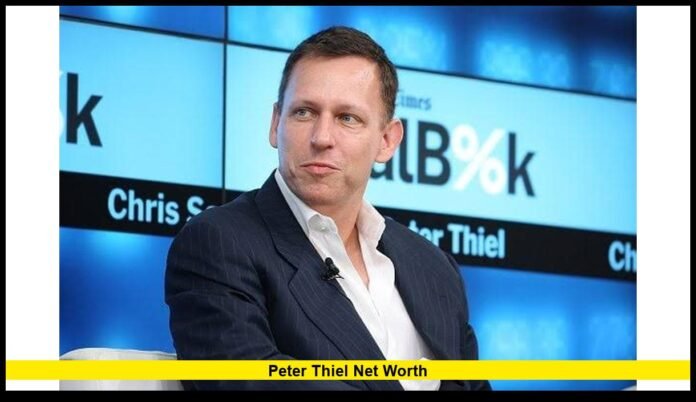

Peter Thiel net worth remains a closely watched figure in the technology and investment world, with current billionaire trackers placing his fortune in the high-$20 billion to mid-$30 billion range in 2026. The difference between estimates reflects the constantly changing value of his public shares, private investments and other assets rather than a disagreement over the scale of his wealth.
Thiel has built his fortune through a combination of entrepreneurship, venture capital and early bets on companies that later became some of the most valuable names in technology. His financial interests now stretch across artificial intelligence, software, aerospace, financial technology and other emerging industries.
Current Estimate of His Fortune
The latest estimates show why it is difficult to attach one permanent number to Thiel’s wealth.
Some wealth calculations have placed his fortune around $35 billion, while other daily indexes have recently valued it closer to $28 billion. These figures can move rapidly because billionaire rankings use different valuation methods, ownership assumptions and market prices.
Publicly traded assets can change in value every trading session. Private investments are even harder to calculate because their worth is generally based on funding rounds, transactions or estimated market valuations.
For that reason, a reasonable description of Thiel’s current fortune is that it sits somewhere around the $30 billion-plus level, rather than treating one daily figure as a permanent total.
The PayPal Breakthrough
Thiel’s rise to billionaire status began well before Palantir became a household name among investors.
He was one of the founders of PayPal and served as the company’s chief executive during its formative years. The online payments business became one of the defining technology companies of the early internet era.
When PayPal was acquired by eBay in 2002, Thiel received a substantial financial return from his ownership position. More importantly, the transaction gave him the capital and credibility to pursue a new phase of technology investing.
The PayPal network also became a launching point for a group of entrepreneurs and investors who later became influential throughout Silicon Valley.
A Remarkable Early Facebook Bet
One of Thiel’s most profitable investments came only a few years after PayPal’s sale.
In 2004, he invested $500,000 in Facebook, becoming the social-media company’s first major outside investor. The investment was made when Facebook was still a young startup with enormous uncertainty surrounding its future.
Facebook eventually became one of the world’s largest technology businesses. Its transformation into Meta created an enormous increase in the value of Thiel’s early investment.
He subsequently sold much of his position and stepped away from Meta’s board in 2022. Even after reducing his stake, the Facebook investment remained one of the defining financial successes of his career.
Palantir Became a Major Wealth Driver
Another important chapter in Thiel’s fortune is Palantir Technologies.
He co-founded the company in 2003 alongside a group of entrepreneurs and technology executives. Palantir initially concentrated heavily on sophisticated data-analysis tools for government organizations before expanding further into commercial markets.
The company eventually became publicly traded through a direct listing in 2020.
Palantir’s expansion into artificial intelligence has added another dimension to its growth story. Its software is used for data integration, analytics and operational decision-making across government and commercial customers.
Thiel continues to own a significant interest in the company. As a result, changes in Palantir’s stock price can have a meaningful impact on the estimated value of his fortune.
Founders Fund Expands His Investment Reach
Thiel’s financial interests are not limited to companies he helped create.
Through Founders Fund, the venture-capital firm he co-founded, he has gained exposure to a broad collection of private technology businesses. The firm’s investment strategy has focused heavily on ambitious startups working in areas where technological breakthroughs could produce unusually large returns.
The portfolio has included businesses such as SpaceX and Stripe, giving Thiel exposure to some of the most highly valued private companies in the technology economy.
Founders Fund has also become a prominent player in artificial intelligence, aerospace and other emerging sectors. The firm’s private holdings make Thiel’s personal wealth particularly difficult to calculate because some assets cannot be priced continuously like public stocks.
Why the Number Changes So Often
The phrase Peter Thiel net worth can suggest that there is a single definitive number available at any moment. In reality, billionaire wealth estimates are constantly moving.
There are several reasons for the fluctuations.
The first is the stock market. If a company in which Thiel owns shares rises sharply, the estimated value of his holdings increases. A market decline can produce the opposite result.
The second factor is private-company valuation. A startup may be worth substantially more after a new funding round, but that valuation does not necessarily mean its shares could immediately be sold for the same amount.
The third factor is asset sales. When billionaires sell shares, their wealth can shift from publicly visible securities into cash, investment funds or other assets.
These factors explain why different wealth rankings can show materially different totals.
Real Estate Adds Another Layer
Thiel has also accumulated high-value property assets.
One of the most notable transactions in 2026 involved the reported purchase of the historic Casa Encantada estate in Los Angeles for approximately $130 million. The property is among the most expensive residential purchases associated with the technology billionaire.
The transaction highlights how Thiel’s wealth extends beyond technology stocks and venture investments.
Luxury real estate can serve several purposes for ultra-high-net-worth individuals, including wealth preservation, diversification and long-term investment. However, property holdings also involve taxes, maintenance, insurance and other costs that are not reflected simply by looking at the purchase price.
His Broader Technology Strategy
Thiel has developed a reputation for backing companies that pursue large technological or economic changes rather than incremental improvements.
That philosophy is visible across his investment history.
PayPal targeted the future of digital payments. Facebook represented a major shift in online social interaction. Palantir focused on advanced data analysis, while Founders Fund has invested in areas ranging from aerospace to artificial intelligence.
His investment record demonstrates a willingness to accept substantial risk in exchange for the possibility of outsized returns.
What Could Happen to His Fortune Next?
The future value of Thiel’s fortune will depend heavily on the performance of the technology sector.
Palantir’s market value will remain an important variable. Continued demand for artificial intelligence and data-analysis products could support higher valuations, while a technology-sector downturn could reduce the value of Thiel’s publicly traded holdings.
Private investments could also become more valuable if major portfolio companies pursue public listings or large financing rounds.
At the same time, Thiel’s extensive diversification means his financial position does not depend entirely on one company.
A Fortune Built on Long-Term Bets
Peter Thiel’s financial history illustrates how early investments can compound dramatically when they are connected to businesses that reshape entire industries.
His PayPal success supplied the foundation. His Facebook investment demonstrated his ability to recognize a transformative company at an early stage. Palantir gave him another major technology platform, while Founders Fund broadened his exposure to a new generation of startups.
As of 2026, Thiel remains one of the most financially influential figures in the technology investment world. His precise wealth figure will continue to move with markets and private valuations, but his position among America’s richest technology entrepreneurs remains firmly established.