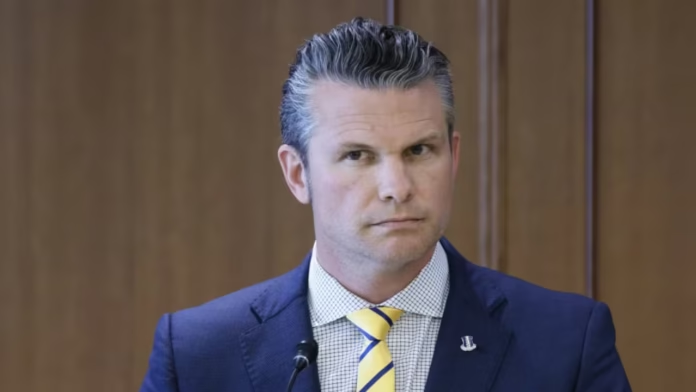

The pete hegseth pentagon doj leak taskforce has become one of the most closely watched developments in Washington this week, as the Trump administration ramps up its efforts to root out unauthorized disclosures of sensitive government information. Defense Secretary Pete Hegseth announced on Monday that the Pentagon and the Department of Justice have joined forces to create a dedicated unit aimed at identifying and prosecuting individuals responsible for leaking classified or sensitive material to the press. The move marks a significant escalation in the administration’s ongoing fight against media leaks and has already triggered strong reactions from press freedom advocates, journalists, and political observers alike.
Background: Who Is Pete Hegseth
Pete Hegseth serves as the current Secretary of Defense, a role that has recently been rebranded under the Trump administration as Secretary of War, reflecting a broader rhetorical shift within the department. Before entering government, Hegseth built a public profile as a television host and commentator, developing a reputation for outspoken views on military policy, veterans’ affairs, and national security. Since taking over the Pentagon’s top civilian post, he has pursued an aggressive agenda that includes tightening grooming and appearance standards for service members, reshaping personnel policy, and taking a hard line against what he characterizes as threats to operational security within the department.
Hegseth’s tenure has not been without controversy. He has faced scrutiny over his handling of sensitive military information, including reports that details about strike planning were shared through informal channels with family members who hold no official national security role. Those disclosures have reportedly been referred to the Pentagon’s inspector general as part of a broader review of his conduct, adding another layer of complexity to his current push against leaks elsewhere in the department.
The Announcement: What the Taskforce Actually Does
In a video statement posted to social media on Monday, Hegseth confirmed the creation of the joint task force, describing it as a partnership between the Department of War and the Department of Justice designed to move quickly against unauthorized disclosures. He said he has delegated tasking authority to the Pentagon’s Office of General Counsel, effective immediately, granting that office the power to request and receive any information, records, or support from across the department related to media leak investigations.
According to Hegseth, every component within the department and all personnel are now required to prioritize these requests. Any tasking issued under this new authority must receive a full and complete response within two days of being submitted. This tight turnaround reflects the administration’s stated goal of accelerating how quickly leak investigations move from initial suspicion to formal referral for prosecution.
Hegseth framed the initiative in stark terms, stating that leaking sensitive national defense information amounts to a betrayal of American service members and puts them directly in danger. He argued that timely coordination between the Pentagon and federal law enforcement partners, including the FBI, is essential to identifying leakers before further harm can occur. He also publicly thanked the acting U.S. Attorney General for supporting the initiative, describing the collaboration between the two departments as closer than it has ever been.
Why Now: The Context Behind the Crackdown
The timing of the pete hegseth pentagon doj leak taskforce announcement is closely tied to a string of recent events. Just days before the taskforce was unveiled, the Department of Justice issued subpoenas to several reporters at a major national newspaper, compelling them to appear before a federal grand jury. Those subpoenas followed reporting that raised security concerns about a foreign-donated aircraft used by President Trump during international travel, along with earlier reporting on military strike planning details that reportedly reached people outside official channels.
The subpoenas themselves have drawn sharp criticism from press freedom groups, who argue that compelling journalists to testify before a grand jury threatens the independence of the press and could have a chilling effect on future reporting about government conduct. Attorneys representing the affected news organization have publicly condemned the subpoenas, describing the appearance of federal agents pursuing journalists as deeply troubling for anyone who values constitutional protections for a free press. Press freedom organizations have echoed these concerns, framing the issue as one that ultimately affects the public’s right to know how its government operates.
For its part, the Department of Justice has pushed back on the idea that journalists themselves are being targeted. A spokesperson clarified that the department’s focus is on the individuals leaking classified information, not the reporters who receive it, while also emphasizing that the government has a legitimate interest in ensuring that people entrusted with national secrets handle that information appropriately.
Public and Political Reaction
The announcement of the new taskforce has sparked a wide range of reactions across the political and media landscape. Supporters of the administration’s approach argue that leaks of sensitive military information pose a genuine risk to service members and undermine operational security, making a coordinated response between the Pentagon and Justice Department a reasonable and even overdue step. Critics, meanwhile, see the timing and scope of the initiative as part of a broader pattern of pressure on independent journalism, pointing to the subpoenas issued just before the taskforce was announced as evidence of a coordinated effort to discourage reporting that reflects poorly on the administration.
Some observers have also noted the apparent tension between Hegseth’s public stance on leaks and his own history of scrutiny over how sensitive information has been shared within his inner circle. This contrast has become a talking point in coverage of the announcement, with some commentators questioning whether the new enforcement mechanism will be applied evenly across the department regardless of rank or personal connections.
Journalism advocacy groups have been particularly vocal, arguing that an independent press plays an essential role in helping the public understand how government agencies operate and how taxpayer resources are used. They contend that aggressive leak investigations, especially when paired with subpoenas targeting reporters directly, risk discouraging sources from coming forward on matters of genuine public interest, even when no classified information is involved.
How the Taskforce Fits Into Broader Pentagon Policy
The creation of this joint task force does not exist in isolation. It reflects a broader tightening of internal controls at the Pentagon under Hegseth’s leadership, which has included stricter standards for personal conduct, appearance, and information handling among military personnel. Sources familiar with internal Pentagon operations have described a workplace culture increasingly focused on discipline and compliance, with leadership paying close attention to how directives are followed at every level of the chain of command.
Whether this new taskforce will lead to a significant number of prosecutions remains to be seen. No official confirmation has been provided regarding specific cases currently under investigation, the identities of any individuals being examined, or a timeline for when the first referrals to federal prosecutors might occur. The Pentagon has indicated that evidence gathered through these expedited channels will be handed over to the Department of Justice once sufficiently developed, with prosecution to follow if warranted, but concrete outcomes have not yet been made public.
What This Means Going Forward
For now, the pete hegseth pentagon doj leak taskforce represents a formal structural change in how the Pentagon and Justice Department coordinate on leak investigations, rather than a single enforcement action against a specific individual. The two-day response requirement for information requests suggests the administration wants this process to move noticeably faster than typical internal investigations, which have historically been criticized for dragging on without clear resolution.
It is also worth noting that the taskforce’s creation comes amid a broader national conversation about the balance between government secrecy and press freedom. As subpoenas targeting journalists and internal leak investigations unfold simultaneously, many in the media and legal communities will be watching closely to see how the Justice Department distinguishes between pursuing individuals who unlawfully disclose classified information and preserving the traditional protections afforded to journalists covering matters of public concern.
As this story develops, additional details are likely to emerge regarding specific cases, potential legal challenges from press organizations, and how effectively the new task force operates in practice. Readers interested in national security policy, press freedom issues, or Pentagon leadership decisions will want to continue following how this initiative unfolds in the weeks ahead.
Final Thoughts
The formation of the pete hegseth pentagon doj leak taskforce marks a notable moment in the ongoing relationship between government secrecy, national security, and press freedom. While the administration frames the effort as a necessary safeguard for protecting service members and sensitive operations, critics view it as part of a larger pattern of pressure on independent journalism. With subpoenas already issued to reporters and a faster investigative process now in place, the coming weeks are likely to reveal how aggressively this new taskforce will be used and what it means for the future of government transparency and press freedom in the United States.
Stay tuned for further updates on this developing story, and feel free to share your thoughts in the comments below.