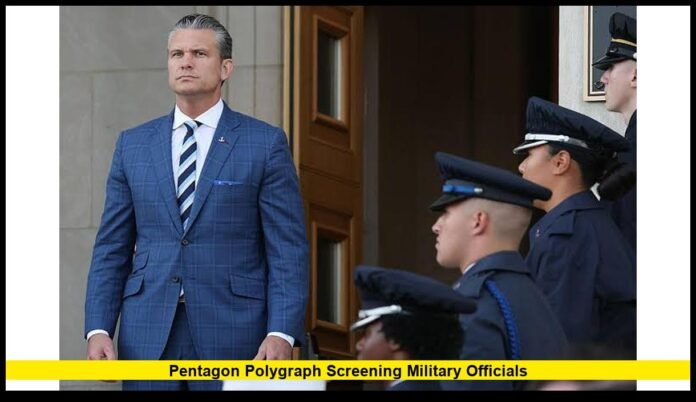

The latest pentagon polygraph screening military officials investigation has drawn national attention after dozens of Joint Staff personnel underwent lie-detector examinations as part of a search for the source of sensitive military disclosures.
The examinations took place in August 2026 and reportedly involved about 50 military officers and civilian employees assigned to the Joint Staff. The investigation centers on suspected leaks involving classified information, including reporting about U.S. weapons inventories and the availability of critical munitions during the conflict with Iran.
The Pentagon has not publicly identified anyone as the source of the disclosures. It also has not released a complete account of the examinations or announced a final investigative finding.
Why the Pentagon Conducted the Polygraph Examinations
The examinations followed a series of media reports about U.S. military weapons stocks.
Those reports described concerns about supplies of advanced munitions, including long-range missiles and Patriot interceptors. The information became especially sensitive because U.S. forces were using sophisticated weapons during the conflict with Iran.
Military officials treat information about weapons availability as highly sensitive. Details about remaining stocks can provide insight into the ability of the United States to sustain military operations.
Investigators therefore wanted to determine whether personnel with access to classified information had provided protected details to journalists.
The questions reportedly addressed whether officials had disclosed classified information to members of the media. Investigators also asked about information involving reduced U.S. munitions stocks.
The examinations were not described as ordinary clearance renewals. Their reported timing and scope indicate that investigators were examining possible unauthorized disclosures.
About 50 Joint Staff Personnel Were Tested
The reported number of people involved is one of the most significant aspects of the investigation.
About 50 members of the Joint Staff underwent polygraph examinations during August. The group included military personnel and civilian employees.
The Joint Staff includes roughly 1,500 to 2,000 personnel. Its responsibilities include coordinating military operations, policy and war planning with U.S. combatant commands.
That means the testing affected only a portion of the organization. However, the reported number remains notable because some of the personnel held senior positions.
Several dozen other military officials also reportedly underwent examinations during the broader investigation. Those included personnel connected with U.S. Central Command and other combatant commands.
The testing did not involve every senior military leader.
Gen. Dan Caine, chairman of the Joint Chiefs of Staff, was not among those subjected to the reported examinations.
The Pentagon has not publicly explained why individual officials were selected or excluded.
No Publicly Identified Leaker Has Emerged
The reported examinations have not resulted in a publicly identified source.
Two officials familiar with the matter said no one failed the questions designed to determine whether personnel had leaked information to journalists.
That detail does not establish that investigators have closed the case.
It also does not mean investigators have concluded that no unauthorized disclosure occurred.
A polygraph is one investigative tool. It does not independently establish who provided information to a journalist.
Investigators can combine examination results with interviews, access records, communications information and other evidence.
The Pentagon has not disclosed the full investigative process in this case.
As a result, the public cannot determine from the available information whether investigators have narrowed their search to a smaller group of personnel.
The Weapons Information at the Center of the Investigation
The reported leak investigation is closely tied to information about U.S. military munitions.
During the conflict with Iran, media reports examined the pace at which the United States was using certain advanced weapons.
Among the systems discussed were long-range missiles and Patriot interceptors.
These weapons have strategic importance. Patriot interceptors, for example, support air and missile defense, while long-range missiles can provide the ability to strike targets from significant distances.
The concern surrounding the reported disclosures was not simply that journalists had discussed weapons.
The sensitive issue involved information about stockpiles and military readiness.
An accurate picture of weapons availability could provide an adversary with useful information about U.S. capabilities and potential limitations.
That explains why Pentagon investigators treated the disclosures as a national security matter.
The investigation, however, has not publicly established that every detail in media reports came from classified information.
Journalists can obtain information through multiple channels. The Pentagon’s investigation is focused specifically on unauthorized disclosure of protected government information.
The Investigation Goes Beyond the Joint Staff
The Joint Staff examinations represent the most widely reported portion of the investigation.
CBS News reported that several dozen people underwent testing earlier in the summer, including some officials connected with U.S. Central Command and other combatant commands.
That broader scope suggests investigators were not limiting their search to personnel working directly within the Joint Staff.
Combatant commands oversee military operations across specific geographic or functional areas. Personnel connected to those commands can have access to information involving ongoing operations, military planning and weapons requirements.
The reported examinations therefore cover a wider portion of the military establishment.
The Pentagon has not disclosed the exact total number of people examined across all organizations.
It also has not released a complete list of commands or offices involved.
What the Pentagon Has Publicly Confirmed
The Defense Department has declined to discuss the individual personnel involved.
Chief Pentagon spokesman Sean Parnell said the department does not comment on internal personnel or investigative matters.
He also emphasized the seriousness with which the Pentagon treats leaks involving classified national security information.
The department’s position leaves important questions unanswered.
There is no public Pentagon announcement naming a suspected leaker. There is no publicly released investigative report detailing the examination results. There is also no announced conclusion stating that the investigation has ended.
That makes it important to distinguish confirmed developments from speculation.
The confirmed reporting establishes that extensive examinations took place and that investigators were seeking information about suspected leaks.
It does not establish the identity of a person responsible for the disclosures.
Why the Scale of Testing Is Unusual
Polygraph examinations already have a place within the national security system.
Military and civilian personnel with access to especially sensitive classified programs can undergo examinations as part of security procedures.
Those examinations can help investigators assess information during security and counterintelligence matters.
What makes the current investigation unusual is the number of people reportedly examined at the same time and the seniority of some of those personnel.
Retired Rear Adm. Donald J. Guter, a former Navy judge advocate general, described the breadth and seniority of the testing as unprecedented in his experience.
The distinction is important.
A routine examination associated with a security clearance is different from a large-scale investigation designed to determine whether military personnel provided information to journalists.
The reported August examinations fall into the second category.
How Military Polygraphs Fit Into Security Investigations
Polygraph testing has been used by U.S. military and intelligence organizations for decades.
The examination measures physiological responses while an examiner asks a structured series of questions.
The process can examine an individual’s responses to questions involving specific allegations or security concerns.
Within the military system, polygraphs can support criminal investigations, counterintelligence inquiries and other security-related cases.
They do not replace other investigative methods.
That point is particularly important in the current Pentagon case.
Even if an individual produces a particular polygraph result, investigators still need broader evidence when determining whether that person disclosed classified information.
A test result does not publicly identify the source of a news report.
The Pentagon has not explained how polygraph results from the current investigation will be combined with other evidence.
The Role of Defense Department Investigators
The reported examinations were conducted through military investigative channels rather than as an FBI-led polygraph operation.
Officials familiar with the matter said the FBI was not involved in the examinations themselves.
The military maintains its own investigative organizations and security procedures.
That distinction matters because the broader leak effort involves cooperation between the Defense Department and federal law enforcement.
Defense Secretary Pete Hegseth announced in July that the Pentagon and Justice Department had created a joint task force focused on identifying and prosecuting people suspected of leaking sensitive government information.
The task force expanded an existing effort inside the Defense Department.
Pentagon officials were instructed to respond quickly to requests connected with leak investigations.
Hegseth said unauthorized disclosures can put lives at risk.
The polygraph examinations reported in August were part of the military’s investigative effort, while the broader task force involves cooperation with the Justice Department and other federal law enforcement partners.
The Pentagon’s Growing Focus on Unauthorized Disclosures
The latest investigation is not the first time the Defense Department has pursued suspected leaks during Hegseth’s tenure.
The department began several leak investigations after reports concerning internal Pentagon decisions and national security matters.
The administration has increasingly emphasized controlling access to sensitive information.
The current investigation is more notable because it involves dozens of military and civilian officials.
The reported testing also comes during a period when the Pentagon has faced intense scrutiny over military operations, weapons availability and internal decision-making.
Those circumstances have increased the importance of identifying whether sensitive information has left official channels.
A Previous Polygraph Threat Involving Senior Officers
The current investigation also follows earlier controversy involving the use of polygraphs.
In 2025, Hegseth reportedly became angry after information about a planned classified Pentagon briefing involving Elon Musk reached the press.
The reported briefing concerned China and potential military planning.
According to previous reporting, Hegseth threatened senior military officers with polygraph examinations while attempting to determine who had disclosed information about the planned briefing.
Those officers were not ultimately subjected to the same type of broad examination reported in August 2026.
The episode demonstrated that polygraph testing had already become part of the administration’s response to suspected Pentagon leaks.
The current investigation represents a much broader application.
Why Munitions Information Is Especially Sensitive
Weapons stockpiles are closely tied to military readiness.
A country conducting sustained combat operations must maintain enough weapons to support current missions while preserving reserves for future contingencies.
Some advanced weapons also require substantial time and resources to manufacture.
Information about declining inventories can therefore reveal more than a simple number.
It can help analysts assess operational endurance, production capacity and the pressure placed on particular weapon systems.
For the Pentagon, preventing unauthorized disclosure of such information can be a significant security priority.
That concern helps explain the intensity of the current investigation.
The administration has also rejected public characterizations that the United States lacks sufficient military power, while emphasizing continued production and replenishment of weapons.
The leak investigation is separate from that public debate.
Its focus is whether protected information was improperly disclosed.
The Investigation Does Not Mean Every Media Report Was a Leak
A crucial distinction remains between reporting about sensitive military subjects and the unauthorized disclosure of classified information.
Journalists routinely report on defense policy, weapons production and military operations using public documents, interviews and other sources.
A story can therefore discuss a sensitive subject without necessarily relying on classified material.
The Pentagon investigation is concerned with disclosures that officials believe crossed security boundaries.
The government has not publicly identified the specific documents or pieces of classified information involved in every reported case.
That limits what can responsibly be concluded about individual news reports.
It also makes it inappropriate to identify journalists, military officers or civilian employees as sources without verified evidence.
What Remains Unknown
Several major questions remain open.
The Pentagon has not publicly announced a suspect.
It has not released the full results of the polygraph examinations.
Officials have not disclosed every question asked during the tests.
The Defense Department has also not provided a complete number of personnel who participated in the wider investigation.
Another unresolved issue concerns the ultimate outcome.
Investigators could continue gathering evidence even after the reported examinations have ended.
They could also determine that additional investigative steps are necessary.
Until the Defense Department announces a formal conclusion, the investigation should be treated as ongoing.
Why the Latest Developments Matter
The significance of the investigation goes beyond the use of polygraphs.
It highlights the Pentagon’s determination to identify unauthorized disclosures involving sensitive military information.
It also demonstrates the unusual measures being used to investigate possible leaks within senior military organizations.
About 50 Joint Staff personnel reportedly underwent examinations. Additional officials from other commands were also tested.
Yet no publicly identified source has emerged.
That combination makes the investigation especially significant.
The Pentagon has demonstrated that it is willing to use extensive investigative resources to find the source of sensitive disclosures. At the same time, the department continues to keep the details of the inquiry private.
What Happens Next
The next major development would likely come from the Pentagon, the Justice Department or congressional oversight.
A formal disciplinary action, criminal referral or public statement could clarify whether investigators have identified a source.
Congress could also seek additional information about the scale and procedures surrounding the examinations.
For now, however, the available facts remain limited.
The examinations took place in August. Roughly 50 Joint Staff personnel were reportedly involved. Additional military officials also underwent testing. Investigators focused on suspected disclosures concerning classified information and sensitive weapons-stockpile details.
No publicly identified individual has been established as the source.
That remains the central unresolved question surrounding the investigation.
Bottom Line
The Pentagon’s large-scale polygraph investigation represents an unusually aggressive effort to determine whether military personnel disclosed classified information to journalists. The examinations reportedly involved about 50 Joint Staff members and additional officials connected to combatant commands.
The investigation followed reporting about U.S. weapons inventories during the conflict with Iran, making the security concerns particularly sensitive.
The Pentagon has confirmed neither a suspect nor a final result. It has instead maintained that unauthorized disclosures of classified information receive serious attention while declining to discuss individual investigative matters.
As the inquiry continues, the most important developments will be any verified finding about the source of the disclosures, any disciplinary or legal action, and any further explanation from the Defense Department about the unusual scale of the testing.
What do you think about the Pentagon’s latest leak investigation? Share your thoughts below and stay informed as verified developments emerge.