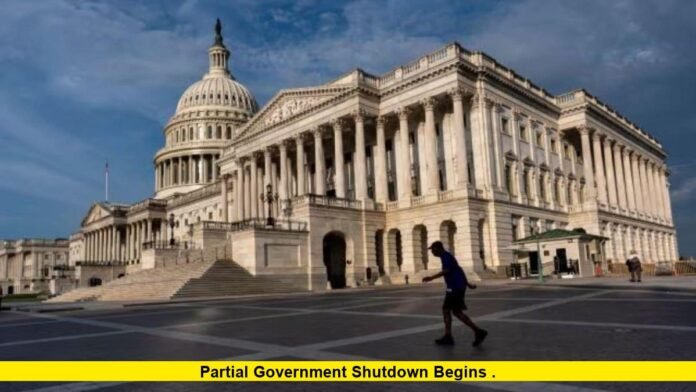

The Partial government shutdown begins as funding lapses despite Senate deal at 12:01 a.m. Eastern Time on Saturday, marking a temporary halt in funding for many federal operations after congressional negotiations failed to produce fully enacted appropriations by the deadline. This development triggered automatic stop-work orders for numerous federal agencies and thrust Capitol Hill back into urgent budget wrangling just as lawmakers thought they had a bipartisan solution in place.
The U.S. government entered a partial shutdown because Congress did not have the full set of spending bills signed into law before the fiscal year clock ran out. Democrats and Republicans had appeared to reach agreement on most appropriations, including a bipartisan Senate vote late Friday on a roughly $1.2 trillion package to keep core agencies funded through September. But procedural timing and unresolved differences over Homeland Security spending meant the House could not act in time before the deadline.
If you’re trying to understand what this means for federal services and for everyday Americans, keep reading for a complete breakdown of who’s affected, what happens next, and why the impasse occurred.
Why the Shutdown Happened
In the days leading up to the deadline, Senate leaders appeared poised to pass a sweeping funding deal that would keep most of the government fully funded through the end of the fiscal year. The Senate approved that package by a bipartisan 71-29 vote late Friday evening, funding key departments like Defense, State, Treasury, Transportation, Health and Human Services, and more. It also included a two-week continuing resolution for the Department of Homeland Security (DHS) to allow extra time for negotiations on immigration enforcement reforms at agencies such as Immigration and Customs Enforcement (ICE).
However, the House of Representatives was in recess and not scheduled to return until Monday, which prevented full congressional approval and presidential signature before the deadline. Because the appropriations bills had not been enacted by midnight Friday, funding for dozens of agencies lapsed, shutting down operations that lack statutory authority to continue without appropriations.
Which Federal Agencies Are Affected
The 2026 partial shutdown is narrower in scope than the extended lapse late last year, but it still affects major components of the U.S. government. Agencies and departments whose funding expired at midnight include:
- Department of Defense (non-combat and non-essential civilian activities)
- Department of Homeland Security (beyond the limited two-week extension)
- Department of State
- Department of Treasury
- Department of Labor
- Department of Education
- Department of Housing and Urban Development
- Department of Health and Human Services (certain non-critical programs)
In contrast, many parts of the government will continue operating because they are funded through separate appropriations or mandatory spending. These include:
- Social Security and Medicare benefits
- Department of Veterans Affairs services
- Federal Reserve functions
- Unemployment insurance and some agricultural programs
- Certain independent agencies and national science agencies
Some agencies like the Environmental Protection Agency and National Science Foundation also remain funded because appropriations were completed earlier.
Impact on Government Services and Workers
During a shutdown, agencies must implement shutdown plans developed with guidance from the Office of Management and Budget. These plans prioritize essential activities that protect life and property while suspending non-essential services.
For federal employees, this means:
- Furloughs for non-essential staff at affected agencies until funding is restored.
- Essential personnel—such as air traffic controllers, border security officers, and other critical operations—must continue working without pay until appropriations resume.
- National parks and museums may see limited closures or reduced services, depending on local arrangements.
- TSA officers and air traffic controllers work through the shutdown, potentially affecting air travel due to staffing strain.
Under existing law, federal workers typically receive back pay once the shutdown ends, but they will experience delayed paychecks in the interim.
The Political Divide Behind the Impasse
Lawmakers struggled to align on the remaining appropriations because of sharp disagreements over immigration policy and oversight of federal law enforcement. A pivotal point of contention was DHS funding, especially provisions related to ICE and Customs and Border Protection (CBP).
Recent high-profile incidents involving immigration enforcement galvanized Democratic opposition to continuing DHS funding without additional reforms. Democrats pressed for:
- Mandatory body cameras and visible identification for agents
- Stricter use-of-force standards and independent oversight
- Limits on “roving” immigration sweeps
Republicans and the White House argued that DHS funding should proceed without new operational restrictions, emphasizing border security and enforcement priorities. A compromise was reached in the Senate that separated DHS funding from broader spending and provided a short extension. But with the House out until Monday, that agreement could not be finalized in time, leading to the lapse.
Shortest Shutdowns in U.S. History
The United States has seen several brief funding gaps since the modern appropriations process began, with lapses of only days in many cases. Historically, shutdowns of one to three days had minimal impact on services. In contrast, the 43-day shutdown late in 2025 was the longest in U.S. history, disrupting agency operations and furloughing hundreds of thousands of workers. The current shutdown is expected to be brief if the House moves quickly to pass the Senate’s package and the president signs it.
What Happens Next
With the House slated to return to Washington on Monday, congressional leaders face intense pressure to pass the Senate package and bring the government back online as soon as possible. Lawmakers of both parties have expressed interest in ending the funding gap quickly to avoid broader disruptions.
House leaders will first consider the Senate-approved package, including the “minibus” of appropriations bills and the short DHS extension. If approved and sent to the White House, the president is expected to sign the measures into law, restoring full funding for the affected agencies.
Meanwhile, negotiations over immigration enforcement reforms at DHS are likely to continue during the two-week extension once funding is enacted. Those debates could shape future policy and emerge as central issues in broader legislative and oversight discussions.
How This Affects Americans
For most U.S. residents, the immediate effects of the shutdown may seem muted if it ends quickly. Programs like Social Security, veterans benefits, and mail delivery continue. But travelers may see air travel delays due to staffing strains at airports, and access to certain services—such as national park facilities or non-essential administrative support offices—may be limited.
Federal contractors and businesses that rely on government operations could face payment delays and planning uncertainty. Federal workers and their families may need to adjust finances in the short term while awaiting back pay.
Signs of Resolution on the Horizon
Despite the lapse, lawmakers and the White House have signaled a desire to finalize spending agreements swiftly. Both sides are wary of prolonged shutdown fallout like last year’s historic stoppage. House leaders have indicated plans to act promptly upon return, and the existing Senate framework offers a roadmap for restoring funding.
Exactly how quickly the government reopens will depend on procedural steps and political dynamics once lawmakers reconvene. But with bipartisan support in the Senate and urgency on both sides, many analysts expect a rapid resolution.
Share your thoughts below or check back as the situation unfolds to see how this funding gap may affect federal operations and services in your area.