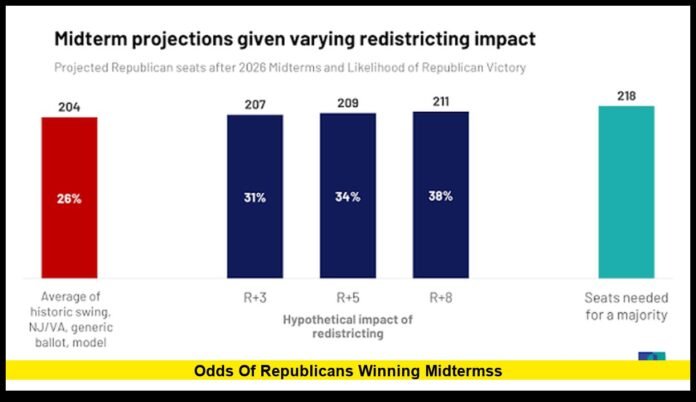

With the 2026 congressional elections approaching, the odds of Republicans winning midterms are being closely tracked as Democrats make gains in national polling while Republicans work to protect their narrow majorities in Congress. The latest election models show a difficult environment for the GOP, particularly in the House, although the Senate remains much more competitive.
The 2026 midterms are scheduled for November 3, when voters will choose all 435 members of the House and 35 senators. Republicans currently hold a 219-214 advantage in the House and a 53-47 edge in the Senate, meaning Democrats must make significant gains to take control of both chambers.
House control has become the bigger Republican challenge
The House is currently the chamber where the electoral landscape has moved most sharply.
Recent forecasting models have placed Democrats in a stronger position to capture the House, with the party benefiting from a favorable national congressional ballot and a relatively small number of seats separating the two parties from a change in control.
One recent forecast estimated Democratic chances of taking the House at more than 80%, while other election markets have placed the probability considerably higher. Those figures are changing as new surveys arrive, but the overall direction of recent forecasts has been unfavorable for Republicans.
The current House margin gives Republicans little room for losses. Democrats would need to gain only a handful of seats to move from the minority to the majority.
That makes competitive suburban districts, open seats and Republican-held seats in politically mixed areas especially important.
The Senate presents a different picture
Republicans have a stronger starting position in the Senate because they currently hold 53 seats.
Democrats would generally need a net gain of four seats to reach a 51-seat majority, assuming the existing party alignment remains unchanged. That creates a different electoral challenge from the House.
Recent forecasting has nevertheless shown the Democratic Senate position improving. A September forecast from a major election model placed the Democratic probability of gaining Senate control at 59%, its highest level of the 2026 cycle at that point.
Other models have been more closely divided, demonstrating that the Senate contest remains considerably less settled than the House race.
The generic ballot is an important warning sign
One of the most closely watched indicators is the generic congressional ballot, which asks voters whether they would prefer a Democratic or Republican candidate for Congress in their district.
Recent surveys have consistently shown Democrats leading the national measure.
A September national poll of likely midterm voters recorded Democrats at 52.3% and Republicans at 47.7%, a 4.6-point Democratic advantage. Other recent surveys have produced even larger Democratic margins.
A separate polling average recently showed Democrats with an advantage approaching nine percentage points, highlighting the unusually strong national environment reflected in some surveys.
The generic ballot does not directly determine how many House seats either party will win. Congressional districts have different political characteristics, and the national popular vote can differ significantly from the final seat distribution.
Nevertheless, the measure is closely watched because it provides an indication of the overall partisan mood heading into the election.
Trump remains a major factor in the congressional campaign
President Donald Trump’s standing is another central component of the 2026 political environment.
Republican candidates are campaigning while the president’s approval ratings and economic assessments remain major issues for voters. Inflation, energy prices, foreign policy and the administration’s broader agenda have all become part of the congressional debate.
The political environment surrounding a president can have an important effect on midterm elections. Historically, the president’s party has frequently lost congressional seats during the first midterm election of an administration.
That historical pattern is not a prediction of the 2026 result, however. Individual races can diverge significantly from national trends, particularly when candidates have strong local organizations or distinctive political profiles.
Republicans still have a path to retaining Congress
Despite unfavorable national indicators, Republicans retain several advantages.
The party begins the campaign with control of both chambers. Republican incumbents have established fundraising networks, campaign organizations and name recognition in many districts and states.
The Senate map also gives Republicans opportunities to defend their majority without having to win a large number of Democratic-held seats.
Republican leaders have continued to argue that turnout could significantly alter the current political landscape. House Majority Leader Steve Scalise recently discussed a potential Republican House result as high as 225 seats, while acknowledging the competitiveness of the election.
The GOP is also benefiting from substantial campaign spending and established voter networks in many states.
Battleground Senate races are crucial
The Senate outcome could depend on a relatively small collection of competitive races.
States including Michigan, Georgia, Maine, North Carolina, Texas, Alaska, Iowa and Kansas have received significant attention as the parties compete for seats that could determine control of the chamber.
Michigan is particularly important because the state’s open Senate contest is attracting major national spending. Republican candidate Mike Rogers is campaigning against Democratic nominee Abdul El-Sayed in a race that has become part of the broader battle for Senate control.
Florida has also attracted attention after recent polling indicated that the Republican-held Senate seat could be more competitive than previously expected.
The number of genuinely competitive races means a small shift in several states could substantially change the Senate map.
Redistricting has not removed the House uncertainty
Congressional redistricting has also influenced the 2026 House campaign.
Several states have adopted new congressional maps, creating new boundaries and changing the political characteristics of some districts.
However, recent election analysis suggests that the overall effect of redistricting is unlikely to provide Republicans with a large nationwide advantage. Some districts have become more favorable to Republicans, while others have shifted in the opposite direction.
That leaves candidate performance, turnout and national political conditions as major factors in determining the final House balance.
Early voting could become increasingly important
Voting behavior is another developing factor in this year’s election.
Recent polling indicates that Democrats are showing greater interest in voting in person than they did in 2024, while both parties continue to organize around early voting.
Changes in voting methods could affect how campaigns allocate resources during the final weeks. Parties are increasingly focused not only on persuading undecided voters but also on making sure supporters actually cast ballots.
The Supreme Court also recently declined to allow the Trump administration to impose proposed new federal restrictions on mail-ballot procedures before the 2026 elections. As a result, existing state-level voting systems remain central to the election process.
Why the numbers can change before Election Day
Election forecasts are dynamic. They are recalculated whenever new polling, fundraising information, candidate developments or other relevant data become available.
A forecast showing one party with a statistical advantage does not mean that outcome is guaranteed.
Late movement can occur when voters become more engaged, when major campaign issues change or when candidates receive greater exposure during the final weeks.
The Senate is especially sensitive to these developments because only a few states are expected to determine the chamber’s final balance.
What voters should watch in the final weeks
The most useful indicators heading toward Election Day will include the generic congressional ballot, state-level Senate polling, House district surveys and presidential approval measurements.
Turnout data will also become increasingly important as early voting expands.
For Republicans, holding the House would require limiting losses across competitive districts, while retaining the Senate would require successfully defending vulnerable seats and preventing Democrats from assembling the four-seat gain needed for a majority.
For Democrats, the central task is converting their current polling advantage into victories in enough individual races to change congressional control.
At this stage, the available evidence shows a highly competitive congressional election, with Republicans facing a more difficult House environment and a closer Senate contest.
The latest forecasts provide useful measurements of the race but should not be interpreted as final results. Polling can move, and congressional control will ultimately depend on the individual contests decided by voters in November.