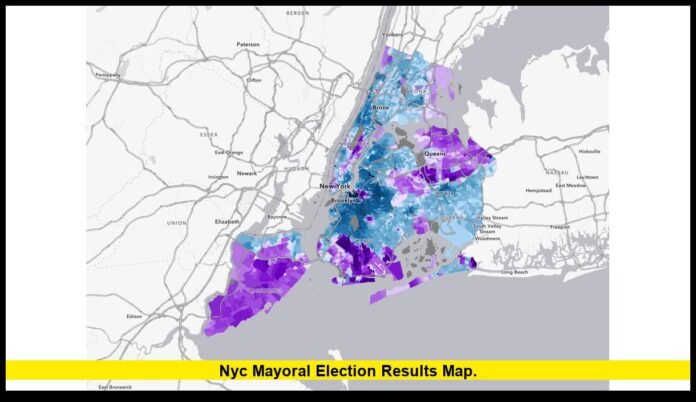

The NYC mayoral election results map of 2025 has revealed a striking new reality for the five boroughs. Zohran Mamdani, a 34-year-old state assemblymember from Queens, emerged as the clear victor in one of the most competitive and consequential mayoral races in decades. His triumph over former Governor Andrew Cuomo marks a generational and ideological turning point for New York City politics, reshaping the city’s future for years to come.
The map tells a compelling story of change: a city divided by wealth but united by a shared demand for progress. From the diverse streets of Queens to the dense heart of Brooklyn, Mamdani’s name appeared again and again in bright, commanding shades across precinct lines, signaling a landslide built on energy, diversity, and a promise to reimagine what leadership in New York City should look like.
A Night of Record Turnout and Historic Margins
The 2025 election drew an unprecedented 2 million-plus voters, making it the highest turnout for a New York City mayoral contest since the late 1960s. The energy was palpable—lines stretched around polling sites in all five boroughs, and early voting participation shattered previous records.
According to the official citywide tally, Zohran Mamdani secured 50.4% of the vote, defeating independent candidate Andrew Cuomo, who finished with 41.6%. Republican nominee Curtis Sliwa followed with 7.1%, while minor third-party candidates together collected less than 1%.
When the NYC mayoral election results map was first released on election night, the city’s political observers were stunned. Borough after borough turned Mamdani’s signature campaign red, leaving only Staten Island blue for Cuomo. The outcome represented not just a personal victory for Mamdani, but also a political statement from voters who had grown weary of establishment politics.
Queens: The Heart of Mamdani’s Movement
Queens, Mamdani’s home borough and the base of his campaign, played a pivotal role in his victory. The results map shows enormous margins in neighborhoods like Astoria, Jackson Heights, Elmhurst, and Long Island City, where Mamdani captured between 60% and 75% of votes.
His campaign headquarters in Astoria became a hub of community energy, filled with local volunteers, small-business owners, and first-time voters. Many credited Mamdani’s consistent presence in Queens as a reason for his dominance there. He had built a reputation as a grassroots leader who showed up in neighborhoods long before he was a mayoral contender.
“Queens carried me because Queens made me,” Mamdani said during his victory speech, standing before a crowd of thousands at his election night rally. “This map isn’t just lines and numbers—it’s people who believe in what this city can become.”
Brooklyn: The Progressive Powerhouse
Brooklyn was another defining factor in Mamdani’s victory. The NYC mayoral election results map shows that the borough overwhelmingly supported him, particularly in working-class neighborhoods and younger, renter-heavy areas.
- In Bushwick and Bedford-Stuyvesant, Mamdani captured upwards of 68% of the vote.
- Williamsburg, with its younger population and growing immigrant communities, also leaned heavily in his favor.
- Even in Downtown Brooklyn and Fort Greene, where Andrew Cuomo once held strong support among moderate voters, Mamdani gained ground thanks to an energized youth turnout.
Brooklyn’s support reflected the resonance of Mamdani’s core campaign issues: affordable housing, public transportation expansion, and climate resilience. His promise to protect tenants and expand rent stabilization policies connected deeply with the borough’s residents, many of whom face rising rent burdens.
Manhattan: A Split Borough Reflecting Economic Divides
The results map paints a complex picture of Manhattan, revealing sharp contrasts along socioeconomic lines. Wealthier districts such as the Upper East Side, Tribeca, and Battery Park City voted decisively for Cuomo, with margins exceeding 60%. However, in neighborhoods like Harlem, Morningside Heights, Washington Heights, and the East Village, Mamdani achieved commanding leads.
The divide across Manhattan reflects a growing tension between two visions of New York City: one defined by corporate redevelopment and luxury housing, and the other rooted in equitable growth and community access. Mamdani’s campaign tapped into the latter sentiment, amplifying voices that felt excluded from the city’s rapid transformation.
The NYC mayoral election results map visually captures this divide—Manhattan appears split down the middle, a microcosm of the larger political and cultural conversation shaping America’s biggest city.
The Bronx: The Unlikely Flip
Perhaps the biggest surprise on election night came from The Bronx. Traditionally a stronghold for establishment-backed Democrats, the borough flipped dramatically for Mamdani. The map shows him outperforming Cuomo in neighborhoods like Fordham, Melrose, Kingsbridge, and Soundview.
Local voters cited Mamdani’s focus on public housing reform and transportation access as key motivators. His call to expand affordable housing and strengthen rent protections resonated strongly in a borough where over 60% of residents are renters.
Community leaders described the outcome as “a mandate for the people,” suggesting that The Bronx’s shift could influence how future city elections unfold. It was a symbolic moment: the city’s poorest borough backing a candidate who campaigned on redistributing resources to those long neglected.
Staten Island: Cuomo’s Lone Stronghold
In contrast to the rest of the city, Staten Island remained firmly in Cuomo’s corner. The borough’s conservative-leaning electorate and suburban character helped him secure a decisive lead, capturing nearly 65% of the local vote.
While Mamdani’s campaign made inroads through town halls and youth outreach, the numbers show that Staten Island’s demographic profile—predominantly white, middle-income homeowners—still aligns with more traditional, centrist candidates.
However, the overall map underscores that Staten Island’s influence was outweighed by the overwhelming margins Mamdani achieved elsewhere. The political isolation of Staten Island within citywide politics remains evident, but Mamdani has vowed to “govern for every borough equally.”
Voter Turnout and Engagement Across the City
One of the most defining features of the NYC mayoral election results map is the high voter turnout across nearly all boroughs.
- Queens and Brooklyn led the city in total ballots cast, with several districts surpassing previous turnout records.
- Manhattan saw heavy participation among younger voters and first-time registrants.
- Early voting centers experienced steady foot traffic, while mail-in ballots accounted for nearly 20% of total votes—a significant increase from 2021.
Grassroots organizations, particularly in immigrant and working-class communities, were credited with mobilizing tens of thousands of new voters. Social media campaigns and neighborhood organizing helped transform civic engagement into tangible results.
The Story Behind the Map: Why It Matters
The map isn’t just a collection of data—it’s a story about identity, class, and the future of America’s most diverse city.
- Demographic Transformation: Younger, more diverse populations drove Mamdani’s win, particularly among Latino, Black, and South Asian voters.
- Economic Inequality: The sharp geographic divide between high-income neighborhoods and working-class zones signals that economic issues dominated the campaign conversation.
- Progressive Coalition: Mamdani’s success builds on the momentum of progressive movements across the country, showing that grassroots politics can prevail even against powerful opponents.
- Representation and Inclusion: As the first Muslim mayor of New York City, Mamdani’s victory marks a profound moment in representation and civic inclusivity.
The NYC mayoral election results map will likely serve as a reference point for years to come, symbolizing a generational shift toward new political values in the city.
Policy Implications and the Road Ahead
Zohran Mamdani will officially take office on January 1, 2026, inheriting a city grappling with housing shortages, rising living costs, and infrastructure strain. His electoral map will likely shape his early policy agenda.
Among his top priorities are:
- Housing Reform: Expanding affordable housing programs, freezing rent increases, and cracking down on corporate landlords.
- Public Transportation: Improving subway reliability, increasing funding for bus lines, and promoting green infrastructure.
- Economic Equity: Supporting small businesses, expanding minimum wage protections, and addressing income inequality.
- Climate Resilience: Implementing citywide climate initiatives to combat flooding and heat vulnerability.
Mamdani’s challenge will be to maintain the broad coalition that carried him to victory, uniting the interests of all five boroughs under a shared vision of inclusion and accountability.
The Public’s Reaction: A City Energized
Across New York City, election night was marked by celebration and anticipation. Thousands gathered in Astoria and Union Square waving signs and chanting Mamdani’s campaign slogan: “A City for Everyone.”
For many, the NYC mayoral election results map represents not just political data but a cultural shift—a signal that voters are ready for a new era of leadership rooted in empathy, fairness, and action.
Even critics acknowledged the historical nature of the win. With every borough shaded and tallied, the map reflected a united message: New Yorkers are embracing change.
Final Thoughts
The NYC mayoral election results map of 2025 will be remembered as one of the most transformative in the city’s modern history. It captures the moment when a new generation took the reins of America’s largest city—powered not by big donors or establishment politics, but by everyday New Yorkers demanding progress and representation.
Zohran Mamdani’s victory symbolizes a profound shift in what New York City stands for: diversity, resilience, and the belief that leadership should rise from the people it serves.
As New York steps into this new chapter, the map stands as proof that when the city’s voices unite, they can redraw not just boundaries—but history itself. Share your thoughts below and tell us how the election changed your view of New York’s future.