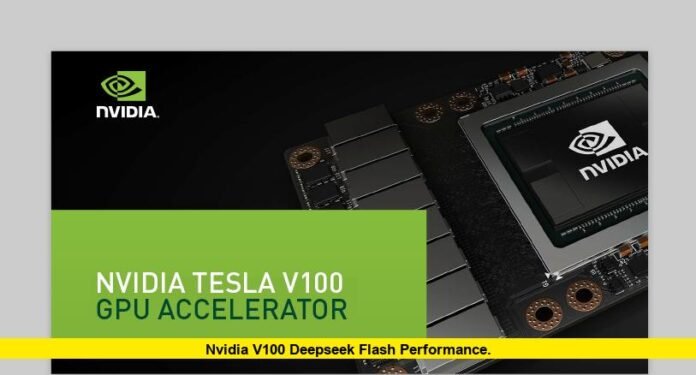

The NVIDIA V100 DeepSeek Flash performance story is attracting attention because researchers and developers are finding ways to run newer DeepSeek Flash models on NVIDIA’s older Tesla V100 data-center GPUs. Although the V100 was introduced years before today’s large mixture-of-experts AI models, recent community experiments demonstrate that carefully optimized software, quantization, multi-GPU configurations, and speculative decoding can make the hardware surprisingly capable.
The results are particularly interesting for AI developers, researchers, small infrastructure teams, and operators who already own V100 servers or can access used enterprise GPU hardware. Instead of automatically replacing older accelerators, some experimental deployments are exploring how much performance can be recovered through specialized inference engines and optimized model configurations.
However, the results require careful interpretation. A V100 running a heavily quantized DeepSeek Flash model with specialized software is not equivalent to a V100 running an officially supported, standard deployment. Performance also varies dramatically depending on the number of GPUs, model quantization, prompt length, memory configuration, attention implementation, and whether speculative decoding is enabled.
What Is NVIDIA V100 DeepSeek Flash Performance?
The keyword NVIDIA V100 DeepSeek Flash performance refers to how quickly DeepSeek Flash-family AI models can process prompts and generate responses when deployed on NVIDIA Tesla V100 GPUs.
Two performance measurements are especially important:
- Prompt processing or prefill: How quickly the GPU processes the input prompt before generating a response.
- Token generation or decode: How quickly the model produces new output, generally measured in tokens per second.
A GPU can perform well at processing a large prompt but generate responses more slowly. Conversely, a system optimized for decoding may produce tokens quickly while taking longer to process a lengthy input.
For AI users, token-generation speed is often the more noticeable metric because it determines how quickly a chatbot, coding assistant, or AI agent responds after processing the user’s request.
Why the Tesla V100 Is Still Being Tested for AI Inference
The Tesla V100 is based on NVIDIA’s Volta architecture and remains an interesting platform for developers who have access to older data-center hardware.
The accelerator includes:
- NVIDIA Volta architecture
- 5,120 CUDA cores
- 640 Tensor Cores
- Up to 32GB of HBM2 memory
- Memory bandwidth of approximately 900 GB/s
- NVLink support on applicable configurations
- PCIe and SXM2 versions
The V100’s memory capacity and bandwidth are particularly important for AI inference. Large language models frequently require substantial GPU memory to hold model weights, intermediate calculations, and the key-value cache used during generation.
NVIDIA’s official specifications show that the V100 NVLink configuration offers up to 125 teraFLOPS of deep-learning performance, while the PCIe version is listed at up to 112 teraFLOPS, depending on the configuration.
The official specifications can be reviewed through the NVIDIA V100 data-center GPU page.
The V100 does have significant limitations compared with newer accelerators. It lacks native support for some newer low-precision AI formats and does not have the newer architectural capabilities found in modern GPUs. Consequently, running contemporary AI models requires software that is specifically adapted to older hardware.
Latest DeepSeek Flash Performance Results on V100 GPUs
Recent community experiments have demonstrated that DeepSeek Flash models can run on V100 systems using specialized inference configurations.
One of the most notable examples involves DeepSeek-V4.1-Flash, a large mixture-of-experts model tested on multiple V100 GPUs. These results are not official NVIDIA or DeepSeek benchmark results. They are experimental measurements reported by developers using particular hardware and software configurations.
The results illustrate how much performance can be achieved when older GPUs are combined with optimized model loading, quantization, custom inference software, and speculative decoding.
Reported performance from an eight-GPU V100 configuration
One experimental deployment using eight NVIDIA V100 32GB GPUs reported results including:
- Approximately 2,200 tokens per second for prompt processing under a reported benchmark configuration.
- Approximately 131 tokens per second for generation in a separate optimized deployment.
- Long-context support under specially configured inference systems.
- Performance improvements using speculative decoding and low-bit model representations.
These numbers should not be treated as universal V100 performance figures. They represent particular experimental systems, and the exact results depend on the benchmark workload and implementation.
A recent community benchmark collection also reports DeepSeek V4.1 Flash testing across V100 configurations. Its reported results include multi-GPU inference with low-bit expert quantization and speculative decoding.
The important takeaway is that the V100’s age does not automatically make it unusable for modern AI inference, although achieving these results requires substantial engineering.
DeepSeek Flash Benchmark Comparison: What the Numbers Actually Mean
The following table summarizes reported performance from experimental V100 deployments. Because these tests use different model configurations, software stacks, quantization formats, and benchmark workloads, the figures should not be interpreted as a direct apples-to-apples comparison.
| Configuration | Reported performance | What it means |
|---|---|---|
| 8× V100, optimized DeepSeek Flash deployment | Around 131 tokens/s | Reported generation performance under a specialized configuration |
| 8× V100, long-context setup | Around 2,200 tokens/s prompt processing | Prompt-reading throughput under a specific benchmark |
| V100 experimental systems | More than 100 tokens/s in some configurations | Performance can improve through optimized inference and decoding |
| Multi-GPU systems | Higher aggregate throughput | Multiple GPUs can increase capacity and distribute model computation |
| Speculative decoding configurations | Potentially higher output rates | Draft tokens can reduce the number of expensive model-generation steps |
Readers can explore community benchmark results at llamaperf’s NVIDIA V100 performance page.
The numbers are useful for understanding the direction of current experiments, but anyone considering a deployment should look at the exact model, quantization, GPU count, software version, context length, and benchmark methodology.
How DeepSeek Flash Runs on Older V100 Hardware
Running a modern AI model on a V100 is not simply a matter of downloading the model and launching it. The model architecture, software kernels, memory requirements, and hardware compatibility must all be considered.
Several techniques are helping developers experiment with DeepSeek Flash on Volta GPUs.
Model Quantization
Quantization reduces the precision used to represent model weights. Instead of storing every parameter using a higher-precision format, a model can use lower-bit representations to reduce memory requirements.
For large mixture-of-experts models, quantization can make the difference between a model that cannot fit in available GPU memory and one that can be distributed across a multi-GPU system.
However, quantization involves trade-offs. More aggressive compression may reduce memory requirements and improve practical deployment options, but it can also affect model accuracy, response quality, and performance.
Multi-GPU Model Distribution
A single V100 may not have enough memory to hold a large DeepSeek Flash model in a usable configuration.
Multi-GPU systems can distribute model components across multiple accelerators. Depending on the inference engine, the deployment may use layer splitting, tensor parallelism, pipeline parallelism, or other approaches.
The benefit is that multiple GPUs can provide:
- More combined GPU memory
- Additional computational capacity
- Greater ability to load larger models
- Improved throughput under certain workloads
The drawback is that multi-GPU deployments introduce communication overhead. GPU interconnects, topology, synchronization, and memory distribution all affect the final performance.
A system with eight V100 GPUs does not necessarily produce eight times the speed of one GPU.
Speculative Decoding
Speculative decoding is another important optimization being tested in newer DeepSeek Flash deployments.
Rather than relying entirely on the main model to generate one token at a time, a smaller draft model or draft mechanism proposes several tokens. The larger model then checks those proposals.
When draft tokens are accepted, the system may generate multiple tokens more efficiently than conventional sequential decoding.
The technique can significantly improve throughput in suitable workloads, but its benefits depend on how frequently the draft tokens are accepted, the additional computational overhead, and the characteristics of the model and prompts.
4. Specialized Inference Software
The software stack can be just as important as the GPU itself.
Modern inference engines frequently target newer GPU architectures and may not support Volta GPUs through their standard installation paths. Developers testing DeepSeek Flash on V100 systems therefore sometimes rely on customized implementations, specialized kernels, compatible forks, or carefully selected software versions.
This is an important consideration for anyone attempting to reproduce reported benchmarks.
A configuration that works on a researcher’s system may require a specific CUDA version, compiler, inference-engine build, kernel implementation, or model conversion process.
DeepSeek Flash on V100: Why Flash Attention Settings Matter
Attention optimization is one of the areas where developers must be particularly careful.
Flash Attention is designed to improve attention computation by reducing memory movement and improving efficiency. However, the performance benefits are not guaranteed for every model architecture, GPU, or implementation.
Recent V100 experiments involving DeepSeek-Coder-V2-Lite have reported a surprising result: enabling Flash Attention in a particular configuration caused a substantial performance regression.
In one reported test on a Tesla V100 PCIe 32GB GPU, generation performance was approximately:
- 164.6 tokens per second with Flash Attention disabled
- 33.6 tokens per second with Flash Attention enabled
The result was specific to the tested model, implementation, and benchmark configuration. It should not be generalized to every DeepSeek model or every Flash Attention implementation.
This finding reinforces an important practical lesson: AI inference settings should be benchmarked individually rather than copied blindly from generic optimization guides.
The same setting may improve performance for one model while slowing down another.
A detailed experimental report discussing this behavior is available in the DeepSeek MLA performance investigation.
Can an NVIDIA V100 Run DeepSeek Flash Efficiently?
The answer depends on what the user means by efficiently.
For experimentation, development, testing, research, and specialized workloads, V100 systems may still provide useful capabilities. The hardware can be especially attractive when it is already available and the cost of purchasing newer GPUs is not justified.
For a production AI service, however, efficiency must be evaluated across several factors.
Performance per user: How quickly does each individual request receive an answer?
Aggregate throughput: How many tokens can the system generate across all active requests?
Latency: How long does a user wait before receiving the first token and subsequent output?
Memory capacity: Can the model, cache, and supporting components fit within the available GPUs?
Power consumption: How much electricity does the system consume while processing AI requests?
Operational complexity: How much time is required to maintain the specialized software and hardware configuration?
A multi-GPU V100 system may offer impressive aggregate throughput for many concurrent requests while delivering a different experience for a single user. This distinction matters when comparing benchmarks.
A high total throughput number does not automatically mean that one chatbot session will generate responses at the same speed.
Single-User Speed Versus Multi-User Throughput
One of the most important details in V100 DeepSeek Flash benchmarks is the difference between single-session performance and aggregate performance.
A benchmark reporting thousands of tokens per second may be measuring multiple concurrent sessions rather than one user receiving thousands of tokens every second.
For example, an inference system may distribute processing across dozens or hundreds of concurrent requests. Each individual user receives a smaller portion of the overall system throughput, but the server can efficiently handle a larger workload.
This makes multi-user benchmarks particularly useful for evaluating:
- AI API servers
- Internal enterprise assistants
- Automated document-processing systems
- Coding-agent infrastructure
- Research workloads
- Batch inference
- AI applications with multiple simultaneous users
For individual users running a local chatbot, single-session generation speed is generally the more relevant number.
How Much GPU Memory Does a V100 DeepSeek Flash System Need?
GPU memory is one of the biggest constraints when deploying large language models.
The Tesla V100 is available in configurations with 16GB or 32GB of HBM2 memory. A 32GB model is generally more practical for local AI inference, particularly when working with larger models or longer contexts.
Even when model weights fit across multiple GPUs, additional memory is required for:
- KV cache
- Runtime allocations
- Intermediate tensors
- Attention buffers
- Model-specific memory requirements
- Concurrent requests
Long-context inference can increase memory requirements significantly. A deployment that successfully loads a model with a short prompt may encounter memory limitations when processing longer conversations or multiple requests simultaneously.
This is why benchmark reports should always identify the context length and memory configuration.
Why Eight V100 GPUs Can Be More Useful Than One
An eight-GPU V100 system can provide a substantially different experience from a single-card configuration.
The combined memory capacity of eight 32GB cards is theoretically 256GB of GPU memory, although the memory is distributed across individual GPUs rather than functioning as one automatically unified pool.
A multi-GPU configuration can make it possible to load larger models, distribute computation, and use specialized inference strategies that would not be practical on a single accelerator.
However, the system needs a suitable GPU topology and software implementation to use that hardware effectively.
NVLink-connected configurations can provide different communication characteristics from PCIe-only systems. The distinction becomes particularly important when model components are distributed across multiple GPUs.
For researchers and infrastructure operators, the exact server configuration can therefore be just as important as the number of V100 GPUs.
DeepSeek-V4.1-Flash and the V100: A New Experimental Frontier
One of the most interesting developments in the current V100 research landscape is the attempt to run much newer DeepSeek Flash models on hardware that originally targeted earlier generations of AI workloads.
A recent technical report describes experimental work with DeepSeek-V4.1-Flash on Tesla V100 GPUs, including optimizations for model distribution, low-bit representations, speculative decoding, and long-context inference.
The report highlights that older GPUs can sometimes remain useful when the deployment is redesigned around their limitations instead of assuming that modern inference software will work without modifications.
The research is particularly relevant to organizations that have older GPU servers sitting idle or facing replacement decisions.
The V100 DeepSeek Flash research report discusses the experimental system, measured performance, optimizations, and trade-offs involved in running newer AI models on Volta hardware.
It is important to remember that these are specialized community and research efforts. They do not mean that every DeepSeek Flash model is officially supported on the V100, nor do they guarantee that the same performance can be reproduced on another server.
Is the V100 a Good Choice for AI Developers in 2026?
The V100 may still make sense for certain AI developers, particularly those who already have access to the hardware.
Who may benefit from V100-based DeepSeek Flash experiments?
AI researchers: Older GPUs can provide a relatively inexpensive platform for investigating model inference, quantization, architecture behavior, and optimization techniques.
Developers with existing GPU servers: Organizations may be able to extend the useful life of their existing hardware instead of immediately purchasing new accelerators.
AI infrastructure teams: Multi-GPU V100 systems can be useful for experimenting with throughput-oriented workloads and specialized serving configurations.
Open-source developers: The V100 offers an opportunity to test how software can be adapted to older GPU architectures.
Budget-conscious AI operators: Used enterprise hardware may provide an attractive entry point for certain workloads, although electricity, cooling, maintenance, and software engineering costs should be included in the total cost of ownership.
Who should consider newer GPUs instead?
Developers building a production AI service from scratch should compare V100 systems with newer GPU platforms.
Newer accelerators generally offer better support for modern low-precision formats, newer inference software, higher efficiency, and more straightforward deployment paths.
A V100 system may be attractive because of its acquisition price, but its total operational cost can be higher if it requires extensive software customization, consumes more electricity, or delivers lower performance per watt.
What Developers Should Check Before Running DeepSeek Flash on V100
Anyone considering a V100 deployment should verify the following before committing to a production configuration.
- GPU model: Confirm whether the cards are 16GB or 32GB V100s.
- GPU topology: Determine whether the system uses PCIe or NVLink-connected GPUs.
- Model compatibility: Confirm that the chosen DeepSeek Flash model can run with the selected inference engine.
- Quantization: Check the exact quantization format and whether it is supported by the implementation.
- Software compatibility: Verify CUDA, compiler, driver, and inference-engine requirements.
- Attention implementation: Test different settings instead of assuming a particular option improves performance.
- Context length: Benchmark short and long prompts separately.
- Concurrency: Test both individual requests and multiple simultaneous sessions.
- Output quality: Verify that quantization and optimization do not introduce unacceptable quality degradation.
- Power and cooling: Measure system power consumption under realistic workloads.
These checks are particularly important because specialized V100 research deployments can differ significantly from ordinary installation instructions for mainstream AI software.
What the Latest V100 DeepSeek Flash Developments Mean
The latest experiments suggest that older GPU hardware may have a longer useful life in AI infrastructure than some operators expected. The Tesla V100 is not a modern accelerator, and it cannot compete directly with current-generation GPUs across every AI workload. Nevertheless, research deployments show that specialized software can unlock capabilities that are not obvious from the hardware’s age alone.
For developers, the most important development is not a single benchmark number. It is the growing number of approaches being explored to make modern model architectures work on older hardware.
Quantization, speculative decoding, custom inference engines, model distribution, attention optimization, and GPU communication strategies are all contributing to these experiments.
The results also show why AI performance claims need context. A benchmark of eight V100 GPUs using a specialized quantized model cannot be directly compared with a single V100 running an unoptimized model. The model size, precision, context length, number of concurrent users, and software implementation all influence the result.
For anyone considering V100 hardware, the best approach is to treat published performance numbers as starting points and reproduce the benchmark using the exact workload they intend to deploy.
Frequently Asked Questions
What is NVIDIA V100 DeepSeek Flash performance?
NVIDIA V100 DeepSeek Flash performance refers to the speed at which DeepSeek Flash models process prompts and generate output on Tesla V100 GPUs. Experimental multi-GPU deployments have reported generation speeds above 100 tokens per second in certain optimized configurations, although performance varies considerably depending on the model, quantization, GPU count, software, and workload.
Can DeepSeek Flash run on a Tesla V100?
Yes, experimental implementations have demonstrated DeepSeek Flash-family models running on Tesla V100 systems. However, compatibility is not universal, and some deployments require specialized software, quantization, custom kernels, or modified inference engines.
How many V100 GPUs are needed for DeepSeek Flash?
The number of GPUs depends on the specific DeepSeek Flash model, its quantization format, memory requirements, context length, and inference configuration. Larger models may require multiple V100 GPUs to distribute model weights and computation. Some recent experimental deployments have used eight-GPU configurations.
Is the V100 fast enough for AI inference in 2026?
The V100 can still be useful for selected AI inference workloads, especially when developers already have access to the hardware. It may be suitable for experimentation, research, batch processing, and specialized deployments. However, newer GPUs generally offer better performance, efficiency, compatibility, and support for modern AI software.
Does Flash Attention always improve DeepSeek performance on V100?
No. Flash Attention performance depends on the model architecture and implementation. Some experimental tests have reported substantial slowdowns when Flash Attention was enabled for particular DeepSeek model configurations on the V100. Developers should benchmark the available options using their actual model and workload.
Can eight V100 GPUs provide 256GB of memory?
Eight 32GB V100 GPUs contain a combined 256GB of physical GPU memory. However, this memory is distributed across the individual GPUs. It does not automatically behave as a single unified 256GB memory pool, and software must distribute model components and computation appropriately.
Is buying used V100 GPUs worthwhile for DeepSeek Flash?
Used V100 hardware may be worthwhile for developers who prioritize lower acquisition costs and have the technical expertise to manage older hardware and specialized software. Buyers should also consider electricity, cooling, server maintenance, GPU memory capacity, compatibility, and performance requirements before making a purchasing decision.
Disclaimer
Performance figures discussed in this article are based on reported experimental and community benchmarks, not guaranteed results or official NVIDIA or DeepSeek performance claims. Benchmark results may vary depending on hardware configuration, GPU count, software versions, model quantization, workload, context length, and inference settings. Readers should independently verify compatibility and performance before deploying or purchasing hardware for production use.
The NVIDIA V100’s story is not over yet—share your thoughts on whether older GPUs still have a place in the AI era, and stay tuned for the latest developments in DeepSeek Flash performance.