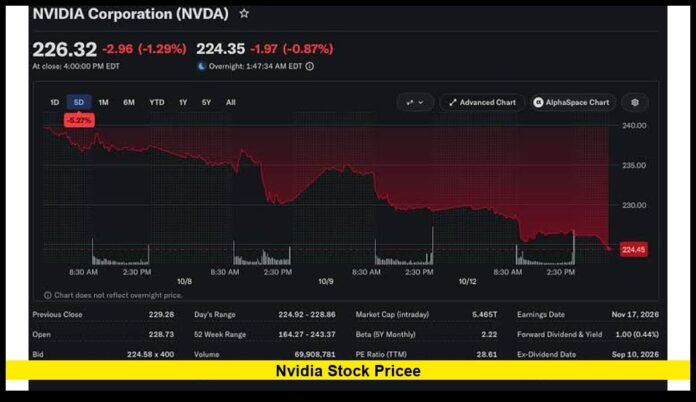

The Nvidia stock price closed at $213.66 on October 29, 2026, falling $1.72, or 0.80%, during the session. Investors are assessing the chipmaker’s strong artificial intelligence business, its next earnings report, and growing competition as they evaluate the stock’s direction heading into November. StockAnalysis.com+1
Nvidia remains a major player in AI computing, with its graphics processing units powering data centers, advanced AI models, and cloud infrastructure. However, the market’s attention now extends beyond sales growth to valuation, future demand, supply capacity, and the company’s ability to meet high investor expectations.
The next major event is Nvidia’s scheduled third-quarter fiscal 2027 earnings announcement on November 17. Until the company releases those results, its most recently reported quarterly performance and management’s guidance provide the clearest picture of its financial position. NVIDIA Investor Relations+1
How NVDA Performed in the Latest Trading Session
Nvidia shares finished Thursday’s session below their previous close of $215.38. The stock traded between $212.08 and $215.33, reflecting continued movement as investors reassessed technology valuations and future growth expectations.
The latest close also placed the shares below their 52-week high of $243.37, reached earlier in October. That pullback illustrates how quickly market sentiment can change, even for companies reporting substantial revenue growth.
Key trading figures include:
- Latest closing price: $213.66
- Previous closing price: $215.38
- Daily decline: $1.72
- Daily percentage change: 0.80% lower
- Trading range: $212.08 to $215.33
- 52-week range: $164.27 to $243.37
These figures reflect the October 29 regular trading session. They are not a live quote for October 30, and the stock’s price may change during the next session.
Upcoming Earnings Could Influence Nvidia Shares
Nvidia’s next earnings announcement is scheduled for November 17, 2026. The report will cover the third quarter of fiscal 2027, which ended October 25.
Investors will examine revenue, profitability, customer demand, and management’s expectations for the coming quarter. The results could influence how the market values Nvidia’s growth prospects.
For the third quarter, management previously projected revenue of $108 billion, with a margin of approximately 2% above or below that figure. Nvidia also expected GAAP gross margin of 74%, plus or minus 50 basis points.
These numbers remain guidance rather than confirmed results. The earnings announcement will establish whether the company met its targets.
Investors will also look for evidence that demand for AI computing continues to support Nvidia’s business. Strong results could reinforce confidence, while weaker-than-expected performance or cautious guidance could place pressure on the shares.
AI Data Center Revenue Remains the Main Growth Driver
Nvidia’s financial performance increasingly depends on its data center operations. Cloud providers and AI developers need advanced processors to train models, operate applications, and handle growing computing workloads.
For the second quarter of fiscal 2027, Nvidia reported total revenue of $96.2 billion, an increase of 106% from the same period a year earlier.
Data Center revenue reached $89 billion, rising 117% year over year. The segment accounted for the vast majority of quarterly sales, highlighting its importance to Nvidia’s overall financial performance.
The company also reported GAAP net income of approximately $59.7 billion and diluted earnings per share of $2.46.
These results demonstrate the scale of Nvidia’s business and the profitability it has achieved amid demand for AI infrastructure.
However, investors must consider whether this growth can continue. Technology companies are spending heavily on computing infrastructure, but their future investment decisions will depend partly on the commercial returns generated by AI services.
Nvidia’s New Computing Platform Adds to Investor Interest
Product development remains another important consideration for the company’s long-term prospects.
Nvidia has announced that its Vera Rubin platform entered full production during the second quarter of fiscal 2027. The platform targets demanding AI workloads and represents another stage in the company’s computing roadmap.
New platforms can encourage customers to upgrade infrastructure as they seek greater computing performance and efficiency. Successful product transitions may also help Nvidia defend its position against competing chipmakers.
Still, production milestones do not automatically translate into immediate financial gains. Customer deployment schedules, component availability, manufacturing capacity, and actual purchasing decisions determine when new products contribute to revenue.
Investors will therefore watch for evidence that Nvidia can turn its product development efforts into sustained sales and profits.
Competition and Regulatory Risks Remain Important
Nvidia faces competition from established semiconductor companies and technology firms developing their own AI processors. Some major customers are also investing in custom chips to manage computing costs and reduce reliance on external suppliers.
Competition does not necessarily mean Nvidia will lose its leadership position. However, it could affect pricing, customer relationships, and the share of AI workloads handled by Nvidia products.
Regulatory scrutiny presents another consideration. U.S. authorities have been examining Nvidia’s business practices and its proposed acquisition of Hugging Face, an AI development platform.
The proposed transaction has attracted attention over possible competition concerns. Regulatory inquiries do not establish wrongdoing, and their eventual outcome remains uncertain.
Investors should distinguish between confirmed developments and potential consequences. Any material decision affecting the transaction could influence market sentiment, but it would not automatically determine Nvidia’s overall financial performance.
What Could Move the Stock in November?
The Nvidia stock price may respond to several developments as the next earnings announcement approaches.
Stronger-than-expected financial results could support investor confidence if revenue, earnings, and forward guidance exceed market expectations.
Slower AI spending could have the opposite effect. If customers delay infrastructure projects or reduce purchasing plans, Nvidia may face pressure to sustain its recent growth rate.
Profit margins will also matter. Investors will want to know whether Nvidia can maintain strong profitability while expanding production and introducing new products.
Broader market conditions can influence the stock independently of company-specific news. Changes in interest rates, investor appetite for technology shares, and expectations for economic growth can affect valuations across the semiconductor industry.
These factors make the November report particularly important. The market will assess not only what Nvidia has achieved but also whether its future outlook justifies current expectations.
What Investors Should Know About Nvidia’s Valuation
Nvidia’s large market capitalization reflects investors’ expectations for its future earnings and role in AI infrastructure. Yet a strong business does not automatically make its shares inexpensive.
The price-to-earnings ratio compares the share price with earnings per share. Investors can use this measure alongside projected earnings growth, profitability, and comparisons with other semiconductor companies.
Forward earnings estimates can help assess expected growth, but they can change as new information becomes available. Valuation measures should therefore be reviewed alongside actual financial results rather than treated as fixed indicators.
Investors should also consider their risk tolerance, investment horizon, and exposure to technology stocks before making decisions. Short-term trading movements do not necessarily reflect long-term business performance.
Nvidia Stock Outlook: What Comes Next?
Nvidia enters November with strong reported revenue growth and a substantial AI data center business. Its next earnings announcement will provide a fresh assessment of demand, profitability, and management’s expectations.
The shares have retreated from their October high, but that movement alone does not establish whether the stock is undervalued or headed for further declines. Future performance will depend on financial results, customer spending, competitive pressures, and market expectations.
For investors, the most useful next step is to follow confirmed earnings figures and company guidance rather than rely on unsupported price predictions. Nvidia’s position in AI computing remains significant, but its valuation and business risks deserve equal attention.
Share your view on NVDA’s performance in the comments, and check back for the latest verified developments as Nvidia approaches its next earnings report.