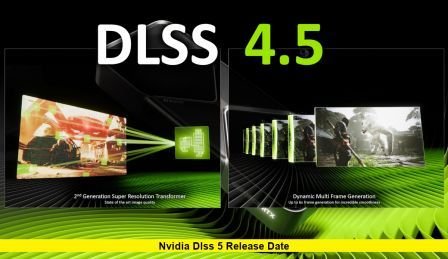

The gaming world woke up to a massive announcement on March 16, 2026. NVIDIA officially unveiled DLSS 5 at its GTC 2026 event, and the nvidia dlss 5 release date has been locked in for Fall 2026. This is not a minor version update — it is being called the most important leap in computer graphics since real-time ray tracing arrived back in 2018.
For PC gamers who have been watching the evolution of NVIDIA’s Deep Learning Super Sampling technology over the years, this announcement signals something far more significant than another performance boost.
👉 Save this page and check back — we’ll update the moment NVIDIA announces an exact launch day.
What Makes DLSS 5 Different From Everything That Came Before
Every previous version of DLSS focused heavily on performance. Whether it was upscaling lower-resolution images or generating frames to smooth gameplay, the core goal was always about speed. DLSS 5 changes that mission completely.
Instead of making games run faster, DLSS 5 is designed to make games look dramatically more real. The technology uses a real-time neural rendering model that takes each frame’s color data and motion vectors, then applies an AI model to layer in photoreal lighting and materials. The result is visuals that have historically only been achievable in Hollywood visual effects pipelines — not in games running live on your GPU.
In short, DLSS 5 is not a performance tool. It is a visual fidelity revolution.
The Science Behind the Technology
At the heart of DLSS 5 is a neural rendering model trained to understand what it is actually seeing in a scene. The AI recognizes complex elements like human skin, hair strands, fabric textures, and different environmental lighting conditions — whether a character is front-lit, standing in backlit shadow, or moving through overcast daylight.
Using that understanding, the system generates physically accurate lighting interactions, subsurface scattering on skin, realistic fabric sheen, and material-specific light responses — all in real time at up to 4K resolution. The output stays anchored to the original 3D scene created by the game developer, meaning it does not randomly generate new content. Every frame remains deterministic and consistent, which is a non-negotiable requirement for real-time games.
This is a major technical leap. Previous AI video generation systems could create stunningly photorealistic images, but they were slow, unpredictable, and impossible to control frame by frame. DLSS 5 solves all three of those problems simultaneously.
Jensen Huang’s Bold Vision for the Future of Graphics
NVIDIA CEO Jensen Huang described the significance of this announcement in direct terms. Speaking at GTC 2026, he said DLSS 5 represents NVIDIA reinventing computer graphics for the first time in 25 years — since the company introduced the programmable shader. He called it the “GPT moment for graphics,” drawing a comparison to the way that large language models transformed how people interact with artificial intelligence.
The analogy is deliberate. Just as generative AI changed text and image creation forever, Huang believes DLSS 5 will do the same for real-time rendering. Instead of writing rules to approximate how light behaves, NVIDIA has trained a system to genuinely understand it.
Which Games Will Support DLSS 5 at Launch
NVIDIA has already lined up an impressive roster of titles for day-one support. Games currently announced include Starfield, Assassin’s Creed Shadows, Resident Evil Requiem, Hogwarts Legacy, The Elder Scrolls IV: Oblivion Remastered, Delta Force, Phantom Blade Zero, AION 2, NARAKA: BLADEPOINT, and several more from major global publishers.
Bethesda Studio Head Todd Howard gave a particularly enthusiastic endorsement of the technology. He noted that his team got DLSS 5 running inside Starfield and found that it brought the game to life in a way that genuinely surprised the entire studio. That kind of reaction from a developer of Bethesda’s stature carries real weight.
Major publishers supporting DLSS 5 at launch include Bethesda, CAPCOM, Ubisoft, Tencent, Warner Bros. Games, NetEase, and others. With that kind of backing, the rollout across the gaming ecosystem should happen quickly.
What It Actually Looks Like in Real Games
Early demonstrations ran inside titles including Resident Evil Requiem, Oblivion Remastered, and Assassin’s Creed Shadows. The results showed dramatic improvements in ambient occlusion and subtle shadowing, making objects feel physically grounded in scenes in a way that standard renderers and even ray tracing struggle to achieve.
Material handling was one of the most striking improvements in hands-on previews. Metals, cloth, and even organic surfaces like fruit skin showed remarkably realistic light response. Foliage — notoriously one of the hardest elements for real-time renderers to handle convincingly — also showed major gains in how light and shadow interact with leaves and branches.
Character rendering showed the clearest before-and-after difference. The early Resident Evil Requiem demo featured Grace Ashcroft’s face and surrounding street environment transformed with far more realistic dynamic lighting and skin detail than the base render could produce.
Developer Tools and Integration
NVIDIA has built DLSS 5 to integrate cleanly with the existing Streamline framework already used by studios for DLSS and Reflex. Developers do not need to start from scratch. Integration follows a familiar workflow, which should make adoption faster across the industry.
Artists and developers get control over intensity, color grading, and masking — meaning they can dial up or dial back the effect in specific areas to match each game’s visual style. NVIDIA has been emphatic that creative control stays in the hands of the people making the games, not the AI.
Current Technical Limitations and What to Expect
NVIDIA used two RTX 5090 graphics cards for its GTC demonstrations — one to run the game itself, and a second dedicated entirely to running the DLSS 5 neural rendering model. That two-GPU setup was required because the technology is still being optimized for performance and VRAM efficiency.
However, NVIDIA has clarified that DLSS 5 is designed to ship as a single-GPU solution. The dual-GPU demo was a development snapshot, not the final product. The company describes what was shown at GTC as a work-in-progress, with further improvements planned before the Fall 2026 launch window.
NVIDIA has not yet announced which GPU architectures will officially support DLSS 5 beyond the RTX 50-series. That detail is expected to be addressed closer to launch.
Not Everyone Is Convinced Yet
Despite the impressive technical demonstration, community reaction has been mixed. A portion of the gaming community has raised concerns that DLSS 5’s visual alterations look more like an AI filter than a genuine rendering upgrade. Some observers noted that characters appeared to reflect idealized AI beauty standards rather than the developer’s original artistic intent.
NVIDIA has responded to this criticism by pointing to the masking and intensity controls built into the developer toolkit. The company maintains that studios have full authority over where and how strongly the technology is applied. Whether that level of control is enough to satisfy skeptics will likely become clearer once real shipping titles hit the market.
DLSS 5 has spent three years in development at NVIDIA. The gap between what was shown at GTC and the final release version could be significant, and the company has left room for continued optimization between now and Fall 2026.
Why This Matters for American PC Gamers
DLSS has already been integrated into more than 750 games, making it one of the most widely adopted graphics technologies in the history of PC gaming. That existing footprint means DLSS 5 has a ready-made distribution network that could spread the technology across the ecosystem at remarkable speed.
For U.S. gamers, the Fall 2026 release window points to a likely launch between September and November of this year. That timing puts it squarely in the holiday gaming season — alongside what could be a wave of major new titles, new hardware releases, and renewed interest from both consumers and developers in what next-generation PC graphics can actually look like.
The gap between game visuals and cinematic visual effects has existed for decades. DLSS 5 is NVIDIA’s most serious attempt yet to close it.
What do you think — is DLSS 5 a genuine graphics revolution or a fancy AI filter? Drop your take in the comments below and let us know if you’re planning to upgrade your setup for Fall 2026.