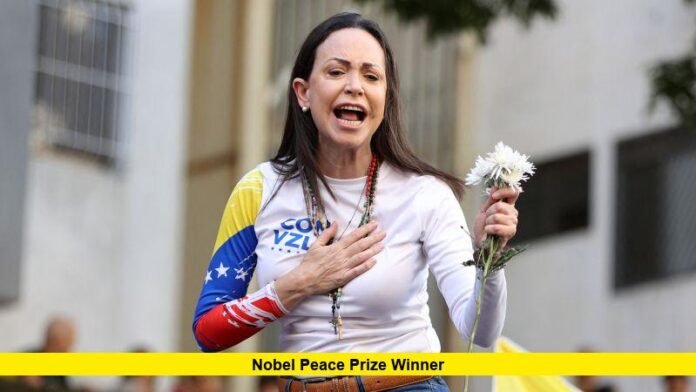

In an era marked by democratic backsliding and political repression, the rise of nobel peace prize winner Maria Corina Machado has become one of the most compelling political stories in the Western Hemisphere. Her journey from civic activist to internationally recognized democratic leader reflects years of nonviolent resistance, personal sacrifice, and unwavering commitment to political freedom in Venezuela.
Machado’s recognition has done more than honor one individual. It has drawn renewed global attention to Venezuela’s prolonged crisis while elevating the broader struggle for democratic accountability, human rights, and peaceful political change.
A Leader Shaped by Conviction, Not Convenience
Maria Corina Machado’s political identity was never built on compromise or gradual accommodation. From the beginning, her approach has been direct, principled, and openly confrontational toward authoritarian governance. Long before international recognition followed, she was already known inside Venezuela for challenging entrenched power structures at a time when doing so carried severe consequences.
Her early public work centered on civic engagement and electoral integrity. Rather than aligning herself with political elites, she focused on building citizen-led movements that emphasized transparency and participation. This foundation shaped her later leadership style: firm in values, resistant to pressure, and rooted in grassroots legitimacy.
Confrontation With Power and Political Exclusion
As Machado’s influence grew, so did resistance from those in power. Her outspoken criticism of state control, corruption, and institutional erosion placed her in direct conflict with the ruling establishment. Over time, that conflict resulted in political sanctions, legal challenges, and formal exclusion from holding office.
Despite these barriers, her political relevance did not diminish. In fact, her removal from official platforms reinforced her credibility among supporters who viewed her exclusion as proof of systemic repression rather than personal failure.
Machado’s leadership continued outside formal institutions, proving that political power does not always depend on titles or positions. Her voice remained influential because it resonated with lived experiences shared by millions of Venezuelans.
A Movement Built on Civic Courage
What distinguishes Machado’s leadership is her emphasis on peaceful resistance. In a region with a history of violent political transitions, her insistence on nonviolence has shaped both her domestic and international image.
She has repeatedly framed democratic change as a civic responsibility rather than a partisan contest. Her messaging avoids inflammatory rhetoric, instead focusing on constitutional principles, voter rights, and national dignity. This approach helped unify diverse segments of society, including those previously disengaged from politics.
Her ability to mobilize support without resorting to force or fear played a major role in her global recognition and later contributed to her receiving the Nobel Peace Prize.
Life Under Pressure and Persistent Risk
International recognition did not reduce the dangers Machado faces. On the contrary, it intensified scrutiny from authorities who view visibility as a threat. Her daily reality involves constant security considerations, restricted movement, and limited public appearances.
Yet she has refused to retreat from public life. Through carefully managed communication and trusted networks, she remains active in shaping political strategy and sustaining morale among supporters. Her continued presence, even under threat, reinforces the message that leadership requires endurance as much as vision.
This personal risk has become inseparable from her public identity. Machado is not merely advocating democracy; she is living the consequences of doing so.
The Meaning Behind the Nobel Recognition
The Nobel Peace Prize acknowledged years of peaceful resistance rather than a single political event. It recognized courage exercised over time, often without international attention or guarantees of success.
The award elevated Machado’s cause without transforming it into a personal triumph. She has consistently framed the recognition as belonging to the Venezuelan people rather than to herself. That framing has helped preserve the movement’s collective identity and prevent the personalization of democratic struggle.
For global audiences, the award reaffirmed that peace includes political freedom, accountability, and citizen participation — not just the absence of armed conflict.
How the Prize Shifted the Global Conversation
Machado’s recognition shifted how Venezuela’s situation is discussed internationally. Instead of focusing solely on economic collapse or migration, global discourse increasingly centers on democratic legitimacy and civic resistance.
For U.S. audiences, her story resonates as an example of democratic values tested under extreme conditions. It highlights the contrast between institutional stability and political vulnerability, reminding readers that democracy depends on constant protection.
Her recognition also underscored the role of individual leadership in sustaining democratic ideals when institutions fail.
Influence Beyond Borders
While Machado’s work remains focused on Venezuela, her influence extends across Latin America and beyond. Activists in other countries facing political pressure have cited her leadership as proof that peaceful resistance can maintain momentum even under repression.
Her example challenges the assumption that authoritarian systems inevitably suppress dissent. Instead, it shows that legitimacy can outlast force, especially when grounded in civic participation and moral clarity.
This broader relevance strengthens her standing as a global democratic figure rather than a solely national leader.
A Symbol of Democratic Persistence
Over time, Machado has become more than a political actor. She represents persistence in the face of systemic exclusion. Her leadership demonstrates that political relevance can survive bans, threats, and isolation.
The image of a leader continuing her work without formal power has resonated deeply with supporters who see their own resilience reflected in her actions. That symbolic role has proven as influential as any campaign or policy platform.
In this context, the Nobel Peace Prize served not as an endpoint but as reinforcement of a path already chosen.
Challenges That Remain
Despite international attention, the challenges facing Machado and Venezuela remain substantial. Political repression persists, civic space remains constrained, and institutional reform faces strong resistance.
Machado has acknowledged these realities openly, avoiding unrealistic promises or dramatic predictions. Her messaging emphasizes long-term commitment rather than immediate victory, reinforcing trust among supporters.
This realism, paired with determination, has helped sustain engagement even during periods of uncertainty.
Why Her Story Matters Now
At a time when democratic norms face pressure worldwide, Machado’s journey offers a reminder that democracy depends on people willing to defend it under unfavorable conditions. Her leadership illustrates that democratic values are not self-sustaining; they require courage, participation, and sacrifice.
Her recognition also challenges the idea that meaningful political impact must occur within established systems. Machado’s influence grew precisely because she continued her work after being excluded from those systems.
This lesson resonates far beyond Venezuela.
A Future Still Unfolding
Maria Corina Machado’s story remains unfinished. Her role continues to evolve as political conditions change and new challenges emerge. What remains constant is her commitment to democratic principles and peaceful civic action.
As a Nobel Peace Prize winner, she carries global recognition. As a Venezuelan leader, she carries responsibility to a population still seeking political dignity and freedom.
Her legacy will ultimately be defined not only by awards, but by the lasting impact of her leadership on democratic culture.
The Enduring Power of Civic Leadership
The journey of Maria Corina Machado underscores a fundamental truth: democracy survives through people who refuse to abandon it, even when institutions fail. Her leadership demonstrates how civic courage can reshape political narratives and inspire collective action.
Whether viewed from Caracas or Washington, her story stands as a testament to the enduring power of peaceful resistance and moral clarity in political life.
How her leadership continues to shape the future of democracy remains a story worth following closely.