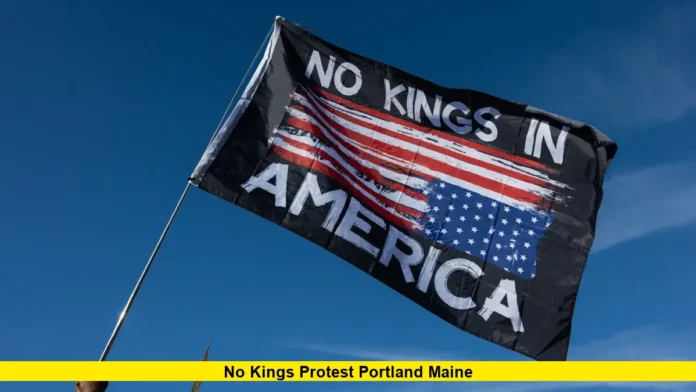

On October 18, 2025, the words no kings protest Portland Maine meant something real and visible. Nearly 6,000 people packed into Deering Oaks Park in Portland, Maine, to stand up, speak out, and send a clear message to Washington: America does not have a king, and it never will. What unfolded that Saturday was one of the most powerful days of civic demonstration this state has ever seen — and it was part of something far bigger than any one city.
This was the second national wave of No Kings demonstrations since President Donald Trump returned to the White House. The first round took place in June 2025. The second round, held exactly 250 years after British forces attacked what is now Portland, Maine, during the Revolutionary War, felt deliberate in its symbolism. The same ground where colonists once resisted monarchy became the gathering place for thousands of Americans refusing to accept what they see as unchecked executive power.
If this story matters to you, bookmark this page and share it with someone who needs to read it.
Portland Turned Out in Force
By 1:30 in the afternoon, Deering Oaks Park was filled from edge to edge. Homemade signs stretched in every direction. People wore costumes. A live band performed. Speakers took the stage one after another, drawing sustained applause and chants from the crowd. Organizers estimated attendance between 5,000 and 7,000 people, making it the largest rally Portland had seen to date by a wide margin.
Lead organizer Marie Follayttar described the energy in the crowd as something she had rarely witnessed. She spoke of gratitude, inspiration, and a deep hunger for community at a time when many people said they felt isolated and afraid. She also made it clear this was not a one-time event. “We’re not done,” she said. “We have to continue to organize. We can become beautifully unstoppable in protecting our country.”
Those who attended echoed that sense of purpose. One woman who had lost her federal job under the current administration said that despite her hardship, she left the rally feeling connected and joyful. Others described showing up as a civic obligation — not just for themselves, but for neighbors who could not safely march alongside them.
The Historic Timing Was No Accident
The date of October 18 carried deliberate weight. Two and a half centuries earlier, British warships bombarded and burned what would become Portland, Maine — a colonial community that had refused to submit to the authority of a crown. Organizers chose the anniversary of that attack intentionally, drawing a direct line between the American resistance to monarchy in 1775 and the resistance to concentrated executive power in 2025.
The name of the movement itself reflects that same lineage. No Kings is not a slogan invented for social media. It is a founding principle — the idea that in America, power belongs to the people, not to any single individual who holds office. That argument resonated deeply in Portland, where speakers tied the language of the Constitution directly to present-day concerns about immigration enforcement, federal court defiance, and cuts to public services.
Forty Communities Across Maine Joined In
Portland was the largest gathering in the state, but it was far from the only one. At least 40 demonstrations took place across Maine on October 18, in communities ranging from major cities to small coastal towns. Organizers had initially planned for around 30 events. The final number exceeded expectations.
In Augusta, hundreds of protesters filled both sides of the Memorial Bridge, chanting “This is what democracy looks like” as traffic passed below. In Auburn, an estimated 2,500 people turned out. In Bangor, thousands gathered at Broadway Park, many of them in elaborate costumes. In Belfast, more than 500 people packed Steamboat Landing Park near the waterfront. One attendee arrived dressed as a lobster holding a sign that read “Toss him back.” Another carried an eight-foot papier-mâché figure of Trump wearing a gold crown.
In Rockland, hundreds gathered in a small downtown park and lined Main Street at noon. Drivers passing by honked steadily in support. In Saco, roughly 300 people rallied, including Maine House Speaker Ryan Fecteau and state Representative Lori Gramlich, who described current federal immigration enforcement as “fear enforcement” and “state-sponsored trauma.”
Notable Speakers and Voices
The Portland rally drew an impressive roster of speakers. U.S. Representative Chellie Pingree addressed the crowd. Senate candidates including David Costello, Jordan Wood, and Tucker Favreau all spoke. Gubernatorial candidates Hannah Pingree, Troy Jackson, and Shenna Bellows also took the stage, making the event as much a gathering of political energy as a protest rally.
In Auburn, Maine Attorney General Aaron Frey spoke plainly and forcefully. He told the crowd that what is happening in the country is not normal and does not align with the principles laid out in the Constitution 250 years ago. He argued that the promise made to every citizen — that the government would work for the people — was being broken. Governor Janet Mills also appeared at the Auburn rally, lending the weight of her office to the gathering.
One of the more memorable moments came from a high school senior from Yarmouth named Katya Fromuth. She told the Portland crowd that just the day before, she had launched a youth organizing effort from her kitchen, naming it the Franklin Project after Benjamin Franklin’s famous response to a woman who asked whether the founders had created a republic or a monarchy. “A democracy,” Franklin said, “if you can keep it.” Her presence on stage underscored that this movement is drawing in young people who cannot yet vote but understand what is at stake.
Immigration Dominated the Conversation
Ask any attendee at the Portland rally what brought them out, and immigration enforcement came up immediately. Protesters described watching federal Immigration and Customs Enforcement conduct raids in their communities and expressed alarm at the presence of the National Guard near immigration facilities. Many said it did not feel like law enforcement. It felt like fear.
One protester said what the administration is doing to immigrants is deeply un-American. Another described watching federal enforcement actions unfold on the news each day and feeling disgust and dread. Organizers tied these concerns directly to what they described as a broader pattern of government targeting vulnerable people while cutting essential services that ordinary Americans depend on.
The event in Portland even included a separate rally later in the evening outside the local federal Immigration and Customs Enforcement facility, where protesters gathered to call for an end to what they see as politically motivated enforcement operations that have separated families and instilled fear in immigrant communities across Maine.
A Movement That Keeps Growing
The scale of what happened in Maine on October 18 only makes sense when viewed as part of a national surge. More than 2,600 rallies took place across the United States that day, from small towns in rural America to the National Mall in Washington, D.C. Organizers estimated total nationwide attendance between 5 million and nearly 7 million people, which would place the October No Kings demonstrations among the largest single-day protests in American history.
For comparison, the first wave of No Kings protests in June 2025 already set records. The October round surpassed it. In Portland alone, attendance nearly doubled from roughly 3,000 in June to nearly 6,000 in October. That trajectory tells its own story.
The protests were also overwhelmingly peaceful. Portland police reported no arrests and no incidents at any of the Maine events. Organizers had invested heavily in preparation, arranging ASL interpreters, safety training, de-escalation resources, and accessible spaces for attendees with disabilities. The result was a large, organized, and calm demonstration that stood in contrast to how critics attempted to characterize the movement.
What the “No Kings” Name Really Means
The name of the movement is direct and intentional. It does not reference any specific policy. It does not name any individual. It speaks to a foundational principle of American democracy — that no one person holds unlimited power, and that every citizen has the right to resist when they believe that principle is under threat.
Speakers across Maine returned to this theme repeatedly. Some quoted the Constitution. Some quoted founding documents. Some spoke about what they see as a dangerous erosion of checks and balances. Others focused on more personal stakes — healthcare, housing, job security, and the fear of being targeted by a federal government they no longer trust.
A couple from Augusta captured the spirit of the day simply and clearly. One of them said, “I wouldn’t be here if I hated America. We want it to be a place where we feel safe again. We’re here to protect our freedoms and our rights.”
That sentiment — love of country paired with alarm about its direction — ran through the entire day, from Portland’s packed park to Augusta’s crowded bridge to Belfast’s waterfront rally.
What Comes Next
No Kings has not stopped. In January 2026, organizers announced plans for a third major mobilization, scheduled for March 28, 2026. The movement continues to grow its infrastructure, expand its reach into smaller communities, and connect with elected officials who are willing to stand alongside it publicly.
Maine has shown up twice in large numbers. The people who attended these rallies came from every corner of the state. They brought their children, their signs, their fears, and their determination. They stood in parks and on bridges and along Main Streets in places where protesters rarely gather.
The message they delivered was the same in every location, spoken in every language and written on every sign: this country was built on the rejection of kings. That rejection is not historical. It is ongoing. And in Portland, Maine, on October 18, 2025, thousands of people made sure the whole country could hear it.
Drop your thoughts in the comments below — were you there, or are you watching this movement from afar? Stay close, because this story is far from over.