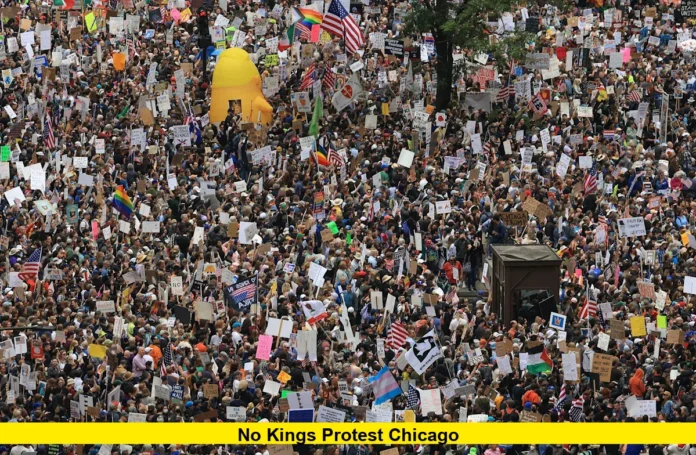

Chicago has become one of the most electric flashpoints in the nationwide No Kings protest movement. With a third massive demonstration planned for this Saturday, March 28, 2026, the city is once again preparing to take center stage in what organizers say could become the largest single-day protest in American history. From Grant Park to the suburbs and beyond, the movement that started with a declaration — No Kings — has grown into something far bigger than anyone predicted.
If you want to understand why millions of Americans are hitting the streets this Saturday, and exactly what is happening in Chicago, this is everything you need to know.
What Is the No Kings Movement and Where Did It Come From
The No Kings movement grew out of a mounting wave of opposition to what demonstrators describe as the Trump administration’s consolidation of power, aggressive immigration enforcement, and what they see as a systematic weakening of democratic institutions across the country.
The movement takes its name from a simple but pointed principle — that the United States was founded on the rejection of monarchy, and that unchecked executive power represents a betrayal of that founding ideal. Organizers have built the protests around that message, and it has resonated in a way few political movements in recent memory have managed.
The first No Kings rallies took place in June 2025, organized in nearly 2,000 locations nationwide. Those early protests were ignited largely by federal immigration raids and the deployment of the National Guard and Marines to Los Angeles, where tensions escalated sharply. Organizers at the time described a military parade held in Washington as a “coronation” — symbolic, in their view, of the administration’s growing authoritarian direction. That framing caught on.
By October 2025, the second No Kings protest had expanded dramatically, drawing an estimated 7 million participants across thousands of cities and towns. It became one of the largest single-day protests in American history. And this Saturday, organizers are expecting to surpass even that.
Chicago at the Heart of the Movement
Few cities have answered the No Kings call with more force than Chicago. The October 2025 demonstration drew an estimated 250,000 people into downtown, flooding Grant Park and Wacker Drive in a sea of hand-lettered signs, chants, and sheer civic energy.
Mayor Brandon Johnson addressed the crowd directly, drawing connections between the current political moment and deep historical currents in American life. Governor JB Pritzker stood beside him on the stage, telling the crowd that tyranny does not arrive all at once — but that the American people will not surrender.
The passion on the streets that day was not just political. It was personal. Chicago had been at the center of one of the most aggressive immigration enforcement operations in the country, and many marchers were there on behalf of neighbors, coworkers, and family members living in fear.
Now, for the third round on March 28, Chicago is organizing at an even larger scale.
What Is Planned for This Saturday in Chicago
The main event in Chicago will take place at Butler Field in Grant Park, at East Jackson Drive and South Columbus Drive, from 1:30 p.m. to 4:30 p.m. The rally is organized by a coalition of groups including Indivisible Chicago and the ACLU of Illinois. Attendees are encouraged to arrive early and use public transit.
But the action is not limited to downtown. Across the Chicago area, more than 30 individual No Kings events are scheduled throughout the day, many timed earlier so that participants can travel downtown for the main rally afterward.
In Western Springs, protesters with Indivisible West Suburban Chicago are gathering on Willow Springs Road from 9:30 a.m. to 11 a.m. Oak Park is holding its event at Scoville Park at 11 a.m. Forest Park, Villa Park, Lombard, Glen Ellyn, Wheaton, Cicero, Bolingbrook, Downers Grove, Lockport, Homewood, Elmhurst, Lisle, Addison, Orland Park — virtually every corner of the metropolitan area has something planned.
The suburban organizers are making a deliberate point: this movement is not just a downtown Chicago story. It belongs to entire communities.
Why the Numbers Keep Growing
Nationally, each No Kings protest has grown larger than the one before it. The June 2025 event drew roughly 5 million participants. October’s drew 7 million. Organizers are now targeting 9 million or more for March 28, with more than 3,000 events planned across every congressional district in all 50 states.
Researchers who have been tracking the demographics of these protests since 2017 have noted a meaningful shift in who is showing up. Early in the Trump era, the protests skewed heavily female and heavily progressive. By October 2025, that had changed. The share of women at No Kings events dropped from 77% to 57%, and the ideological makeup broadened as well. The movement is pulling in people who would not have identified as political activists a year ago.
One of the most striking data points: when asked whether political violence might be the only answer, 33% of early protesters said yes. By October 2025, that number had dropped to 23%, with 59% outright rejecting political violence. The movement is becoming more mainstream, not more radical, even as it grows in scale.
Indivisible, one of the lead organizing groups, reports that its membership has quadrupled in the past year. West Suburban Chicago alone has roughly 3,000 people on its mailing list, with membership doubling since the 2024 election.
Organizers have also emphasized that the movement warmly welcomes anyone — including people who voted for Trump in 2024 — who have since changed their minds. “It’s OK, if you voted for Trump, to admit you were wrong,” one local organizer said. “We’re not there to fight anyone.”
What Is Driving Chicagoans Into the Streets
The national picture matters, but for many Chicago-area residents, the reasons to march are intensely local.
Federal immigration enforcement operations in and around Chicago have resulted in more than 1,000 arrests. Federal agents have shot at least two people in the region. U.S. citizens, including children, have reportedly been detained. A Chicago alderwoman was handcuffed in a hospital. First responders were tear-gassed. Rubber bullets were fired at protesters.
Those events have made the stakes feel immediate and personal for many who are planning to attend Saturday’s march. The No Kings protest, for them, is not an abstract political statement — it is a direct response to things they have witnessed or experienced in their own communities.
The national backdrop has only intensified the urgency. Federal immigration operations in Minneapolis resulted in the deaths of multiple people in recent weeks, including Alex Pretti, whose killing drew national attention and helped crystallize the purpose of the March 28 demonstrations.
The Broader Stakes of March 28
Researchers who study protest movements have pointed to a well-documented threshold: if 3.5% of a country’s population actively participates in sustained nonviolent protest, it creates the conditions for real political change. For the United States, that figure is approximately 11 million people.
The No Kings movement is approaching that number. Whether Saturday crosses that threshold or not, the trajectory of the movement — its growth, its broadening demographic base, its consistency over multiple events — has made it one of the most sustained grassroots political mobilizations in modern American history.
Trump’s disapproval rating currently stands at the highest level of any president at this point in his term in this century. The No Kings protests have both reflected and amplified that discontent.
What started as a single day of action in June 2025 has become something more durable — a recurring, organized, and growing expression of opposition that shows no signs of losing momentum.
Chicago has been there from the beginning. And this Saturday, it will be there again.
If what is happening in Chicago and across the country on March 28 moves you — whether you are planning to march, watching from home, or simply trying to make sense of this moment — share your thoughts in the comments below and keep checking back as this story unfolds.