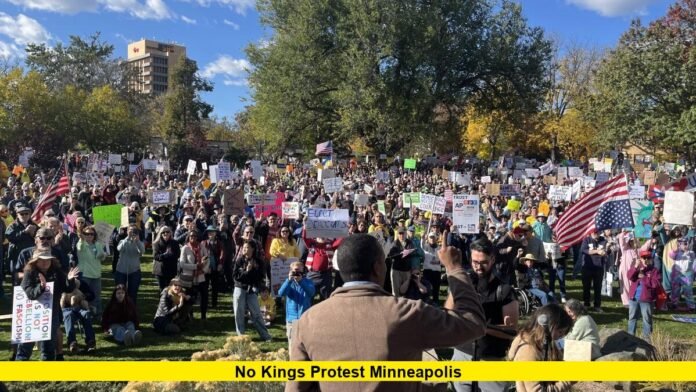

The Twin Cities are about to make history. On Saturday, March 28, 2026, Minneapolis and St. Paul will stand at the center of what organizers are calling the largest coordinated single-day protest movement in American history. The No Kings movement — born from grassroots frustration, fueled by civic grief, and amplified by some of the most recognizable voices in American culture — is arriving at its most powerful moment yet.
For Minnesota, this is not simply a protest. It is a reckoning.
What Is the No Kings Movement and How Did It Start?
The No Kings movement began in the summer of 2025 as a single day of organized national resistance timed to coincide with President Trump’s birthday. What looked at first like a symbolic gesture quickly transformed into one of the most sustained and rapidly expanding civic movements in recent American political history.
The name itself is deliberate and direct. It signals a core belief held by millions of Americans: that the United States is a constitutional democracy, not a monarchy, and that no president — regardless of party — is above the law, above accountability, or beyond the reach of the people’s dissent.
The movement was organized under the banner of the 50501 coalition — 50 protests, 50 states, one movement — a decentralized network that grew organically from online communities and quickly attracted support from labor unions, immigration advocates, civil liberties organizations, and elected officials.
By October 2025, an estimated seven million people participated in No Kings events across all 50 states, making it one of the largest single-day protest turnouts in U.S. history at that point. March 28, 2026 is expected to surpass even that.
Why Minneapolis Is the National Flagship City for the March 28 Rally
Minnesota did not become the center of the No Kings movement by chance. The state has been at the epicenter of some of the most controversial and painful moments of the Trump administration’s immigration enforcement campaign — specifically, a federal operation known as Operation Metro Surge.
Operation Metro Surge brought waves of ICE agents into the Minneapolis metropolitan area, resulting in mass immigration arrests, community fear, and widespread disruption to everyday life across neighborhoods in the Twin Cities. But it was the deaths of two American citizens — Renee Nicole Good and Alex Pretti — at the hands of federal agents during the operation that turned a local crisis into a national flashpoint.
Those deaths shocked the country. They put Minnesota on the front page of every major news outlet and drew condemnation from civil rights leaders, legal scholars, and lawmakers on both sides of the aisle. They also inspired protest. They inspired music. And they inspired the decision to make St. Paul the flagship city for the March 28 No Kings rally.
Minnesota has become a symbol of what millions of Americans fear is happening across the country — and on March 28, people from across the nation will march in solidarity with the communities most directly impacted by that fear.
Bruce Springsteen, Bernie Sanders, and a Historic Lineup of Voices
Few protest events in American history have attracted this level of cultural and political star power. The St. Paul rally has confirmed an extraordinary lineup of speakers and performers who will take the stage at the Minnesota State Capitol.
Bruce Springsteen will perform his protest anthem “Streets of Minneapolis,” a song written in direct response to Operation Metro Surge and the deaths of Renee Good and Alex Pretti. The song debuted at the top of the Billboard charts and became an anthem for the No Kings movement almost immediately upon its release. Springsteen has described the events in Minnesota as a turning point in his understanding of what is at stake in American democracy today.
Senator Bernie Sanders will speak at the rally, bringing his decades-long voice for working-class Americans and democratic values to what he has called one of the most important civic moments of his lifetime.
Legendary folk singer Joan Baez — whose career stretches back to the Civil Rights Movement and the Vietnam War protests — will also take the stage, lending historical weight and musical power to the event.
Actress and activist Jane Fonda, who has been among the most consistent voices of the No Kings movement since its founding, will address the crowd alongside Minnesota Lieutenant Governor Peggy Flanagan and Attorney General Keith Ellison.
Singer-songwriter Maggie Rogers rounds out the musical lineup, representing a younger generation of artists who have embraced civic activism as inseparable from their public work.
Event Details: When, Where, and How to Join the March
The St. Paul rally is carefully planned to be peaceful, accessible, and community-centered. Here is everything participants need to know.
Date: Saturday, March 28, 2026
Location: Minnesota State Capitol, St. Paul
Main Program: 2:00 p.m. — 3:30 p.m.
Three separate marches will begin at noon and converge at the Capitol:
- Harriet Island Regional Park — A 1.5-mile march north to the Capitol, beginning with a short kickoff program at the park.
- St. Paul College — A 0.6-mile march north to the Capitol.
- Western Sculpture Park — A 0.5-mile march east to the Capitol grounds.
Large video screens and speaker systems will be installed across the Upper and Lower Capitol Mall to ensure everyone can see and hear the program, regardless of where they are standing in the crowd. Trained de-escalation teams will be present throughout the event to maintain a peaceful and safe environment for all participants.
Organizers ask that attendees not bring chalk or stickers, to avoid marking Capitol surfaces. The event is free and open to all. For the most up-to-date logistical information, participants are directed to visit NoKingsTwinCities.org.
3,000+ Rallies Across America — The Scope of National Resistance
While the Twin Cities rally is the flagship event, March 28 is being felt from coast to coast. More than 3,000 No Kings events are scheduled nationwide, a figure that represents roughly 1,000 more events than the October 2025 round of protests.
Major rallies are planned in New York City, Los Angeles, Chicago, Houston, Atlanta, Phoenix, and Washington, D.C., where thousands of demonstrators are expected to march across Memorial Bridge past the Lincoln Memorial and to the Washington Monument.
The coalition organizing these events includes a wide range of groups: Indivisible chapters, state AFL-CIO affiliates, Women’s March organizations, immigrant defense networks, faith communities, and student organizations. The breadth of participation reflects how far the movement has grown beyond its original online origins.
In Minnesota specifically, the organizing coalition includes Indivisible Twin Cities, the MN AFL-CIO, Women’s March Minnesota, the Immigrant Defense Network, and Reviving the Islamic Sisterhood for Empowerment, among others.
What Are Protesters Demanding?
The No Kings movement has several overlapping but interconnected demands that its participants say are all rooted in the same core value: the protection of American democracy and the rule of law.
End to warrantless immigration arrests. Protesters across the movement have consistently called for an end to what they describe as the targeting of immigrant families without proper warrants, due process, or judicial oversight.
Accountability for Operation Metro Surge. The deaths of Renee Good and Alex Pretti have not resulted in any federal charges or accountability for the agents involved. Protesters and civil rights groups are demanding a full, independent investigation.
Protection of democratic institutions. Many No Kings demonstrators cite concern about threats to free elections, independent courts, a free press, and the separation of powers as motivating factors for their participation.
Reversal of cuts to public services. The movement has also drawn in Americans concerned about federal cuts to healthcare programs, public education, and environmental protections — issues that affect communities far beyond the immigration debate.
The Political Backdrop: Rising Tensions and an Emboldened Movement
The March 28 protests are taking place against a backdrop of rising national tension. In addition to the ongoing fallout from Operation Metro Surge, the United States has seen escalating military conflict abroad, with growing public concern about the possibility of a broader war. The combination of domestic immigration enforcement controversies and international instability has added urgency to the movement’s message.
Republican officials have pushed back hard against the No Kings protests. House Speaker Mike Johnson characterized previous No Kings rallies as anti-American and accused organizers of exploiting public emotion for political gain. Some Republican governors warned that law enforcement would respond swiftly to any incidents of violence or property destruction.
Organizers, for their part, have consistently emphasized nonviolence as the movement’s defining commitment. Previous No Kings events — including the large October 2025 Minneapolis rally — were widely reported as peaceful, even festive in atmosphere, with many participants bringing families and children.
Minnesota’s Grief and the Roots of Resistance
The No Kings movement in Minnesota carries a weight that goes beyond politics. The state has absorbed a remarkable amount of civic trauma over the past year.
The very first No Kings protest at the Minnesota State Capitol on June 14, 2025, took place on the same day that former Minnesota House Speaker Melissa Hortman and her husband Mark were assassinated, and state Senator John Hoffman and his wife were shot and wounded. The fact that tens of thousands of Minnesotans showed up to protest democracy’s erosion even on that day of staggering personal and political loss says something profound about the depth of conviction driving this movement.
Minnesota communities — particularly immigrant communities in the Twin Cities metro — have lived through federal raids, family separations, and the deaths of their neighbors at the hands of agents they were told were enforcing the law. That lived experience is what makes March 28 in St. Paul more than a rally. It is a moment of collective grief, collective resolve, and collective demand for something better.
FAQ: Everything You Need to Know About the No Kings Protest Minneapolis
What is the No Kings protest? The No Kings protest is a series of nationwide, nonviolent demonstrations opposing what organizers describe as authoritarian federal overreach, with a particular focus on immigration enforcement, democratic accountability, and civil liberties.
When is the No Kings protest in Minneapolis and St. Paul? The flagship Twin Cities event takes place on Saturday, March 28, 2026. Marches begin at noon from three locations in St. Paul, with the main program at the State Capitol running from 2:00 to 3:30 p.m.
Who is speaking and performing at the St. Paul No Kings rally? Confirmed participants include Bruce Springsteen, Senator Bernie Sanders, Joan Baez, Jane Fonda, Maggie Rogers, Lt. Gov. Peggy Flanagan, and Attorney General Keith Ellison.
Why is Minneapolis the center of the No Kings protests in 2026? Minnesota was the site of Operation Metro Surge, a controversial federal immigration enforcement campaign that resulted in the deaths of two American citizens, drawing national outrage and making the Twin Cities the symbolic heart of the resistance.
How many No Kings protests are happening across the country? More than 3,000 No Kings events are planned in cities and towns across all 50 states on March 28, 2026, making it potentially the largest coordinated single-day nonviolent protest in U.S. history.
Is the St. Paul rally free and open to the public? Yes. The event is completely free, open to all, and organizers are fully committed to maintaining a peaceful, family-friendly atmosphere throughout the day.
If this story moved you, angered you, or made you think — share it, drop a comment below with your thoughts, and stay right here for continuing live coverage as March 28 unfolds across America.