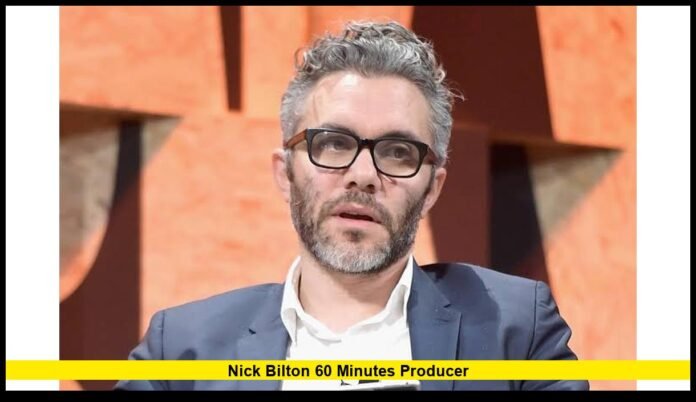

Nick Bilton 60 Minutes producer news is drawing attention as the CBS newsmagazine prepares for its 59th season under a new leadership structure. Bilton became the program’s executive producer in May 2026, and he has spent the summer reshaping the broadcast ahead of its September 13 premiere. The latest confirmed plans include new correspondents and contributors, newsroom changes, updated production methods, and a major opening interview with a U.S. Air Force officer who survived two days behind enemy lines in Iran.
The appointment marked a significant change for the long-running CBS program. Bilton became the fifth executive producer in the history of the newsmagazine and arrived from a background in technology journalism, magazine reporting, books, podcasts and documentary filmmaking rather than traditional television news.
Now, with the new season only days away, the focus has shifted from the leadership change itself to what Bilton has actually changed inside the program.
Nick Bilton’s Role at 60 Minutes
CBS News announced Bilton as executive producer on May 28, 2026. He replaced Tanya Simon, who had taken over the position the previous year after more than three decades with CBS News.
The appointment placed Bilton in charge of one of the most established television news programs in the United States. He became the fifth person to hold the executive producer position since the program launched in 1968.
CBS News described the decision as part of a broader effort to expand the program beyond its traditional Sunday-night broadcast. The stated goal included developing the show as a broader product that can reach viewers across multiple platforms.
Bilton brought a different professional background to that assignment.
Before joining CBS, he worked as a technology columnist at The New York Times and later as a special correspondent at Vanity Fair. He also wrote bestselling nonfiction books and worked on documentary projects.
His documentary work includes projects such as The Inventor, Fake Famous and Biggest Heist Ever. That experience became an important part of CBS News’ rationale for choosing him to lead the program.
Bilton has also acknowledged that he entered the job without traditional broadcast-news experience. He has argued that his outsider perspective can be useful because it allows him to examine established television practices with fresh eyes.
The Season 59 Premiere Is Set for September 13
The immediate test for Bilton will arrive on Sunday, September 13, when 60 Minutes begins its 59th season.
CBS has confirmed that the program will air at 7:30 p.m. ET/PT on CBS and stream on Paramount+.
The premiere already has several confirmed elements.
One of the biggest is an interview with the U.S. Air Force weapons systems officer who was aboard an F-15 fighter jet shot down over Iran in April. The officer, identified by the mission call sign Dude 44 Bravo, spent two days on the ground before his rescue.
Norah O’Donnell conducted the interview. CBS describes it as the officer’s first public account of his experience.
The interview covers his ejection, injuries, efforts to avoid Iranian forces and the circumstances surrounding his eventual rescue. O’Donnell also interviewed senior U.S. military officials connected with the operation.
That interview gives the season premiere a major hard-news component.
The episode will also include a report from Jon Wertheim on the Los Angeles Rams. The segment examines the team, its leadership and its use of technology, including artificial intelligence, as part of its efforts to gain a competitive advantage.
The combination reflects the familiar 60 Minutes formula while also showing the range Bilton wants for the new season.
What Bilton Has Changed Inside the Program
Bilton has not simply changed personnel. He has also altered elements of how the program is produced.
In a recent interview, he described a summer of changes affecting different parts of the broadcast. Some adjustments involve visual presentation, while others concern the reporting and production process.
One example involves the way correspondents appear on camera.
Bilton told camera operators to avoid routine “walk and talks,” a common television technique in which a correspondent walks alongside an interview subject. The production team has also changed elements of the program’s graphics package.
The familiar shadow beneath the 60 Minutes logo has been removed.
The large “book” graphics traditionally displayed behind correspondents have also been replaced with simpler rectangular screens.
Those changes may look minor individually. Together, they represent Bilton’s effort to update the program without abandoning its core identity.
The production team is also working toward 4K resolution and has changed camera lenses as part of the visual overhaul.
A New Approach to Story Development
Some of the more important changes involve what happens before a story reaches the screen.
The traditional “blue sheet” system used to pitch stories is being updated. Under the new approach, producers and correspondents will provide more information about the video and photography planned for each segment.
Bilton has also encouraged producers to concentrate on creating compelling scenes rather than simply collecting interviews and information.
That emphasis fits with his background in long-form journalism and documentary filmmaking.
He has also moved his office closer to the producers and correspondents instead of remaining in the executive producer’s larger corner office. Bilton said the change is designed to make collaboration easier.
Senior editorial staff have also become more involved in the editing process.
The goal is to create a newsroom environment in which producers, correspondents and editors work more closely together as stories develop.
More Investigative Reporting Is Planned
The new season is also expected to put additional emphasis on investigative journalism.
In an August staff memo, Bilton outlined increased investment in investigative reporting. He also announced that senior investigative producer Michael Kaplan had joined the program from the CBS News investigative unit to work on two major stories for the season.
Pulitzer finalist Scott Pham was also brought in to support data-driven reporting.
Tanya Lukyanova joined as an associate producer after previously working at The New Yorker, The Wall Street Journal and The Free Press.
These staffing moves indicate that the new leadership is putting resources into reporting capacity rather than focusing only on the program’s appearance.
That distinction matters because the central challenge for Bilton is maintaining the reporting standards that viewers associate with 60 Minutes while introducing new methods for a changing media environment.
New Faces Join the Correspondent Lineup
Personnel changes have been among the most visible elements of the new season.
CBS announced in July that Ross Douthat, Sebastian Junger, Gianna Toboni and Trevor Phillips would join the program as correspondents or contributors.
Douthat, a longtime New York Times Opinion columnist, is joining as a correspondent. CBS said his work would include interviews and reporting on major political and social issues.
Junger is joining as a contributor. He is known for nonfiction books, documentary filmmaking and war reporting.
Toboni is also joining as a contributor. Her previous journalism work includes reporting with VICE News and CNN.
Phillips, who previously worked at Sky News, is contributing to 60 Minutes while also serving as CBS News’ senior global affairs correspondent.
Norah O’Donnell is also moving into a larger role on the broadcast. CBS said she will serve as a correspondent rather than remaining only in a contributing capacity.
The Returning Veterans Remain Important
Despite the extensive changes, Bilton has kept several veteran correspondents at the center of the program.
Lesley Stahl, Bill Whitaker and Jon Wertheim remain with the show.
Their continued presence provides continuity at a time when the program has undergone substantial changes in leadership and staffing.
The returning correspondents also give the new season a direct connection to the program’s established reporting style.
Bilton has repeatedly emphasized that he does not intend to discard the fundamental journalism that made 60 Minutes successful.
Instead, his stated approach is to update production, storytelling and distribution while keeping the core reporting mission intact.
The Scott Pelley Conflict Changed the Early Transition
Bilton’s arrival was followed by a highly publicized confrontation with longtime correspondent Scott Pelley.
During an introductory staff meeting in June, Pelley challenged Bilton about his qualifications and questioned decisions surrounding the show’s personnel changes. The exchange became one of the most consequential moments of the leadership transition.
CBS later fired Pelley.
Bilton informed Pelley of the decision in a letter, citing the correspondent’s conduct during the staff meeting and a subsequent private discussion.
The episode intensified scrutiny of the new leadership.
Bilton subsequently worked to reassure remaining veteran correspondents that the program’s fundamental journalistic standards would remain intact.
That effort included conversations with Lesley Stahl, Bill Whitaker and Jon Wertheim.
All three remained with the program as it moved toward Season 59.
Bilton Addresses Editorial Independence
Editorial independence has become an important issue during the transition.
Bilton told staff that the program would remain editorially independent from its corporate parent. He has also said that political figures should remain legitimate subjects for scrutiny regardless of party affiliation.
In a recent interview, Bilton said President Donald Trump is fully within the program’s scope, as are other political figures in Washington.
His stated approach is to treat political reporting broadly rather than exclude major figures because of their political affiliation.
That position will be closely watched as the new season begins.
The program enters Season 59 after months of internal upheaval, making its editorial choices particularly significant.
A Hidden-Camera Investigation Is in Development
Another notable change is Bilton’s interest in hidden-camera reporting.
A story using hidden-camera footage is in development for the program. The approach recalls some of the investigative techniques associated with former 60 Minutes correspondent Mike Wallace, who famously used hidden cameras in reporting on fraud and deception.
CBS has not disclosed the full subject of the upcoming investigation.
Bilton has also declined to reveal the details of a new segment planned for the end of the broadcast later in the season.
That segment will eventually occupy the final minute of an episode, giving the program another new element without changing the basic Sunday-night format.
The Program Is Being Built for a Changing Media Environment
One of Bilton’s central arguments is that the audience for news has changed.
Traditional television remains important, but Americans now encounter reporting through streaming services, websites, social platforms, podcasts and other digital formats.
Bilton’s professional background makes that shift particularly relevant.
His career has included print journalism, digital media, documentary production and podcasting. That experience gives him familiarity with forms of storytelling that exist outside conventional television news.
CBS News has said the broader strategy is to make 60 Minutes more than a single hour on Sunday night.
The program already has a significant digital presence, and CBS has reported strong performance across television and digital platforms. The challenge is to build on that reach without weakening the distinctive reporting style that viewers expect.
A New Digital Storyboard Is Part of the Overhaul
One of the less visible changes is the replacement of the newsroom’s traditional dry-erase story board with a digital system.
Bilton discussed the change in his August staff memo while encouraging greater collaboration among employees working on the broadcast.
The change reflects a larger effort to modernize newsroom operations.
Bilton has also encouraged staff members to spend more time collaborating in person when they are not reporting from the field.
His message is that a major television news program depends on close cooperation among reporters, producers, editors, photographers and other staff members.
That emphasis is especially important during a season when many employees are adapting to new leadership and new colleagues.
The New Season Will Show Whether the Changes Work
The September premiere represents the first major public test of Bilton’s vision.
Viewers will see the updated graphics, new correspondents and new reporting approach immediately.
The opening stories also offer a clear indication of the balance the new leadership is pursuing.
The Iran rescue interview provides serious national-security reporting, while the Los Angeles Rams profile brings sports, technology and business into the broadcast.
Additional changes will emerge as the season continues.
Bilton has said the show has made changes across its production process, including camera work, story development, collaboration and visual presentation.
The new season therefore represents more than a change in executive producer. It is the first full broadcast cycle in which viewers can judge the direction Bilton has established.
What Viewers Can Expect From Bilton’s Leadership
The clearest confirmed priorities for Bilton’s first season include several themes:
- More investigative reporting: CBS has added investigative and data-reporting resources.
- A broader talent pool: New correspondents and contributors bring experience from newspapers, magazines, documentaries and international broadcasting.
- Modernized production: Graphics, camera work and newsroom systems have been updated.
- Stronger collaboration: Bilton has encouraged producers and correspondents to work more closely.
- Digital expansion: CBS wants the program to reach audiences beyond the traditional Sunday broadcast.
- Continued accountability reporting: Bilton has said major political figures remain legitimate subjects for scrutiny.
- New storytelling formats: A hidden-camera investigation and a new final-minute feature are in development.
These are confirmed initiatives rather than predictions about where the program might go.
Where the Program Stands Now
As of September 8, Bilton remains the executive producer of 60 Minutes, and the program is preparing for its Season 59 premiere on September 13.
The current correspondent lineup includes Lesley Stahl, Bill Whitaker, Jon Wertheim, Norah O’Donnell and Ross Douthat. Contributors include Sebastian Junger, Gianna Toboni and Trevor Phillips, with CBS also highlighting additional contributors in its current Season 59 team material.
The season premiere will feature O’Donnell’s first interview with the Air Force officer who survived two days in Iran after his F-15 was shot down.
It will also feature Wertheim’s report on the Los Angeles Rams and their technology-focused approach.
Behind the scenes, Bilton has spent the summer preparing a revamped production operation.
The result will be visible for the first time when the familiar stopwatch returns on Sunday night.
Why Bilton’s First Season Matters
The significance of Bilton’s appointment goes beyond one personnel decision.
He is leading 60 Minutes at a point when traditional television news faces a rapidly changing audience, stronger competition from digital platforms and increasing expectations for immediate access to reporting.
His career gives him experience across several parts of that changing media landscape.
At the same time, the program’s reputation was built over decades through long-form reporting, investigative journalism and correspondent-driven storytelling.
Bilton therefore faces a clear balancing act.
He must modernize the production without making the program unrecognizable.
He must attract new audiences without losing viewers who value its established reporting standards.
And he must introduce new talent while preserving the experience of veteran journalists who remain central to the program.
The Season 59 premiere will provide the first broad public look at how that balance is working.
For now, the confirmed changes show a newsroom moving toward newer technology, additional reporting resources, a larger contributor pool and a more collaborative production model.
The core Sunday broadcast remains in place.
The reporting mission remains in place as well.
What has changed is the person responsible for deciding how those elements should work together.
What do you think of the changes under Bilton’s leadership? Share your thoughts and stay updated as Season 59 begins.