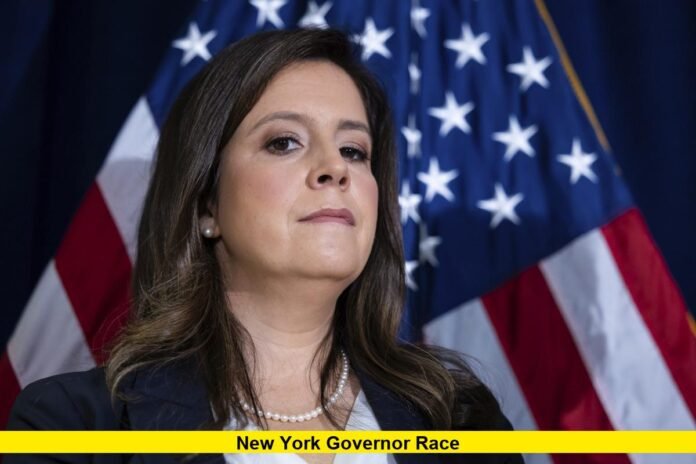

The race for New York’s governor’s seat in 2026 is already shaping up to be one of the most dynamic and consequential political contests in the nation. Representative Elise Stefanik, a prominent Republican from upstate New York and a leading figure within her party, has officially announced her run for governor, setting the stage for a fierce showdown with Democratic incumbent Governor Kathy Hochul. The announcement marks a pivotal moment in New York politics, as Republicans aim to reclaim the governor’s mansion after more than two decades of Democratic leadership.
Elise Stefanik’s Entry Shakes Up New York Politics
Representative Elise Stefanik’s announcement to run for governor sent ripples through the political landscape of New York. Known nationally as a vocal conservative and a close ally of former President Donald Trump, Stefanik’s decision to enter the race positions her as the Republican Party’s most high-profile candidate in years.
In her campaign launch, Stefanik framed her message around issues that resonate deeply with voters across the Empire State: affordability, public safety, and government accountability. She has promised to “make New York affordable and safe again,” emphasizing her commitment to reversing what she calls “failed Democratic policies” that have made living in the state increasingly expensive.
The congresswoman criticized the current administration’s handling of rising taxes, housing costs, and the state’s controversial bail reform laws, pledging to restore what she describes as “common sense and balance” to New York governance. Stefanik’s campaign is already gaining traction among upstate voters and suburban communities frustrated with the direction of state politics.
Governor Kathy Hochul Faces Her Toughest Challenge Yet
Governor Kathy Hochul, who ascended to office in 2021 after the resignation of Andrew Cuomo and won her first full term in 2022, now faces perhaps the toughest political challenge of her career.
Hochul has sought to portray herself as a steady, pragmatic leader who guided New York through post-pandemic recovery, but her administration has been dogged by criticism over rising living costs, concerns about public safety, and the state’s handling of the ongoing migrant crisis. While Hochul remains popular among many Democrats, she has also encountered growing dissent within her own party.
In a surprising twist, her current lieutenant governor, Antonio Delgado, has also entered the 2026 race, signaling a potential Democratic primary showdown before the general election even begins. This intraparty competition could complicate Hochul’s path to re-election and divide Democratic resources just as Stefanik’s campaign gathers momentum.
A State With a Deep Blue History – But Shifting Undercurrents
New York has long been a Democratic stronghold, and no Republican has won the governorship since George Pataki’s victory in 2002. Yet, recent trends suggest growing frustration among voters across the state.
In the 2022 gubernatorial race, Republican Lee Zeldin came closer than expected to unseating Hochul, performing strongly in Long Island, the Hudson Valley, and upstate regions. That unexpectedly tight race revealed vulnerabilities in the Democratic coalition and proved that with the right candidate and message, Republicans could make serious inroads in New York.
Elise Stefanik appears poised to build on that momentum. Her upstate roots, high national profile, and close ties to the national GOP could help her attract both donor support and widespread name recognition early in the campaign. She is positioning herself as a champion for middle-class families and small business owners, claiming that the state has been “driven to decline by one-party rule in Albany.”
The Key Issues Defining the 2026 Campaign
The 2026 New York governor’s race is expected to revolve around a handful of dominant issues that have defined state politics in recent years.
1. Cost of Living and Taxes:
New York consistently ranks among the most expensive states in the nation. Housing prices, property taxes, and utility costs continue to burden families and businesses. Stefanik has vowed to pursue aggressive tax cuts and expand economic incentives for small businesses, while Hochul argues that her administration’s investments in infrastructure and housing will reduce long-term costs and improve affordability.
2. Crime and Public Safety:
Public safety remains a major flashpoint. While crime rates in New York City have shown mixed trends, public perception of safety has deteriorated. Stefanik has promised to repeal bail reform measures she believes have made communities less safe, while Hochul insists on balanced reform that maintains fairness and justice within the legal system.
3. Immigration and the Migrant Crisis:
The arrival of thousands of migrants in New York has placed pressure on city resources and state funding. Hochul has called for federal assistance, while Stefanik has used the issue to criticize “failed sanctuary policies” and pledge stricter immigration enforcement.
4. Education and Parental Rights:
Education policy, particularly around curriculum content and parental involvement, is also becoming a key point of debate. Stefanik has long positioned herself as an advocate for parental rights and school transparency, while Hochul has emphasized investments in public education and teacher support.
5. Economic Growth and Jobs:
New York’s post-pandemic economic recovery has been uneven, with rural and upstate areas still lagging behind. Stefanik’s campaign has promised to focus on revitalizing these regions through manufacturing incentives and deregulation, while Hochul points to her administration’s job growth initiatives and green energy investments as evidence of progress.
A Battle of Style and Substance
Beyond policy, the race between Hochul and Stefanik also represents a stark contrast in leadership style and political identity.
Governor Hochul embodies a centrist, pragmatic brand of Democratic politics — cautious, moderate, and focused on consensus-building. Stefanik, by contrast, represents the new generation of assertive Republican leadership, unapologetically conservative and fiercely combative in tone.
This stylistic divergence may play a significant role in shaping public perception. For many voters, the decision may come down not just to policies but to personality and trust. Hochul’s supporters see her as a steady hand guiding the state through turbulent times, while Stefanik’s backers view her as a bold reformer ready to challenge the status quo.
Early Outlook and Potential Scenarios
With the election still two years away, early polling gives Hochul a modest lead, though Stefanik’s entry has clearly tightened the race. Historically, incumbents in New York have enjoyed a built-in advantage, but Stefanik’s strong name recognition, national fundraising network, and appeal among suburban and rural voters could significantly shift the balance.
If Antonio Delgado gains traction in the Democratic primary, a prolonged intraparty contest could weaken Hochul heading into the general election — an opportunity Republicans would be eager to exploit. Conversely, if Hochul consolidates her party’s base early, Stefanik will face an uphill battle in a state where Democratic registration far outweighs Republican numbers.
One key factor will be voter turnout in urban centers versus rural and suburban regions. Republicans have steadily improved their performance in Long Island and the Hudson Valley, while Democrats remain dominant in New York City. Whoever can mobilize these critical swing areas will likely determine the outcome of the 2026 race.
The Broader National Significance
The 2026 New York governor’s race will also carry national implications. Elise Stefanik is not just a state politician — she is a nationally recognized Republican leader and a key figure in her party’s congressional leadership. A victory in New York would not only be historic but would send shockwaves through the national political landscape, signaling a Republican resurgence in one of America’s bluest states.
For Democrats, retaining the governorship is equally crucial. A loss in New York would be a major symbolic setback and could influence the narrative heading into the 2028 presidential election. Both parties view this contest as a test of their appeal to suburban and independent voters — a critical demographic in modern American politics.
A Defining Race for New York’s Future
As the 2026 campaign season gains momentum, the New York governor’s race promises to be one of the most watched elections in the country. With Elise Stefanik’s fiery challenge and Kathy Hochul’s determination to defend her record, voters are set to witness a spirited and deeply consequential battle over the future of the Empire State.
This race will test whether New Yorkers are ready to break with decades of Democratic leadership — or whether the blue stronghold remains unshakable.
Stay tuned for more updates on the New York governor’s race, and share your thoughts below — which issues do you believe will decide the future of the Empire State?