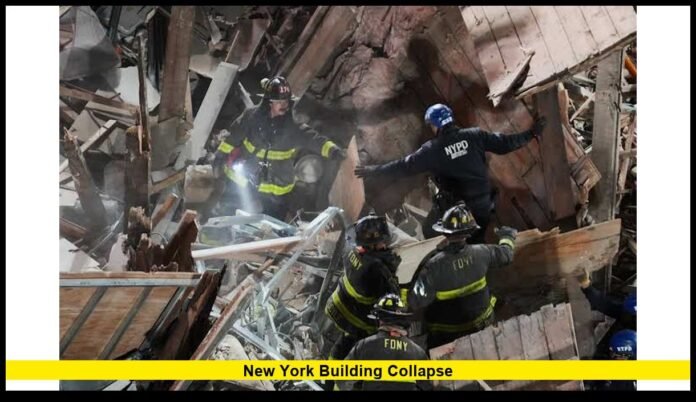

The New York building collapse in Brooklyn has become a major developing news story after a three-story building in the Flatbush neighborhood collapsed beside an active construction site on November 11, 2026. The disaster prompted an extensive emergency response, with firefighters searching through heavy rubble for trapped occupants, rescuing survivors, and transporting injured people to nearby hospitals. The incident also raised serious questions about construction safety, excavation practices, and the protection of older buildings located near development projects.
The collapse happened shortly after 4 p.m. Eastern time near the intersection of Flatbush Avenue and Bedford Avenue. The affected structure fell toward an adjoining construction and excavation property, leaving a large amount of debris in the work area. Emergency crews arrived within minutes and began a technical rescue operation as reports emerged that several people might still be trapped.
Initial reports confirmed one death and multiple injuries. Later reporting from the Associated Press indicated that at least two people had died. The reported number of injured people also changed as emergency officials provided additional information. Several victims required hospital treatment, including people initially reported in critical condition.
The New York City Fire Department, police officers, emergency medical personnel, and building inspectors responded to the disaster. Rescue workers used specialized equipment, search dogs, drones, and manual debris removal techniques to locate survivors.
Although the immediate priority remains the safety of affected people, investigators must now establish why the building failed. The neighboring construction site, the property’s structural condition, and its construction history are important parts of the ongoing examination.
What Happened During the New York Building Collapse?
The incident occurred in Flatbush, a residential and commercial neighborhood in Brooklyn. A three-story mixed-use building at 1321 Flatbush Avenue collapsed shortly after 4 p.m. on Wednesday, November 11.
The structure contained residential space above a commercial area. Reports described the property as a building with four residential units, although its precise occupancy at the time of the collapse has not been fully established publicly.
The building fell toward an adjacent property at 2625 Bedford Avenue, where demolition and excavation work had taken place. The neighboring site contained an open construction area, and much of the collapsed structure landed inside the excavation zone.
The force of the collapse created a substantial pile of bricks, wood, and other building materials. Parts of the structure became difficult to distinguish as floors, walls, and other components broke apart.
The incident also damaged a neighboring building. Although that property remained standing, part of its exterior wall was severely affected, exposing sections of its interior.
The exposed rooms included residential areas and personal belongings. The damage created additional concerns for people living nearby because inspectors needed to determine whether the remaining structure was safe.
Emergency officials quickly established a restricted area around the site. Firefighters concentrated on locating trapped people while other personnel assessed the surrounding buildings.
The incident developed into a major technical rescue operation involving multiple emergency teams.
Where Did the Brooklyn Building Collapse Occur?
The collapse took place at 1321 Flatbush Avenue in the Flatbush neighborhood of Brooklyn, New York City.
The neighboring construction property is located at 2625 Bedford Avenue. The proximity of these properties is important because the collapsed structure fell toward the adjoining excavation area.
Flatbush contains a mixture of residential buildings, apartment properties, commercial establishments, and development projects. Construction activity in established neighborhoods requires careful coordination because new projects can take place very close to occupied structures.
The location of the collapse also created transportation challenges.
Flatbush Avenue is an important route for local traffic, pedestrians, and businesses. Emergency vehicles needed sufficient space to reach the site, transport injured people, and support the rescue operation.
Police instructed the public to avoid the affected area. Road restrictions were also introduced around Flatbush Avenue and Bedford Avenue.
Residents and commuters were encouraged to follow official instructions and use alternative routes while emergency personnel continued working.
Latest New York Building Collapse Death Toll and Injury Reports
Casualty information became one of the most closely followed aspects of the disaster.
Initial information from emergency officials indicated that one person had died and at least 10 others had suffered injuries. Four injured people were initially reported in critical condition.
Later reporting indicated that the death toll had increased to at least two people. The number of injured people also varied between updates as hospitals and emergency officials continued accounting for victims.
Because the rescue operation remained active, early casualty figures should not be treated as a final accounting.
The victims included people associated with the building and construction activity in the surrounding area. Construction workers were reportedly among those injured.
The incident also involved residents and people who may have been inside the building when it collapsed.
Several important developments emerged during the emergency response:
- Fatalities: Later reporting indicated at least two deaths.
- Hospitalizations: More than 10 people were reported injured or transported for medical attention.
- Critical injuries: Early reports identified several victims in critical condition.
- Survivors: Firefighters successfully removed multiple people from the debris.
- Firefighter safety: A firefighter was also reported to have suffered a minor injury.
- Search operations: Emergency personnel continued examining the wreckage for anyone who might remain trapped.
The final number of casualties requires confirmation from the appropriate authorities.
Officials also need to establish the identities of victims and provide accurate information to families.
Firefighters Launch Major Rescue Operation in Brooklyn
The rescue response became the central focus immediately after the collapse.
The FDNY dispatched firefighters and specialized rescue personnel to the scene. Emergency medical teams also arrived to provide treatment and transport injured people to hospitals.
The operation required careful coordination because the wreckage contained unstable building materials and potentially dangerous structural sections.
Firefighters could not simply remove all the debris using heavy machinery. Moving large pieces without first assessing their position could create additional movement and place trapped people at greater risk.
Rescue teams therefore used a combination of manual work and specialized equipment.
Their efforts included:
- Removing smaller pieces of debris by hand.
- Using power saws to access difficult areas.
- Deploying trained search dogs.
- Using drones to examine inaccessible sections.
- Identifying possible spaces where survivors could remain.
- Providing immediate medical assistance to rescued occupants.
Reports indicated that approximately 250 fire and emergency medical personnel from 69 units participated in the response.
The number of personnel involved demonstrates the scale of the operation and the difficulties associated with searching a collapsed structure.
Pregnant Woman Rescued From the Rubble
One of the most emotional developments involved a man who was desperately searching for his pregnant wife.
He told people near the emergency scene that his wife was inside the collapsed building and that he had not received information about her condition.
His concern attracted attention as rescue crews continued searching the debris.
At approximately 6:30 p.m., firefighters removed a woman from an opening in the rubble. Her identity and condition were not immediately confirmed by authorities, although her rescue raised hope among people waiting for information about missing relatives.
Later reporting described the pregnant woman being rescued alive, and her husband expressed relief.
The rescue became an important moment during an otherwise devastating emergency.
Child Among Those Affected
Reports also indicated that a child was among the people rescued or injured during the incident.
The presence of children and families among those affected made the disaster particularly distressing for the surrounding community.
However, information about individual victims should be treated carefully until authorities or their families provide confirmation.
Why Finding Survivors Takes Time
Building collapses create complicated rescue environments.
When floors and walls fall together, they can form spaces between large pieces of material. These spaces sometimes provide enough room for someone to survive.
However, rescuers cannot assume that every opening is safe.
Structural materials may shift unexpectedly, and damaged walls may collapse further during the removal process.
Specialized rescue personnel must assess each area before moving debris.
Search dogs and other detection methods can help identify possible survivors in places that firefighters cannot immediately access.
The operation may continue even after the first successful rescues because emergency crews must carefully examine the remaining debris.
What Was the History of the Collapsed Building?
The building’s history is another important part of the investigation.
Reports described the structure as a three-story building constructed in 1930. It contained four residential units and was located in an established part of Brooklyn.
Its age means the property had been standing for approximately 96 years when the collapse occurred.
However, the age of a building does not automatically establish that it was unsafe.
Older properties can remain structurally sound when they receive appropriate maintenance and comply with applicable building requirements.
Investigators will need to examine the building’s actual condition rather than draw conclusions from its construction year.
Important areas of examination may include the foundation, exterior walls, structural supports, previous repairs, and any modifications made during its lifetime.
The property’s relationship with the adjacent construction site also requires careful attention.
When excavation takes place close to an existing building, engineers must consider how changes to surrounding ground conditions could affect nearby foundations.
That relationship is particularly important in densely developed parts of New York City.
Previous Construction Violation Raises Questions
Another important detail concerns the neighboring construction site.
Public Department of Buildings records reportedly showed that the adjacent property received a violation in April 2026.
The reported violation involved demolition work continuing while a stop-work order was in effect.
This information has attracted attention because the building collapse occurred beside the same construction property.
A stop-work order is an official instruction requiring specified construction or demolition activity to stop. Such orders can be issued when authorities identify conditions requiring corrective action or additional review.
Construction companies and property owners must comply with these instructions.
However, the reported April violation does not establish that the construction site caused the November collapse.
Investigators must determine whether the earlier violation involved work that had any connection to the structural failure.
They will also need to establish whether the violation was corrected, what activities took place afterward, and whether the project complied with the necessary permits and engineering requirements.
The distinction between a previous regulatory violation and the direct cause of a disaster is important.
Responsibility cannot be determined solely from the existence of an earlier violation.
What Caused the New York Building Collapse?
The official cause of the New York building collapse has not been established in the latest available reporting.
Investigators are examining the circumstances surrounding the failure, including the condition of the building and the nearby construction activity.
The structure’s location beside an excavation site has made the neighboring property an important part of the investigation.
However, no confirmed finding establishes that excavation or demolition caused the building to collapse.
Several areas require technical examination.
Foundation and Structural Conditions
A building’s foundation transfers its weight into the ground and helps maintain its stability.
If a foundation experiences damage or loses adequate support, the structure above it may become unstable.
Investigators may examine whether the building had foundation problems before the incident.
They may also inspect the remaining structural components to understand how the building failed.
Excavation Near Existing Properties
Construction projects sometimes require the removal of substantial amounts of soil.
When excavation occurs close to an occupied property, engineers must evaluate how the work may affect nearby ground conditions and foundations.
Depending on the site, contractors may need temporary retaining structures, underpinning, monitoring systems, or other protective measures.
Investigators will need to establish what systems were required and whether the approved construction procedures were followed.
Demolition and Construction Activities
The neighboring property had undergone demolition before the collapse.
Investigators may examine the demolition sequence, excavation work, construction plans, and any changes made during the project.
They may also review whether contractors followed the applicable safety requirements.
Building Maintenance and Previous Alterations
The condition of the collapsed property is another important factor.
Investigators may examine whether previous renovations or structural changes affected the building.
They may also review maintenance records and earlier inspection findings.
None of these possible investigation areas should be confused with a confirmed explanation.
The cause will depend on the physical evidence and technical findings.
New York City Officials Respond to the Flatbush Disaster
The collapse attracted attention from city and state officials.
Mayor Zohran Mamdani acknowledged the emergency and recognized the work of first responders.
He urged New Yorkers to avoid the affected area while firefighters and rescue personnel continued their work.
His response also emphasized concern for the people directly affected by the incident.
Governor Kathy Hochul expressed condolences following reports of the fatality.
Congresswoman Yvette Clarke also responded to the disaster, expressing concern for residents, workers, and families waiting for information.
City Council Member Farah Louis said she was coordinating with emergency personnel and relevant city agencies.
Her office emphasized the need to assist affected families and obtain reliable information about the circumstances surrounding the collapse.
These responses reflect the seriousness of the incident and the importance of coordination between different levels of government.
The immediate responsibilities include supporting emergency operations, helping displaced residents, and ensuring that investigators can examine the site.
Emergency Assistance for Displaced Residents
A building collapse can affect people who were not physically inside the structure.
Nearby residents may be unable to return to their apartments because of structural damage, restricted access, or safety inspections.
People may also lose access to essential belongings, identification documents, medication, and personal property.
To support affected residents, New York City Emergency Management and the American Red Cross established a reception center at the Flatbush YMCA, located at 1401 Flatbush Avenue.
The center was intended to provide assistance and information to people affected by the emergency.
Depending on individual circumstances, displaced residents may need:
- Temporary accommodation.
- Emergency clothing and essential supplies.
- Help contacting relatives.
- Information about building access restrictions.
- Assistance connecting with community organizations.
- Guidance about damaged personal belongings.
- Emotional and practical support.
Families searching for missing relatives may also need assistance obtaining confirmed information.
During a major emergency, information can change quickly. Residents should rely on official announcements and verified updates when making decisions about their safety.
Traffic Closures and Neighborhood Disruptions
The New York building collapse also created significant disruption around Flatbush and Bedford avenues.
Police asked drivers and pedestrians to avoid the area while emergency operations continued.
Flatbush Avenue was reported closed between Clarendon Road and Bedford Avenue during the response.
These restrictions allowed emergency vehicles to reach the site and gave rescue personnel sufficient room to work.
The closures also reduced the risk of people entering areas where damaged materials or unstable structures could present hazards.
Local businesses and residents may experience temporary disruption because of restricted access.
The duration of the closures depends on the progress of rescue operations, structural inspections, and debris removal.
People traveling through Flatbush should follow current traffic instructions from local authorities.
Why the Collapse Has Renewed Concerns About Construction Safety
New York City contains a large number of older buildings alongside active development projects.
In neighborhoods such as Flatbush, construction and renovation frequently take place near occupied residential properties.
This makes construction safety an important responsibility for developers, contractors, engineers, property owners, and city regulators.
A project can create risks beyond its own property boundaries when demolition or excavation takes place near existing structures.
For this reason, construction regulations address several important areas.
Structural protection: Existing buildings may require additional support when nearby construction changes surrounding conditions.
Excavation planning: Engineers must consider soil conditions, foundation depth, and the location of neighboring structures.
Demolition procedures: Contractors must follow appropriate methods when removing structural components.
Inspections: Authorities may inspect construction sites to identify unsafe conditions and verify compliance.
Stop-work enforcement: Contractors must respect official orders requiring work to stop.
The Flatbush disaster has brought these issues back into public attention.
However, the investigation must establish the specific circumstances of this incident before any broader conclusions can be drawn.
What Happens Next in the Building Collapse Investigation?
After the immediate rescue operation, authorities must focus on securing the site and examining the evidence.
The investigation may involve several stages.
1. Securing the property
Emergency personnel and structural specialists must evaluate the remaining building materials and determine whether additional collapses are possible.
2. Inspecting neighboring structures
The Department of Buildings must assess nearby properties to identify structural damage and determine whether residents can safely return.
3. Reviewing construction records
Investigators may examine permits, engineering plans, demolition records, inspection reports, and previous violations associated with the neighboring development.
4. Examining physical evidence
Specialists can study the remaining structural components to understand how the building failed.
5. Conducting engineering analysis
Engineers may evaluate foundation conditions, structural connections, excavation practices, and other relevant factors.
6. Determining possible violations
If authorities identify unsafe work or regulatory violations, they may pursue appropriate enforcement action.
7. Releasing verified findings
Officials may provide additional information when the investigation produces reliable conclusions.
The process can take time because determining the cause of a major structural failure requires technical analysis.
Latest Updates on the New York Building Collapse
As of November 12, 2026, the following information summarizes the major developments reported about the Flatbush incident.
| Category | Latest reported information |
|---|---|
| Location | Flatbush, Brooklyn, New York |
| Collapsed building | 1321 Flatbush Avenue |
| Adjacent construction property | 2625 Bedford Avenue |
| Incident date | November 11, 2026 |
| Approximate time | Shortly after 4 p.m. ET |
| Building height | Three stories |
| Construction year | 1930 |
| Residential units | Four reported units |
| Death toll | At least two reported in later coverage |
| Injuries | More than 10 reported |
| Rescue operation | Multiple survivors removed from rubble |
| Emergency response | Approximately 250 personnel from 69 units reported |
| Construction history | Previous violation reported at adjacent site |
| Official cause | Not yet established |
Casualty numbers may differ between early and later reports because emergency officials continued updating the information.
The most important outstanding issue is the cause of the collapse. Investigators have not established that the neighboring construction project was responsible.
Final Thoughts
The New York building collapse in Brooklyn represents a devastating emergency for the Flatbush community. The destruction of a three-story building left people dead and injured, forced emergency responders into a difficult rescue operation, and raised concerns about the safety of neighboring properties.
Firefighters worked through large amounts of debris to locate survivors. Their efforts included specialized equipment, search dogs, drones, and careful manual removal of building materials.
The rescue of multiple people, including a woman reported to be pregnant and a child among those affected, brought moments of hope during an extremely difficult situation.
The investigation now needs to establish exactly what happened. The building’s age, the neighboring excavation, and the reported history of a construction-site violation are relevant details, but they do not independently prove the cause.
New York City authorities must examine the physical evidence, construction records, and structural conditions before reaching conclusions.
The findings may also have broader importance for construction safety in established urban neighborhoods, where development projects frequently take place beside occupied buildings.
For residents and families affected by the disaster, immediate assistance and reliable information remain essential.
Frequently Asked Questions
Q1. When did the New York building collapse happen?
The Brooklyn building collapse occurred shortly after 4 p.m. Eastern time on Wednesday, November 11, 2026. Emergency crews arrived shortly afterward and began searching for people trapped beneath the debris.
Q2. Where did the New York building collapse happen?
The incident occurred at 1321 Flatbush Avenue in the Flatbush neighborhood of Brooklyn. The structure fell toward an adjoining construction and excavation property at 2625 Bedford Avenue.
Q3. How many people died in the Brooklyn building collapse?
Later reporting indicated that at least two people had died. More than 10 others were reported injured. The final casualty figures require confirmation from emergency authorities.
Q4. Has the cause of the New York building collapse been confirmed?
No. The official cause has not been established in the latest available reporting. Investigators are examining the collapsed structure, neighboring construction activity, and relevant building records.
Q5. Was the collapsed building located beside a construction site?
Yes. The three-story building stood beside an active construction and excavation property. The structure fell toward the neighboring site during the incident.
Stay connected for verified New York building collapse updates, and share your thoughts in the comments about construction safety and the importance of protecting residential communities.