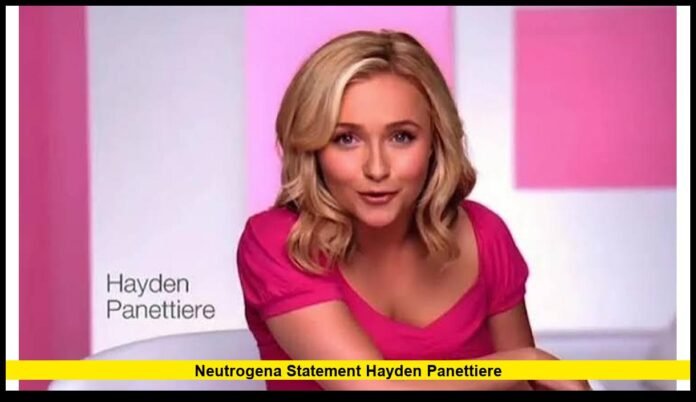

a Statement Hayden Panettiere:
The neutrogena statement hayden panettiere story is receiving renewed attention after the actress’s sudden death brought fresh scrutiny to claims she made about her former relationship with the skincare company. Panettiere had alleged that Neutrogena moved to end her decade-long partnership after she publicly discussed her experience with postpartum depression following the birth of her daughter.
The controversy first returned to the spotlight in 2026 when Panettiere discussed the experience while promoting her memoir, This Is Me: A Reckoning. Her comments have now been revisited following her death at age 36 on August 16, 2026.
The renewed interest has also prompted criticism of Neutrogena across social media, with some fans calling for a boycott of the brand. However, an important distinction remains: Panettiere’s account represents her description of what happened, while the company has not publicly confirmed that her comments about postpartum depression were the reason her contract ended.
Hayden Panettiere’s Long History With Neutrogena
Panettiere’s connection with Neutrogena began when she was still a teenager and became one of the most recognizable celebrity partnerships of her early career.
For years, she represented the skincare company in advertising campaigns and promotional appearances. Her youthful image, television success and growing profile made her a natural fit for a major beauty brand looking to appeal to younger consumers.
The relationship reportedly lasted for approximately a decade.
That lengthy association is central to Panettiere’s recollection of what happened. She did not describe the partnership as a short-lived endorsement that simply ran its course. Instead, she portrayed Neutrogena as an important part of her professional life and said she was deeply hurt by the way the relationship eventually ended.
Her comments have taken on additional significance because the dispute involved a subject that remains highly sensitive: maternal mental health.
Why Postpartum Depression Became the Center of the Dispute
Panettiere became a mother in 2014 when she and former professional boxer Wladimir Klitschko welcomed their daughter, Kaya.
The actress subsequently experienced severe postpartum depression. She later spoke openly about the condition, explaining that she initially struggled to understand what was happening to her emotionally.
Her experience was complicated by a difficult childbirth and the pressures of returning to a demanding acting career.
Rather than keeping those struggles private, Panettiere eventually decided to discuss postpartum depression publicly.
That decision became particularly important during a 2015 television appearance, when she spoke about the condition and encouraged greater awareness of the issue.
At the time, postpartum depression was increasingly being discussed publicly, but stigma remained widespread. Panettiere’s willingness to talk about her experience helped make an often-hidden problem part of a much larger cultural conversation.
According to her later account, however, that openness had an unexpected professional consequence.
Panettiere’s Account of What Happened
Panettiere said she was surprised when she learned that Neutrogena wanted to end their relationship.
She recalled that her representative informed her that the company believed her public discussion of postpartum depression had created an issue under the terms of her agreement.
One of the most notable elements of Panettiere’s account involved the contract’s morality clause.
She explained in a later interview that she had assumed the agreement contained extensive restrictions governing her public behavior. Because of that, she said she was particularly surprised that discussing a mental-health condition would become the issue that threatened the partnership.
Panettiere maintained that she had simply been honest about her own experience.
She did not believe she had made an intentionally controversial statement or done anything that should have affected her professional relationship with the brand.
According to her account, her representative challenged the company’s attempt to terminate the contract immediately.
Panettiere said the intervention prevented the immediate cancellation of the agreement. Nevertheless, she believed the relationship was effectively finished.
She later said she was not invited back after the contract period ended.
Did Neutrogena Fire Hayden Panettiere?
The wording surrounding the controversy deserves careful attention.
Online discussions have frequently described the situation as Neutrogena “firing” Panettiere. Her own comments have also used language about being fired or having the company sever ties with her.
But the available public account is more complicated.
Panettiere said the company wanted to terminate her agreement after she discussed postpartum depression. Her representative challenged that decision, and the existing contract continued.
The actress subsequently said that she knew she was unlikely to return for another campaign.
That means there is an important distinction between an immediate termination and the eventual decision not to renew or continue the relationship.
The exact contractual circumstances have not been publicly established in enough detail to independently reconstruct every step of the dispute.
As a result, the safest description is that Panettiere alleged Neutrogena attempted to end the relationship because of her public comments about postpartum depression and that she ultimately was not brought back after the contract ended.
What Has Neutrogena Said?
The question of a corporate response is now at the center of renewed interest.
As of the latest update, Neutrogena has not publicly offered a detailed explanation addressing Panettiere’s specific allegations.
The absence of a substantive response has become especially noticeable because the controversy has resurfaced so dramatically following her death.
Social-media users have been posting comments on Neutrogena’s accounts and revisiting older reports about Panettiere’s experience. Some users have called on the company to explain why its relationship with the actress ended.
Others have argued that Neutrogena should acknowledge Panettiere’s contribution to the brand and address the allegations she made shortly before her death.
However, the absence of a public response does not by itself establish that Panettiere’s account was correct or incorrect.
It simply means that there is currently no detailed corporate explanation available to resolve the competing narratives.
Why the Story Has Returned After Panettiere’s Death
Panettiere died on August 16, 2026, at age 36.
She was found unresponsive in Greenville, South Carolina. Authorities have said there was no evidence of trauma contributing to her death and no foul play is suspected, while the official cause and manner of death remain under investigation.
Her death came only months after the release of her memoir.
That timing has led fans, journalists and entertainment outlets to revisit many of the subjects Panettiere discussed during the final period of her life.
Her memoir was especially revealing because she wrote about childhood fame, motherhood, addiction, mental-health struggles, relationships, grief and the pressures of living under constant public attention.
The Neutrogena dispute was one of the professional experiences she used to illustrate how difficult it could be to be open about personal struggles while simultaneously maintaining a carefully managed public image.
What Her Memoir Revealed About Postpartum Depression
This Is Me: A Reckoning gave readers a much deeper look at Panettiere’s experience following the birth of Kaya.
She described a traumatic childbirth that involved prolonged labor, a C-section and serious medical complications.
After becoming a mother, she struggled emotionally despite having achieved something she had wanted for years.
Her memoir described the disconnect she felt during a period that many people expected to be purely joyful.
Panettiere eventually recognized that postpartum depression was affecting her.
The condition also became intertwined with other challenges in her life, including substance use and anxiety.
Her willingness to discuss those experiences publicly was a recurring theme in her later interviews.
She wanted people to understand that postpartum depression could affect women even when they appeared to have everything going for them.
Her Comments Were About More Than a Brand Contract
Although the Neutrogena controversy has become a major part of the current online conversation, Panettiere’s original motivation for discussing postpartum depression was broader.
She wanted to challenge the idea that mothers should simply be grateful and happy after giving birth.
Her experience demonstrated that childbirth can be physically and emotionally overwhelming, and that mental-health struggles do not necessarily reflect a person’s love for their child.
Panettiere’s openness was particularly notable because she was a celebrity whose career depended heavily on public perception.
She had been in front of cameras since childhood and understood how carefully celebrities’ images could be managed.
That made her decision to speak openly about postpartum depression significant.
She was essentially choosing personal honesty over maintaining an entirely polished public persona.
The Importance of the Morality Clause Allegation
The contract issue is another reason the story continues to attract attention.
Celebrity endorsement agreements often contain provisions governing conduct and public behavior. These clauses can give companies significant flexibility when an ambassador becomes involved in a controversy.
Panettiere’s argument was that openly discussing postpartum depression should not have been treated as a violation of the spirit of such a provision.
She said she was especially shocked because she believed the subject was an important health issue rather than scandalous behavior.
Her comments have consequently raised questions about how companies evaluate celebrities who publicly discuss mental health.
Should an entertainer be penalized professionally for acknowledging a legitimate medical or psychological condition?
Or can companies legitimately decide that a spokesperson’s public image no longer fits their marketing strategy?
The answers depend heavily on individual contracts and circumstances, and the public does not have access to the complete agreement between Panettiere and Neutrogena.
Renewed Boycott Calls Against Neutrogena
The controversy has now moved beyond entertainment coverage and into online consumer activism.
Following Panettiere’s death, social-media users have renewed calls to boycott Neutrogena.
Some fans say they view the actress’s account as evidence that the company treated her unfairly at a vulnerable point in her life.
Others have criticized the brand for not publicly addressing the allegations.
The scale of the backlash varies across platforms, but the common theme is that Panettiere’s story has become part of her posthumous legacy.
Still, online campaigns should be distinguished from established facts.
A social-media post repeating that Neutrogena “fired” Panettiere does not independently establish why the contract ended. Likewise, the company’s silence does not prove that it accepted her version of events.
The underlying facts remain based largely on Panettiere’s own recollections.
How Panettiere’s Career Shaped the Controversy
Panettiere was far more than a celebrity spokesperson.
She began working in entertainment as a child and built a career across television, film and voice acting.
She became internationally recognized as Claire Bennet on Heroes and later gained another major following as Juliette Barnes on Nashville.
Her performances on Nashville were particularly relevant to her personal journey because the series eventually incorporated storylines involving addiction and postpartum depression.
Panettiere later reflected on how emotionally difficult it could be to portray material that mirrored parts of her own life.
That overlap between her career and personal struggles made her increasingly candid with audiences.
Rather than separating her professional identity from her personal challenges, she increasingly discussed both together.
Why the Story Matters Beyond Hayden Panettiere
The controversy raises broader questions about celebrity endorsements and mental-health stigma.
Public figures are often expected to present an image that is attractive, successful and reassuring to consumers.
At the same time, society increasingly encourages people to discuss mental health openly.
Those expectations can sometimes collide.
A celebrity might be praised for speaking honestly about depression or addiction by the public while worrying that the disclosure could affect professional opportunities.
Panettiere’s story illustrates that tension.
Whether or not her interpretation of the Neutrogena contract dispute is ultimately confirmed, her experience highlights the risks public figures can perceive when discussing deeply personal issues.
The Current Status of the Controversy
The latest developments have not produced a definitive corporate explanation from Neutrogena.
Panettiere’s allegations remain the central source of the story.
Her memoir and later interviews provided additional detail about what she believed happened, including her claim that the company’s concerns were connected to her public discussion of postpartum depression.
The brand has not publicly confirmed that account.
That leaves several unanswered questions, including precisely how the contract was structured, whether the company attempted to invoke a morality provision, and what factors influenced the decision not to continue the partnership.
Those questions could remain unanswered unless Neutrogena or individuals directly involved in the original contract provide additional information.
What to Watch Next
The biggest potential development would be a public response from Neutrogena or its parent company.
Such a statement could clarify whether the company disputes Panettiere’s recollection, whether the contract ended through normal negotiations, or whether other factors influenced the decision.
For now, readers should be cautious about treating social-media claims as established facts.
The most reliable understanding is that Panettiere publicly described a painful professional experience, connected it to her discussion of postpartum depression, and said the long-standing relationship eventually ended.
The company has not publicly supplied a detailed alternative account.
That distinction is particularly important as interest in Panettiere’s life and career continues following her death.
Bottom Line
The renewed neutrogena statement hayden panettiere controversy centers on the actress’s claim that her decade-long relationship with the skincare brand was effectively ended after she spoke publicly about postpartum depression.
Panettiere viewed her comments as an honest discussion of a serious health issue rather than inappropriate conduct. She said her representative challenged the company’s attempt to end the contract and that she ultimately was not invited back after the agreement expired.
The controversy has resurfaced with much greater intensity following Panettiere’s death at 36. Fans have criticized Neutrogena online and some have called for a boycott, while the company has not publicly provided a detailed response to her allegations.
For now, the story remains one in which Panettiere’s firsthand account is central, but several contractual details have not been independently established. Any future statement from Neutrogena could significantly change the public understanding of what happened.
What do you think about Hayden Panettiere’s account and the renewed reaction to the controversy? Share your thoughts and stay tuned for the latest developments.