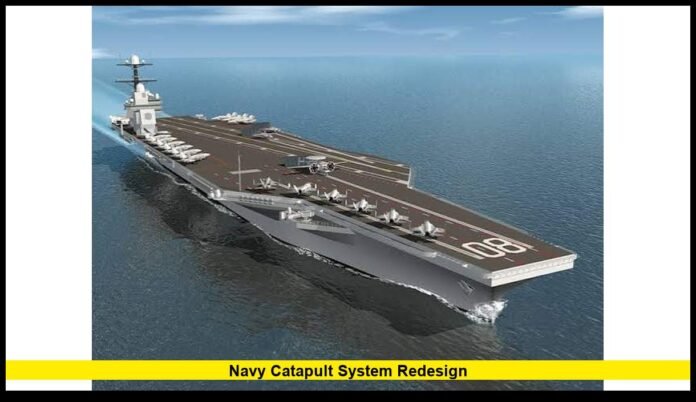

The navy catapult system redesign has become a major U.S. Navy shipbuilding issue after President Donald Trump signed a national security memorandum directing future Ford-class aircraft carriers toward traditional steam catapults instead of the Electromagnetic Aircraft Launch System, or EMALS. The order, signed August 13, 2026, specifically affects future carriers such as the USS Doris Miller (CVN-81), while the first three Ford-class carriers remain equipped with the electromagnetic system.
The decision represents a sharp change in direction for one of the Navy’s most technologically ambitious carrier programs. The Ford class was designed around a highly electric architecture, with EMALS replacing the steam catapults used aboard the older Nimitz-class carriers. The new policy means the Navy must now work through significant design and engineering changes for future ships.
The change is not simply a matter of installing a different catapult. Steam technology requires supporting infrastructure that differs substantially from the electrical architecture developed for the Ford class. The Navy must determine how to incorporate that equipment into a carrier design that was built around a different approach.
What Changed on August 13, 2026
The White House memorandum directs the Navy to return to steam-powered catapults on future Ford-class carriers. It also calls for hydraulic systems for aircraft carrier elevators rather than the newer electromagnetic approach used by the Ford class.
That decision puts future USS Doris Miller at the center of the issue.
The first three ships in the class are not being redesigned under the new policy:
- USS Gerald R. Ford (CVN-78) will continue using EMALS.
- USS John F. Kennedy (CVN-79) will continue using EMALS.
- USS Enterprise (CVN-80) will continue using EMALS.
- Future USS Doris Miller (CVN-81) is expected to incorporate the new approach.
- Subsequent Ford-class carriers are also affected by the policy.
The result will eventually be a Ford-class fleet with different launch and recovery technologies.
That creates an unusual situation for the Navy. The same carrier class could contain ships with substantially different engineering arrangements, maintenance requirements and operating procedures.
Why the Decision Matters for CVN-81
CVN-81 is particularly important because it is the fourth Ford-class aircraft carrier.
The ship is being built by Huntington Ingalls Industries’ Newport News Shipbuilding in Virginia. It was originally planned around the Ford-class technology package, including EMALS and other advanced systems.
The Navy has already invested in equipment and industrial work associated with the original configuration. The new policy therefore introduces a major design question while the carrier program is still progressing.
CVN-81 has also experienced schedule pressure. Its planned delivery has moved to February 2034, extending the construction timeline compared with earlier expectations.
The redesign adds another challenge to a program already dealing with construction complexity, equipment availability and shipyard capacity.
Engineers now have to determine how much of the ship’s existing design can remain unchanged and what must be modified to accommodate steam equipment.
EMALS Was a Core Part of the Ford-Class Design
The Ford class was developed to modernize the U.S. Navy’s nuclear-powered aircraft carriers.
EMALS was one of the most visible changes.
Instead of using steam pressure to drive an aircraft along the catapult track, EMALS uses electrical energy and an electromagnetic motor system. The technology was intended to give operators greater control over the aircraft launch process.
The system also formed part of the Navy’s effort to reduce manpower and maintenance demands.
Ford-class carriers use a large electrical architecture that supports multiple advanced systems. The carrier’s nuclear reactors provide power for the ship’s electrical network, creating an architecture that differs from the steam-heavy arrangement of older carriers.
That distinction now matters because returning to steam requires more than replacing equipment on the flight deck.
Why Steam Requires a Different Ship Architecture
Steam catapults have decades of operational experience aboard U.S. aircraft carriers.
The Nimitz class relies on steam catapults, and sailors across the carrier fleet have extensive experience operating and maintaining them.
However, steam catapults require supporting machinery and piping.
The Ford class was designed to reduce the amount of steam infrastructure carried throughout the ship. Its design allocated space differently because EMALS relies on electrical power rather than a traditional steam-powered launch mechanism.
A return to steam therefore raises several engineering questions.
The Navy must consider:
- Steam generation and distribution.
- Machinery-space requirements.
- Piping arrangements.
- Weight and balance.
- Maintenance access.
- Electrical-system integration.
- Crew requirements.
- Flight-deck equipment.
- Long-term maintenance.
- Construction sequencing.
These factors make the new policy a substantial ship-design change rather than a simple equipment replacement.
Read More – USS Gerald R Ford: Deployment History, Technology Upgrades, and Strategic Role in 2026
The Difference Between EMALS and Steam Catapults
Both technologies perform the same basic mission: accelerating aircraft to takeoff speed over a carrier’s limited flight-deck distance.
Their operating methods differ significantly.
A steam catapult uses high-pressure steam to drive a piston. The piston moves along the catapult track and transfers force to the aircraft through the launch shuttle.
EMALS uses electrical power and electromagnetic force.
The electromagnetic system allows launch parameters to be controlled electronically. That provides a more precise acceleration profile for different aircraft.
The technology was also designed to reduce some of the stresses imposed on aircraft during launch.
For the Navy, those characteristics became particularly important as carrier aviation evolved.
Modern carriers operate different aircraft types, and future carrier aviation is expected to include an increasing number of unmanned platforms.
The original Ford-class concept therefore treated EMALS as more than a replacement for steam. It represented a broader change in how carrier aviation would operate.
Why Trump Wants Steam Technology Back
President Trump has criticized EMALS for years.
His objections have centered on complexity, expense and reliability. He has repeatedly argued that the Navy should use the steam technology that has operated aboard American carriers for decades.
The administration’s August 2026 decision turns that longstanding position into formal policy for future carriers.
The White House’s position is that proven steam technology offers a more dependable approach and supports the broader goal of improving U.S. naval readiness.
The decision also reflects a broader debate over whether the Navy should continue introducing complex new technologies into major shipbuilding programs or rely more heavily on mature systems.
That debate has become particularly important as the Navy faces pressure to increase fleet size while controlling shipbuilding costs and schedules.
EMALS Has Had a Complicated Development History
EMALS was not an overnight technology.
The Navy spent years developing, testing and refining the system before it became operational aboard USS Gerald R. Ford.
The program experienced technical challenges during development and early operations.
Reliability became one of the most closely watched issues.
The Navy continued making modifications and improvements as operational experience accumulated. The system’s performance has also been assessed during carrier exercises and deployments.
That experience created a more complicated picture than simply describing EMALS as either successful or unsuccessful.
The system introduced new capabilities while also creating technical challenges that required continued engineering attention.
The August 2026 decision effectively ends the expectation that EMALS will remain the standard launch system across the entire Ford-class production run.
Gerald R. Ford Will Continue Using EMALS
The redesign does not erase electromagnetic launch technology from the Navy.
USS Gerald R. Ford remains equipped with EMALS.
The ship has accumulated substantial operational experience with the system since entering service.
Ford’s flight operations have provided the Navy with valuable information about aircraft launching, recovery operations and carrier deck performance.
The second and third Ford-class carriers are also associated with the electromagnetic architecture.
This means the Navy will have to support EMALS for years even as it begins preparing future ships for steam catapults.
That creates a long-term logistics challenge.
Training pipelines, technical expertise, spare parts and maintenance procedures will need to accommodate both systems.
The USS Doris Miller Becomes the Most Important Ship in the Redesign
The future USS Doris Miller will provide the clearest indication of how the Navy intends to implement the new policy.
The carrier already belongs to the Ford-class production line. Its basic hull and major ship systems are tied to a design philosophy built around advanced electrical technology.
Changing the launch system could therefore require modifications in areas beyond the catapult itself.
The ship’s construction schedule also means the Navy cannot treat the issue as a theoretical future concept.
Decisions made now can affect engineering work, procurement, construction sequencing and testing.
The Navy must establish exactly which systems will change and how those modifications will be incorporated without creating additional construction problems.
Hydraulic Elevators Add Another Major Change
The presidential memorandum does not focus only on aircraft catapults.
It also directs a return to hydraulic systems for carrier elevators.
That is significant because the Ford class introduced electromagnetic technology into its weapons elevators.
The Advanced Weapons Elevators were designed to move weapons between internal magazines and the flight deck. Their purpose is to improve the speed and efficiency of weapons handling during carrier operations.
Replacing that technology with hydraulic systems would therefore represent another departure from the original Ford-class concept.
The combination of steam catapults and hydraulic elevators moves future carriers closer to the traditional technology architecture used aboard the Nimitz class.
That creates a much broader redesign than changing one flight-deck component.
The Redesign Could Affect Construction Costs
The financial impact is one of the biggest unresolved questions.
The change is expected to cost billions of dollars, but the final amount cannot be established until the Navy completes the engineering work.
The reason is straightforward.
The Ford class was designed around EMALS. Removing that system and installing steam technology requires engineering changes, equipment procurement and potentially significant modifications to spaces that were designed for another purpose.
There may also be costs associated with equipment already purchased or work already completed.
The Navy will need to determine which existing components can be retained, repurposed or removed.
Until that assessment is complete, precise cost figures should be treated cautiously.
Schedule Effects Are Also Unclear
The new policy could affect the construction schedule for CVN-81 and later carriers.
However, the Navy has not yet established a final timetable for the redesigned configuration.
The engineering work itself must come first.
Design teams will need to determine where steam equipment will fit, how it will connect to the ship’s machinery systems and how construction should proceed.
That work must then be coordinated with Newport News Shipbuilding and the companies supplying carrier equipment.
CVN-81 already faces a revised delivery timeline, making schedule management especially important.
Any additional redesign work could create further pressure if it requires changes to components that are already being manufactured or installed.
The Navy Will Operate Two Different Carrier Technologies
One of the most immediate long-term consequences will be technological separation within the carrier fleet.
The first three Ford-class carriers will use EMALS.
Future ships will move toward steam.
That means sailors, engineers and maintenance teams will eventually support two different launch-system families across the same carrier class.
The Navy has managed different carrier designs before, but the Ford class was specifically intended to establish a common technological foundation for a new generation of carriers.
The latest policy changes that assumption.
It could also affect training.
Personnel who move between carriers may need qualifications and experience with both electromagnetic and steam systems.
Maintenance organizations will likewise need to preserve expertise in technologies that the Navy had been moving away from.
What the Change Means for Future Carrier Design
The decision could influence how the Navy approaches aircraft carrier modernization more broadly.
The Ford class was intended to reduce manpower, improve aircraft sortie generation and create additional capacity for future technologies.
Its electrical architecture was part of that modernization effort.
A return to steam does not automatically eliminate those goals, but it changes how future carriers will pursue them.
The Navy will need to balance mature technology against the advantages that newer systems were designed to provide.
That balance will be especially important as aircraft become more diverse.
Carrier aviation is already evolving toward a mix of manned and unmanned aircraft. The launch system must accommodate different aircraft weights and operating requirements.
The final design will therefore need to meet both today’s operational requirements and the Navy’s future aviation plans.
The 60-Day Planning Period
The next major development will be the Navy’s response to the presidential directive.
The administration has directed the Navy to develop a plan addressing the measures, resources and timeline required to implement the changes.
That planning process should provide more concrete information about CVN-81.
Among the most important details will be the engineering approach, expected construction effects and estimated financial requirements.
The Navy will also need to coordinate with Congress because major changes to a large defense acquisition program can affect budgets and appropriations.
Industry involvement will be equally important.
Newport News Shipbuilding and major equipment suppliers will have to determine how the revised design affects manufacturing and construction.
What Happens to EMALS on the First Three Ford-Class Ships
The new policy does not eliminate EMALS from ships already configured around the system.
USS Gerald R. Ford, USS John F. Kennedy and USS Enterprise will continue with their existing electromagnetic launch systems.
That means the Navy will not immediately undertake a fleetwide conversion.
Instead, the transition is focused on future construction.
This distinction reduces the immediate disruption to the operational carrier fleet.
It also allows the Navy to keep collecting information from the existing EMALS-equipped carriers while it develops the future steam configuration.
Why CVN-81 Is Now the Key Test
The future USS Doris Miller is likely to become the most closely watched Ford-class carrier in the coming years.
Its design will show how much of the original Ford-class architecture can survive the policy change.
The ship will also demonstrate whether the Navy can introduce steam and hydraulic systems without creating unacceptable increases in cost or schedule.
The result could influence later carriers.
If the redesign proves practical, the Navy could continue with the approach for subsequent Ford-class ships.
If major engineering problems emerge, future decisions could become more complicated.
For now, the Navy has been directed to move ahead with the redesign.
What the Latest Update Means for U.S. Navy Carriers
As of August 14, 2026, the direction is clear even though many implementation details remain unresolved.
The administration has ordered future Ford-class carriers toward steam catapults and hydraulic elevator technology.
The first three Ford-class carriers will retain their electromagnetic systems.
CVN-81 is the critical ship for the transition, and its revised design will require substantial engineering attention.
The change also comes at a time when the Navy is already confronting shipbuilding capacity, construction delays and the challenge of maintaining a technologically advanced carrier fleet.
The central question now is not whether the Navy has been ordered to return to steam. That decision has already been made.
The important question is how the Navy will redesign a carrier created around electrical technology while preserving the performance, capacity and future growth that the Ford class was intended to provide.
The next phase of the CVN-81 redesign could shape the future of U.S. aircraft carriers—share your thoughts and stay informed as confirmed details emerge.