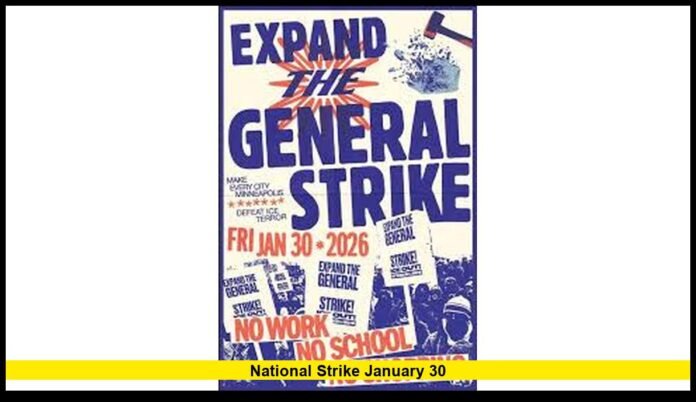

The National Strike January 30 is unfolding today as a coordinated nationwide action urging Americans to halt work, skip school, and pause spending in protest of federal immigration enforcement practices. Across the country, communities are responding through walkouts, business closures, demonstrations, and digital activism, marking one of the most visible protest actions of the year.
Organizers and participants describe the strike as an intentional disruption of daily economic life meant to force attention on immigration enforcement, public safety, and government accountability. While participation levels vary by region, the scope of the action has pushed the strike into the center of the national conversation.
What the National Strike January 30 Represents
The National Strike January 30 is not tied to a single union, political party, or advocacy organization. Instead, it operates as a decentralized movement built around a shared call for action. Participants were encouraged to withdraw from everyday responsibilities for one day to demonstrate how essential workers, students, and consumers are to the nation’s economy.
Unlike traditional marches focused on symbolic locations, this strike emphasizes absence. The lack of labor, reduced commerce, and empty classrooms are intended to serve as the message. Supporters argue that economic stillness speaks louder than words when policy debates appear stalled.
The strike also reflects a shift in how modern protest movements organize. Much of the mobilization occurred online, with activists sharing guidance, graphics, and personal pledges across social platforms in the days leading up to January 30.
Events That Sparked Nationwide Momentum
Public anger surrounding immigration enforcement escalated earlier this month after several fatal encounters involving federal agents. These incidents triggered large demonstrations in multiple cities, with the most significant early protests taking place in the Midwest.
Minnesota became a focal point after tens of thousands of people gathered despite extreme winter conditions. Those demonstrations evolved into a regional work stoppage that drew national attention and inspired activists in other states to coordinate similar actions.
The decision to hold a nationwide strike on January 30 emerged from these earlier protests. Organizers viewed a single, unified day of action as a way to connect local grievances into a national statement.
Key Issues Driving Participation
Participants in the National Strike January 30 are united less by formal leadership and more by shared concerns. Among the most frequently cited issues are:
- The use of force during immigration enforcement operations
- Lack of transparency following fatal encounters
- The presence of federal agents in local communities
- The human impact of detention and deportation policies
Supporters argue that these concerns extend beyond immigration alone. Many frame the strike as part of a broader debate about civil liberties, accountability, and the balance of power between federal agencies and local communities.
How Americans Are Taking Part
Workers Across Multiple Sectors
Workers in service industries, education, healthcare support roles, and freelance professions are among those participating. Some coordinated with coworkers to stage walkouts, while others individually chose to stay home.
For hourly workers, participation carries financial risk. Many supporters acknowledge this challenge and emphasize that any form of participation, including reduced spending or online advocacy, contributes to the collective action.
Student Involvement
Students at colleges and high schools across the country organized class absences, teach-ins, and campus rallies. Student leaders describe the strike as both a protest and an educational moment, aimed at raising awareness among peers who may feel disconnected from policy debates.
In some districts, parents joined the action by keeping children home, framing the day as a lesson in civic engagement.
Small Business Closures
Small businesses have played a visible role in the strike. Independent restaurants, cafés, bookstores, and creative spaces announced temporary closures or limited hours as a sign of solidarity.
Owners cite different motivations. Some point to personal connections to immigrant communities. Others describe the closure as a moral decision, even when it comes at a financial cost.
Not all businesses are able to participate, and many supporters stress that the strike is voluntary rather than prescriptive.
Demonstrations and Public Gatherings
While the strike centers on absence from daily routines, visible demonstrations are still a major component. Rallies and marches are taking place in major metropolitan areas as well as smaller cities.
Common features of these gatherings include:
- Peaceful marches through downtown corridors
- Vigils honoring individuals killed during enforcement actions
- Speeches from community leaders and affected families
- Mutual aid efforts providing food and supplies
Law enforcement agencies in several cities prepared for large crowds, though early reports indicate that most events remain peaceful and organized.
Digital Organizing and Online Impact
Social media has been essential to the reach of the National Strike January 30. Hashtags related to the strike have trended throughout the day, with participants sharing photos of empty workplaces, closed storefronts, and protest signs.
Public figures, including entertainers and online creators, have amplified the message by encouraging followers to participate or observe the strike. Their involvement has helped push the issue beyond activist circles into mainstream public awareness.
Digital participation also allows people unable to miss work or school to engage in the movement, broadening its reach.
Public Response and National Debate
The strike has generated sharp debate across the United States. Supporters view it as a peaceful and necessary response to policies they believe cause harm. They argue that economic pressure has historically played a role in driving social change.
Critics question the effectiveness of a single-day action and express concern about the impact on workers who cannot afford to lose income. Some also argue that immigration enforcement is a complex issue that cannot be addressed through protest alone.
Despite differing opinions, the strike has succeeded in drawing attention to immigration enforcement and protest tactics, forcing conversations that extend beyond January 30.
Economic Effects So Far
The immediate economic impact of the National Strike January 30 appears uneven. In cities with high participation, reduced foot traffic and temporary closures are noticeable. In other regions, daily life continues with minimal disruption.
Economists note that the symbolic impact of such actions often outweighs short-term financial losses. The visibility of participation, particularly through business closures and worker absences, may shape public perception more than raw economic data.
Longer-term effects will depend on whether the movement sustains momentum after today.
Political Implications Moving Forward
Federal immigration policy remains a contentious topic in Washington, with ongoing debates around funding, enforcement priorities, and oversight. While today’s strike does not carry legislative power, it adds pressure by signaling public dissatisfaction.
Elected officials across the political spectrum are watching participation levels closely. High engagement may encourage renewed discussion or influence how future policy debates are framed.
Activists emphasize that the strike is not intended as an endpoint. Many see it as a starting signal for continued organizing, voter engagement, and local advocacy.
Why the National Strike January 30 Matters
Beyond immediate demands, the National Strike January 30 highlights a broader shift in how Americans express dissent. The action reflects frustration with traditional channels of influence and a growing willingness to use economic behavior as a form of protest.
It also underscores the role of decentralized organizing in modern movements. Without a central authority, participants have still managed to coordinate nationwide action, demonstrating the power of digital communication and shared purpose.
Whether or not the strike produces direct policy changes, it has already left a mark on the national conversation.
What Comes Next
Organizers and participants are expected to evaluate the impact of the strike in the coming days. Some groups are discussing follow-up actions, including targeted boycotts, local protests, and community forums.
Others emphasize the importance of rest and reflection before determining next steps. For many involved, January 30 represents both a protest and a test of collective action in a divided political climate.
As the day continues, the National Strike January 30 remains a defining moment for modern protest in the U.S., and its influence may extend well beyond today. Join the discussion and share how this moment is unfolding in your community.