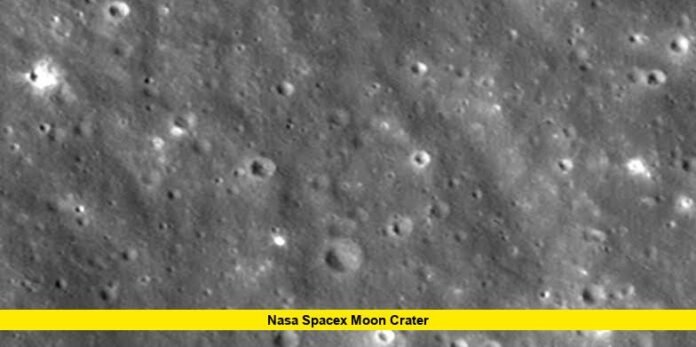

NASA has released the sharpest images yet of a NASA SpaceX moon crater formed when a discarded Falcon 9 rocket stage slammed into the lunar surface. The photos, captured by the Lunar Reconnaissance Orbiter (LRO), give scientists their clearest look at the aftermath of an unplanned collision that occurred on August 5, 2026.
The images were released on August 18, 2026, and show a fresh, bright divot carved into the moon’s already cratered terrain. Streaks of displaced rock and dust radiate outward from the impact point, offering researchers a rare opportunity to study how man-made objects interact with the lunar surface.
How the Falcon 9 Rocket Ended Up on the Moon
The rocket stage responsible for the crater began its journey more than a year earlier. On January 15, 2025, SpaceX launched a Falcon 9 rocket carrying Firefly Aerospace’s Blue Ghost 1 lunar lander as part of NASA’s Commercial Lunar Payload Services initiative. The mission successfully delivered the lander to the moon.
After completing its job, the rocket’s upper stage was released into space. Its first stage, or booster, returned safely to Earth. The upper stage, however, remained adrift for more than a year. Solar activity and gravitational forces gradually altered its path, eventually pulling it onto a collision course with the moon.
Independent astronomer Bill Gray was among the first to flag the rocket’s trajectory earlier this year, using orbit-tracking software to predict where and when the impact would occur. NASA and SpaceX subsequently monitored the object using ground-based telescopes and space-based tracking assets.
The Moment of Impact
On August 5, 2026, the Falcon 9 upper stage struck the lunar surface near the Einstein and Bell craters at an estimated speed of 5,400 miles per hour (8,700 kilometers per hour). The stage, roughly 39 to 45 feet long and weighing close to 10,000 pounds, hit with a force comparable to nearly three tons of TNT.
NASA has described lunar surface impacts of this kind as an accepted and safe method of disposing of spent hardware, noting that the collision posed no danger to Earth. The crash site was first pinpointed using data from the Korea Aerospace Research Institute’s Danuri spacecraft, with additional support from professional and amateur astronomers who helped narrow down the exact location.
What the New Crater Looks Like
According to NASA’s measurements, the fresh crater spans about 60 feet (18 meters) across and is estimated to be less than 10 feet (3 meters) deep. Scientists calculated the depth using the length of the shadow cast inside the crater in the LRO images.
The crater displays a distinctive butterfly-wing pattern of ejecta. Darker streaks close to the impact point represent material that had been exposed to solar wind, cosmic rays, and micrometeorite strikes over time. Brighter rays extending farther out show fresh rock and soil thrown up from beneath the surface, material that had not yet been weathered by the harsh lunar environment.
How NASA Captured the Images
Photographing the exact impact site was no simple task. The Lunar Reconnaissance Orbiter circles the moon from pole to pole roughly every two hours while the moon rotates slowly beneath it. For LRO’s cameras to capture the crash site, engineers had to wait for the spacecraft’s orbit to align precisely with the location, a process that took six days.
Once aligned, flight controllers tilted the orbiter so its Narrow-Angle Camera could point toward the crater during each pass. The spacecraft photographed the site on August 11 and August 12, 2026, flying about 56 to 60 miles above the surface at a speed of roughly one mile per second. The resulting images cover an area about a quarter of a mile wide and were enlarged three times to reveal fine detail.
Why the Crater Matters for Lunar Science
Beyond the striking imagery, scientists say the event offers valuable data as NASA works toward establishing a permanent moon base by 2032. Studying how a known object of a specific mass and speed interacts with the lunar surface helps researchers refine models used to interpret naturally occurring impacts, which are far more common but harder to observe in real time.
Former NASA Associate Administrator Mike Gold described the incident as a useful, if accidental, contribution to lunar research, framing it as a small setback for SpaceX that could yield meaningful insight for scientists studying the moon’s surface composition and impact dynamics.
The discovery also highlights a growing operational consideration for future lunar missions: as more spacecraft and rocket components journey to the moon, tracking their eventual fate becomes an increasingly important part of mission planning.
Have thoughts on what this new moon crater means for future lunar missions? Drop a comment below and stay tuned for more updates as NASA continues to study the impact site.