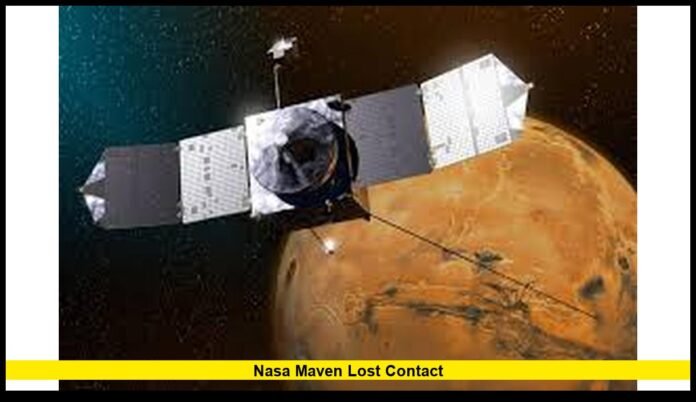

NASA continues its urgent efforts to diagnose and recover the MAVEN spacecraft after the nasa maven lost contact incident on December 6, 2025. The orbiter, which has served as one of the most important assets in the Mars fleet for more than a decade, went silent immediately after a routine pass behind the planet. Before the loss of signal, MAVEN’s systems appeared normal, making the interruption both unexpected and deeply concerning for mission teams. This development has prompted one of the most comprehensive interplanetary recovery operations NASA has undertaken in recent years.
MAVEN’s silence comes at a time when its scientific observations and communication relay duties remain crucial to both current and future Mars missions. As the investigation unfolds, NASA teams are balancing the need for rapid diagnostics with the methodical, fact-driven procedures required to safely re-establish contact.
What happened during the loss-of-signal event
On December 6, MAVEN entered what should have been a normal behind-Mars occultation. During these periods, the spacecraft temporarily loses its communication link with Earth due to the planet obstructing the signal path. Ordinarily, the spacecraft re-emerges and resumes its data downlink within minutes. Instead, no telemetry returned.
Just before the blackout, MAVEN’s final transmission showed stable power output, proper attitude control, nominal thermal levels, and healthy science instruments. Nothing in the signal suggested an impending anomaly. When engineers attempted to reacquire the spacecraft after Mars cleared the line of sight, they detected no carrier signal, beacon tone, or diagnostic ping.
This absence of communication set off NASA’s standard deep-space anomaly procedures, activating teams across mission operations, flight systems, communications engineering, and planetary science.
Why MAVEN is vital to the Mars program
MAVEN, launched in 2013 and arriving at Mars the following year, has become one of NASA’s most productive atmospheric science missions. Its primary purpose is to study how Mars lost much of its atmosphere, a question central to understanding the planet’s transition from a potentially habitable world to the cold, thin-aired environment we know today.
The spacecraft collects real-time data on:
- Ionized particles in the upper atmosphere
- Solar wind interactions
- Atmospheric escape rates
- Space-weather variability
- Chemical composition of high-altitude gases
These measurements inform models that future missions depend on, especially those involving crewed exploration, precision aerobraking, or landings that require accurate atmospheric predictions.
Beyond scientific observations, MAVEN supports rover and lander missions by acting as a relay. Many surface missions transmit data to orbiters rather than directly to Earth to increase bandwidth and reliability. MAVEN’s absence places more pressure on the remaining orbiters, especially during periods of high-priority science operations.
NASA’s immediate response to the communication failure
NASA’s engineers follow a structured and proven recovery process for deep-space assets. After the missed communication window, teams immediately began:
- Attempting multiple signal acquisition scans
- Using different Deep Space Network (DSN) antennas across global locations
- Searching for weak or drifting carrier signals
- Repeating command sequences that may trigger safemode transitions
- Replaying the final telemetry packet for overlooked warning signs
- Running simulations of the spacecraft’s condition using pre-loss data
Each of these steps helps narrow the possibilities without risking harm to the spacecraft. Deep-space recovery requires extreme precision; an incorrect command could worsen an already unknown condition.
Engineers continue to rotate responsibility across 24-hour shifts because recovery attempts must match DSN availability and MAVEN’s orbital position around Mars.
Key technical issues engineers are evaluating
NASA has not identified a definitive root cause, but several categories of technical concern guide early analysis. These areas represent established diagnostic priorities and help determine which recovery commands are safest to attempt first.
1. Communication hardware malfunction
A fault in MAVEN’s radio transmitter, power amplifier, or antenna assembly could prevent the spacecraft from sending signals even if the rest of the system is running. Engineers are evaluating whether:
- The transmitter experienced a power drop
- The antenna failed to deploy or rotate properly
- A hardware component lost functionality due to age or radiation
Since MAVEN has operated beyond its initial mission lifespan, some degradation is always possible, though no signs were visible before occultation.
2. Attitude-control or pointing issue
Deep-space communication requires exact antenna alignment. Even a slight misalignment can cause Earth-bound signals to vanish.
Possible contributors include:
- A stuck reaction wheel
- A star-tracker error causing incorrect orientation
- A momentum-management anomaly that forced the spacecraft into an unplanned attitude
If MAVEN cannot orient its antenna toward Earth, communications may remain impossible until a correction is successfully commanded.
3. Power or battery irregularities
Although MAVEN’s power levels looked normal before the blackout, engineers must consider:
- A sudden solar-array drop
- A battery cell failure
- An unexpected load triggering a shutoff event
Any interruption in power could disable the transmitter or force the spacecraft into a reduced-function mode.
4. Software lockup or safemode transition
Interplanetary spacecraft depend heavily on onboard software. A corrupted instruction, unexpected data interaction, or incomplete safemode entry can interrupt communication.
Safemode, when entered properly, should preserve the spacecraft. But if MAVEN encountered a partial or incomplete transition, communications may be disrupted.
5. Radiation-related anomalies
Solar events sometimes cause temporary disruptions in memory or power systems. Even without major solar storms, high-energy particles can interfere with electronics over time.
How the loss affects surface missions on Mars
While NASA maintains multiple operational orbiters, MAVEN’s absence reduces flexibility for managing data from rovers and landers. The two remaining primary relays — Mars Reconnaissance Orbiter and Mars Odyssey — are also long-running spacecraft.
Rovers depend on orbiters for:
- High-bandwidth data transmission
- Weather observations
- Precise navigation updates
- Safety-critical telemetry
Without MAVEN, engineers must adjust communication schedules to avoid bottlenecks, potentially delaying non-essential data transfers or re-timing major science activities.
No surface mission is currently at risk due to the loss, but the communication network is operating with less redundancy than NASA prefers.
Scientific impact if MAVEN remains offline
If MAVEN cannot resume operations, long-term atmospheric datasets would face major disruptions. Scientists rely on MAVEN’s measurements for studies requiring:
- Multi-year ionospheric behavior tracking
- Seasonal monitoring of atmospheric loss
- Space-weather response comparisons
- Solar cycle-driven change analysis
Some of MAVEN’s instruments provide unique observations not duplicated by any other active orbiter. Losing these capabilities would create a permanent gap in Mars atmospheric research.
It would also impact future mission design, especially for human exploration, which depends on accurate models of upper-atmosphere density and behavior.
How NASA communicates with the public during spacecraft anomalies
NASA follows a careful approach when releasing information about spacecraft incidents. Only confirmed details are shared, avoiding speculation or assumptions while engineers continue the technical investigation. This commitment to transparency ensures the public receives reliable information without overstating or underestimating the situation.
Updates typically occur when:
- Engineers complete a major diagnostic step
- New facts become available
- The DSN detects any signal, even partial
- A new command sequence produces measurable effects
NASA will continue offering updates as the recovery effort evolves, though deep-space spacecraft investigations often require extended periods of patient verification.
The role of aging components in long-term missions
MAVEN has exceeded its original design life by several years. While many NASA spacecraft operate well beyond expectations, aging hardware carries increased risk. Components exposed to repeated thermal cycles, radiation exposure, and mechanical stress gradually degrade.
MAVEN’s extended mission has allowed it to collect an invaluable atmospheric dataset, but it also means the spacecraft has endured more conditions than originally planned. Even with excellent engineering and maintenance strategies, long-duration deep-space operations come with uncertainties.
What NASA is expected to do next
As the investigation continues, NASA’s next steps will likely include:
- Additional global DSN scans across multiple frequency bands
- Attempts to send blind commands to trigger safemode re-entry
- Continued review of engineering data from MAVEN’s final transmission
- Cross-team simulations replicating possible hardware or software faults
- Adjustments to Mars orbiter relay schedules to reduce operational risk
The recovery effort will continue as long as there is reasonable confidence that the spacecraft can respond.
A critical moment for the Mars exploration program
The silence from MAVEN represents more than the loss of a single spacecraft. It highlights the importance of sustaining a robust Mars orbital network, ensuring future missions — robotic and human — have the support they need.
MAVEN’s scientific contributions have redefined modern understanding of Mars’ atmospheric evolution. Its communication role has strengthened every rover mission since its arrival. As NASA intensifies efforts to restore contact, the global scientific community watches closely, aware of how meaningful MAVEN’s return would be.