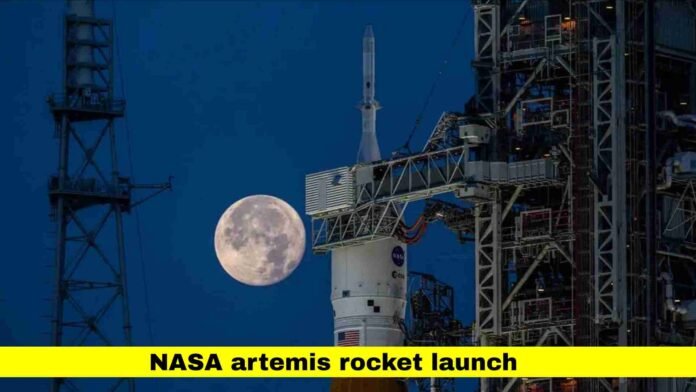

The nasa artemis rocket launch is on the brink of a historic milestone as NASA prepares its Space Launch System rocket and Orion crew vehicle for what could be the earliest crewed lunar mission in more than half a century. Employees and contractors at the agency’s Kennedy Space Center in Florida have recently completed a massive rollout of the spacecraft to its launch pad, marking a key turning point in the journey toward returning humans to deep space.
This 2000+-word in-depth article explains the current status of the Artemis II mission, the preparations under way at NASA, the scope and objectives of the launch, the astronauts involved, the technical processes being carried out, the mission timeline and launch windows, and the broader implications for human space exploration. Everything included here has been verified and confirmed as of today and reflects the latest developments in the Artemis lunar program and rocket launch preparations.
What Makes the NASA Artemis Rocket Launch So Significant
NASA’s Artemis program represents the United States’ most ambitious push into deep space since the Apollo era. The upcoming mission tied to this nasa artemis rocket launch — named Artemis II — will be the first crewed lunar mission the agency has undertaken since Apollo 17 in 1972.
While the mission will not include a lunar landing, it will play a crucial role in testing critical systems designed for future moon landings and sustained lunar operations. The success of this launch will pave the way for Artemis III, which is planned to bring humans back to the lunar surface and ultimately build toward an extended presence on the Moon and, someday, Mars.
Where NASA Is in the Artemis II Preparations
As of today, the massive Space Launch System (SLS) rocket — the vehicle that will propel astronauts beyond Earth orbit — has been successfully moved to Launch Pad 39B at the Kennedy Space Center in Cape Canaveral, Florida. This move marks a symbolic and practical shift from assembly to pre-launch preparations.
The rocket’s rollout from the Vehicle Assembly Building to the launch pad took more than 11 hours and involved careful coordination to transport the 322-foot tall launch stack, which includes the SLS, solid rocket boosters, and Orion crew capsule. Engineers and technicians have now begun a series of final readiness tests that will ultimately determine the exact launch date.
A key pre-launch event is the so-called “wet dress rehearsal,” during which the rocket’s fuel tanks will be filled, held under countdown conditions, then drained. This full-systems test verifies fueling procedures and checks for any issues before the mission moves into the final countdown stages, helping ensure the safety and success of the launch.
Launch Windows: When NASA Could Send Artemis II to Space
NASA mission planners have confirmed several possible launch windows for the Artemis II mission based on precise orbital mechanics, spacecraft readiness, and range availability. These launch windows reflect times when the Earth-Moon geometry is optimal for the spacecraft’s trajectory and safe return.
The earliest window for launch opens in early February 2026, with dates such as February 6 through 11 currently viable for liftoff. Additional windows exist later in the year, including a period in early to mid-March and another in late March through early April. Each window provides a set of days during which conditions align for a safe and efficient flight path around the Moon.
Final decisions on the exact launch date will depend on the results of pre-launch tests, including the wet dress rehearsal and any final system readiness reviews. The timeline remains dynamic as NASA engineers evaluate data and schedule the mission accordingly.
Mission Goals: Testing for the Future of Moon Exploration
The primary objective of the nasa artemis rocket launch associated with Artemis II is to send a crew of four astronauts on a lunar flyby mission to test the performance of the SLS rocket, Orion spacecraft, and all associated support systems under real mission conditions.
During the approximately 10-day mission, the crew will travel around the Moon and back to Earth, making this the first time humans have journeyed beyond low Earth orbit in more than five decades. The mission serves as a crucial stepping stone toward future lunar surface exploration and sustained lunar operations expected in Artemis III and beyond.
Testing objectives include validating life support systems, navigation and communication systems, crew procedures, and spacecraft performance in the deep space environment. Success in these areas will provide NASA with the confidence and data needed to send humans to the lunar surface in subsequent missions.
Who Will Fly on the Artemis II Mission
The Artemis II crew consists of four highly experienced astronauts representing the United States and Canada. Each crew member brings deep expertise in spaceflight operations and will play an integral role in testing spacecraft systems throughout the mission.
The astronauts named to this mission include:
- Commander: A seasoned NASA astronaut with extensive mission experience.
- Pilot: Responsible for spacecraft operations and supporting flight maneuvers.
- Mission Specialist: Tasked with managing specific technical systems and experiments.
- International Crew Member: An astronaut from the Canadian Space Agency, underscoring international cooperation in space exploration.
The crew will work together throughout the mission to monitor spacecraft systems, communicate with mission control, and execute mission plans designed to stress-test deep space operations.
Technical Preparations: What Happens at the Launch Pad
Once the SLS rocket and Orion spacecraft reached Launch Pad 39B at Kennedy Space Center, teams began a regimented sequence of technical processes critical to preparing for the nasa artemis rocket launch.
These steps include:
- Completing integrated systems checks to verify that all hardware and software function correctly.
- Conducting fueling tests and countdown rehearsals that simulate the launch sequence in real time.
- Inspecting key structural and propulsion components to ensure they meet performance requirements under mission conditions.
- Performing health checks on spacecraft life support, navigation, and communication systems.
Each of these steps must be completed successfully before NASA will clear the mission for launch. The goal is to identify and resolve issues early, maximizing the safety margin for the astronaut crew and mission success.
Launch Site and Infrastructure: Kennedy Space Center’s Role
The Kennedy Space Center in Florida has served as the launch site for America’s most iconic space missions, and it continues to play a central role in enabling deep space exploration.
Launch Pad 39B — the same complex that supported Apollo and Space Shuttle missions — has been adapted for the SLS rocket and Orion spacecraft. The pad includes state-of-the-art support infrastructure, fueling systems, service structures, and safety systems designed to support crewed deep space launches.
Supporting engineers, technicians, and mission controllers work round-the-clock to prepare the site, monitor readiness, and coordinate final launch activities as key milestones approach.
Global Implications of the Artemis Program
The nasa artemis rocket launch is not just a milestone for NASA — it represents a major achievement for global space exploration. The Artemis II mission bridges the gap between uncrewed testing and future lunar landings, laying the foundation for long-term lunar presence, expanded international cooperation, and exploration beyond the Moon.
By pushing the boundaries of deep space travel, the mission also contributes to scientific understanding of human physiology in space, advanced propulsion and life support technologies, and the development of infrastructure that might one day support human missions to Mars and other destinations in the solar system.
Public Engagement and Participation Opportunities
In addition to the technical side of the mission, NASA has introduced opportunities for public engagement tied to the Artemis II launch. For example, members of the public can participate in special events, immersive experiences, and educational activities that bring the excitement of human exploration closer to home.
NASA’s outreach efforts aim to inspire a new generation of scientists, engineers, and space enthusiasts, while highlighting opportunities for students and communities to connect with the mission’s objectives, design, and legacy.
These initiatives underscore the public’s role in celebrating and supporting monumental achievements in space exploration.
Challenges and Reality of Launch Scheduling
Preparing for a crewed lunar mission — the first in decades — involves managing a wide range of technical, logistical, and environmental challenges. Launch windows depend on careful calculations of orbital alignment, weather conditions, spacecraft readiness, and ground support availability.
As a result, while the earliest potential launch dates fall in early February 2026, NASA maintains flexibility in its schedule to account for test outcomes, external factors, and safety considerations. Every major milestone, including the wet dress rehearsal and final flight readiness review, will influence the final launch decision.
This approach reflects decades of experience and an emphasis on crew and mission safety above all else.
What Happens After the Launch
If the nasa artemis rocket launch occurs within its primary window, the spacecraft will carry its crew on a 10-day journey around the Moon. Upon returning to Earth, the Orion capsule is expected to splash down in the Pacific Ocean, completing the mission.
Data collected throughout the flight will be analyzed intensively to refine plans for future missions, including Artemis III, which aims to land astronauts on the lunar surface and expand human presence on the Moon.
The knowledge gained during Artemis II will inform spacecraft design, mission planning, astronaut training, and deep space operational protocols for years to come.
The Broader Legacy of Artemis II
This mission represents a historic return of humans to deep space — a journey that has not occurred in more than 50 years. It reflects decades of technological innovation, international cooperation, and a renewed human ambition to explore beyond our planet.
The successful launch and completion of Artemis II will mark a defining moment in space exploration history and serve as a milestone on the pathway to sustainable lunar operations and future missions to distant destinations.
Will you be watching the nasa artemis rocket launch or following mission updates as the countdown progresses? Share your thoughts below and stay tuned for future developments.