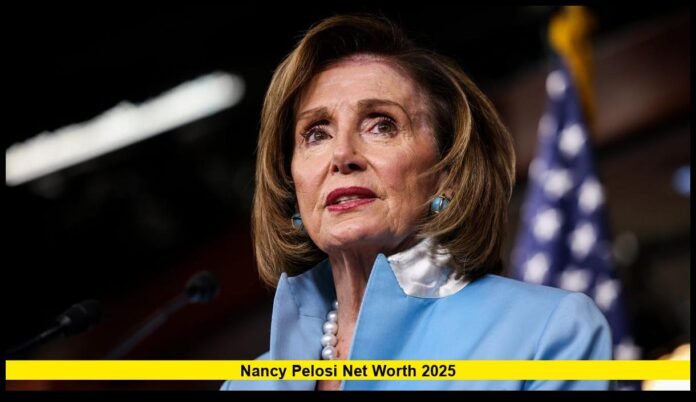

The Nancy Pelosi net worth 2025 update remains a subject of great public interest as one of America’s most prominent political figures continues to rank among the wealthiest members of Congress. As of November 2025, Pelosi’s net worth is estimated at $135 million, based on official financial disclosures submitted to the Clerk of the U.S. House of Representatives and publicly available property and investment data.
Pelosi’s financial portfolio, shared with her husband, businessman Paul Pelosi, reflects decades of strategic investing, real estate acquisitions, and business ventures. Although she no longer serves as Speaker of the House, her wealth and influence in both political and financial circles remain substantial.
This detailed analysis explores how Nancy Pelosi built her fortune, where her wealth is invested, and how her net worth in 2025 compares to other lawmakers.
Nancy Pelosi’s Net Worth in 2025: The Complete Picture
Nancy Pelosi’s estimated net worth of $135 million in 2025 places her firmly among the richest members of Congress. Her wealth primarily stems from stock investments, real estate holdings, and her husband’s business ventures.
Her financial disclosures show a diverse portfolio that has performed well in recent years, buoyed by a strong U.S. stock market and California’s continued real estate boom.
Pelosi’s 2025 Financial Overview:
- Estimated Net Worth: $135 million
- Primary Income Sources: Investments, real estate, and business interests
- Assets Under Management: Between $110 million and $145 million
- Liabilities (Loans and Mortgages): Less than $5 million
- Annual Congressional Salary: $223,500
Pelosi’s wealth accumulation over her nearly four-decade career demonstrates consistent growth through both public service and private investment.
How Nancy Pelosi Built Her Fortune
Pelosi’s financial success is rooted in long-term investments and a strong family business foundation. While her congressional salary has remained relatively modest compared to her total wealth, her family’s savvy financial strategy has allowed their assets to grow steadily.
1. Stock Market Investments
The largest portion of Nancy Pelosi net worth 2025 comes from stock market holdings. Managed primarily by her husband, Paul Pelosi — the founder of Financial Leasing Services, Inc., a San Francisco-based investment and consulting firm — the Pelosi portfolio includes stakes in major American corporations.
Their disclosed holdings include:
- Apple Inc. (AAPL) – Long-term tech investment dating back to the early 2000s.
- Alphabet Inc. (GOOGL) – Shares benefiting from growth in AI and digital advertising.
- NVIDIA Corporation (NVDA) – Notable gains following the AI semiconductor boom of 2025.
- Microsoft Corp. (MSFT) – Steady appreciation tied to cloud computing and enterprise software.
- Visa Inc. (V) and Amazon.com (AMZN) – Consistent performers in diversified portfolios.
In total, Pelosi’s stock portfolio is valued between $60 million and $80 million, depending on market fluctuations. Her portfolio also includes municipal bonds and mutual funds for long-term stability.
2. Real Estate Holdings
Real estate is the second major pillar of Nancy Pelosi’s net worth. Her family owns several high-value properties across California and Washington, D.C., each appreciating significantly over the past decade.
Notable Real Estate Assets:
- Pacific Heights Mansion (San Francisco): Pelosi’s primary residence, valued at approximately $25–30 million in 2025, featuring luxury architecture and panoramic views.
- Napa Valley Vineyard Estate: Estimated at $6–8 million, this property includes vineyards and a guest house that generate secondary income.
- Washington, D.C. Townhouse: A valuable residence near Capitol Hill, worth about $3 million.
Combined, Pelosi’s real estate assets contribute roughly $40 million to her overall wealth. These holdings also benefit from California’s sustained high property values, especially in the Bay Area.
3. Business Ventures and Private Equity
Paul Pelosi’s company, Financial Leasing Services, Inc., plays a key role in maintaining and expanding the family’s financial portfolio. The firm’s investments include venture capital, private equity, and real estate development.
Through this firm, the Pelosis have invested in:
- Commercial real estate partnerships in California.
- Early-stage technology startups.
- Private bond markets and leasing ventures.
Though Nancy Pelosi has no direct managerial role in these ventures, her financial disclosure lists them as primary income-producing assets.
Pelosi’s Congressional Salary and Pension
Nancy Pelosi’s official congressional salary in 2025 is $223,500, reflecting her seniority as a long-serving member of Congress. In addition, she qualifies for a federal pension after nearly four decades of service, estimated to be worth around $125,000 per year upon retirement.
While her salary and pension form a stable base, they represent only a small fraction of her total net worth. Pelosi’s financial independence is largely attributed to long-term private investments rather than her government earnings.
Pelosi’s Financial Growth Over Time
Nancy Pelosi’s rise in wealth has paralleled her long political career. Here’s a timeline showing the evolution of her financial growth:
| Year | Key Financial Milestone | Estimated Net Worth |
|---|---|---|
| 1987 | First elected to Congress | ~$3 million |
| 2003 | Became House Minority Leader | ~$25 million |
| 2007 | First tenure as Speaker of the House | ~$60 million |
| 2013 | Expanded real estate portfolio | ~$90 million |
| 2021 | Ended second term as Speaker | ~$114 million |
| 2025 | Latest estimate | ~$135 million |
This steady growth shows how Pelosi’s portfolio benefited from market resilience, particularly in the technology and real estate sectors.
How Pelosi’s Investments Are Managed
While Nancy Pelosi is often associated with stock market discussions, her investment management is handled independently by her husband’s firm. Financial disclosures confirm that her assets are actively managed under federal compliance laws, ensuring no direct conflict of interest with legislative activity.
Paul Pelosi’s investment decisions often mirror major market trends, focusing on blue-chip technology, finance, and real estate sectors. Their investment approach leans conservative, emphasizing diversification and stability over high-risk ventures.
Public Scrutiny and Transparency
Pelosi’s wealth has faced increasing scrutiny, particularly in discussions about congressional stock trading ethics. Critics have questioned whether lawmakers should be allowed to own or trade individual stocks, given their access to insider policy information.
In 2025, Pelosi reiterated her support for stricter rules requiring full disclosure and limiting individual stock trades by members of Congress and their families. Her most recent financial report, filed mid-2025, remains fully compliant and publicly available through the House Ethics Committee database.
Despite public criticism, Pelosi maintains that her investments are legally transparent and independently managed.
Comparison with Other Wealthy Lawmakers
Nancy Pelosi ranks among the top tier of financially successful lawmakers in 2025 but is not the wealthiest. Her net worth trails behind a few notable peers.
| Lawmakers (2025) | Estimated Net Worth | Primary Source of Wealth |
|---|---|---|
| Rick Scott (R-FL) | $260 million | Investments, healthcare industry |
| Mark Warner (D-VA) | $215 million | Telecom and venture capital |
| Nancy Pelosi (D-CA) | $135 million | Stocks, real estate, business income |
| Mitt Romney (R-UT) | $110 million | Private equity, Bain Capital |
| Darrell Issa (R-CA) | $105 million | Technology patents, manufacturing |
Pelosi remains the wealthiest woman in Congress, maintaining that position for more than a decade.
Philanthropy and Public Service Contributions
Despite her wealth, Pelosi has consistently used her resources to support philanthropic causes and public programs.
Her contributions focus on education, healthcare, and cultural institutions:
- Education: Endowments to universities, including Georgetown and the University of San Francisco.
- Health Initiatives: Donations to cancer research and children’s hospitals.
- Arts & Culture: Support for the San Francisco Symphony and local art museums.
- Community Aid: Funding for homelessness prevention and housing programs in California.
These efforts underscore Pelosi’s role not just as a politician but as a benefactor of social progress.
Pelosi’s Role in 2025 and Ongoing Influence
Though no longer House Speaker, Pelosi remains active as the Representative for California’s 11th District, covering the San Francisco Bay Area. In 2025, she continues to focus on economic policy, healthcare reform, and environmental legislation, while mentoring younger Democratic lawmakers.
Her influence extends beyond politics, as investors and media outlets continue to monitor her family’s financial decisions and the broader conversation about congressional ethics.
Pelosi’s mix of political longevity, financial acumen, and philanthropy has made her one of the most recognized public figures in U.S. political history.
Impact of the 2025 Economy on Pelosi’s Wealth
The 2025 economic landscape has been favorable for high-net-worth individuals like Pelosi. The Dow Jones Industrial Average and NASDAQ Composite both hit record highs this year, lifting the value of her technology-heavy portfolio.
Additionally, despite minor slowdowns in the California real estate market, Pelosi’s property holdings in prime areas continue to appreciate steadily. The growth of renewable energy and technology sectors — areas where the Pelosis hold significant investments — has further boosted their wealth.
The Bottom Line
The Nancy Pelosi net worth 2025 estimate of $135 million highlights not only her financial success but also her enduring influence in American politics and business. Her diversified wealth — spanning technology investments, prime real estate, and family enterprises — underscores decades of financial strategy and stability.
As Pelosi continues to shape policy discussions and mentor new lawmakers, her wealth remains a reflection of both personal success and the broader debate about financial transparency in U.S. government.
What are your thoughts on Nancy Pelosi’s financial journey and the role of wealth in politics? Share your opinions in the comments below and join the discussion.