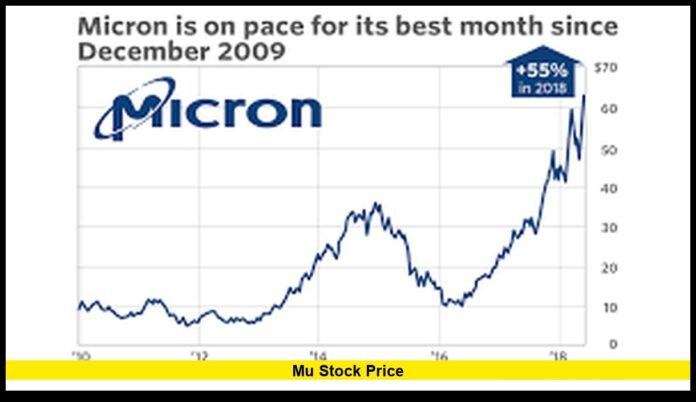

mu stock price remains a major focus for U.S. investors as Micron Technology continues to ride strong artificial intelligence demand and improving memory pricing trends. As of February 24, 2026, Micron stands among the most closely tracked semiconductor companies because its business sits at the center of AI infrastructure, cloud computing, and data-center expansion.
Recent trading activity shows Micron shares moving with broader semiconductor momentum while reacting sharply to earnings guidance, memory pricing updates, and high-bandwidth memory production signals.
Recent mu stock price performance
Micron Technology (NASDAQ: MU) has maintained elevated market attention throughout 2025 and early 2026. The stock experienced strong gains during the AI-driven semiconductor rally, followed by periodic pullbacks linked to sector rotations and profit-taking.
Current performance trends highlight:
- Continued investor demand for AI-related chip companies
- Increased trading volume around earnings periods
- Sensitivity to memory pricing updates
Because Micron’s revenue depends heavily on memory pricing, even small industry changes can influence stock movement.
Primary factors moving Micron stock
Several key industry developments explain recent movement in the mu stock price.
AI memory demand growth
Artificial intelligence hardware requires significantly more memory than traditional computing. High-bandwidth memory has become essential for AI accelerators, positioning Micron as a critical supplier.
Ongoing AI infrastructure investment continues to support stronger demand visibility.
Memory pricing recovery
The memory industry shifted into recovery during 2024 after a downturn. Pricing improved through 2025 as inventories normalized across consumer devices and data centers.
That pricing momentum remains one of the most important drivers of Micron’s financial performance.
Industry supply discipline
Manufacturers reduced production growth during the downturn, which helped stabilize pricing. Investors now watch whether companies maintain this discipline through 2026.
Earnings influence on mu stock price
Micron earnings releases consistently act as major catalysts.
Recent financial direction shows:
- Revenue growth tied to data center demand
- Improving profitability as pricing strengthened
- Forward outlook increasingly linked to AI memory shipments
Statements about high-bandwidth memory supply often trigger immediate market reactions.
Key indicators investors monitor
To understand mu stock price direction, investors track several core metrics.
| Indicator | Reason investors watch |
|---|---|
| DRAM pricing | Main revenue driver |
| HBM production | Measures AI exposure |
| Gross margin | Reflects pricing power |
| Inventory levels | Signals cycle strength |
| Data center sales | Growth engine |
These indicators provide early insight into the memory cycle.
Market sentiment around Micron
Micron’s market perception has shifted over time. The company is no longer viewed only as a cyclical memory supplier.
Bullish sentiment focuses on:
- Structural growth from AI computing
- Limited advanced memory supply globally
- Pricing leverage during recovery cycles
Cautious views emphasize:
- Memory cycles historically reversing quickly
- Large capital spending requirements
- Sensitivity to macroeconomic conditions
This balance contributes to ongoing volatility.
Understanding the memory cycle
Memory companies follow recognizable industry cycles that strongly affect stock performance.
Typical stages include:
- Oversupply leading to price declines
- Production cuts and inventory reset
- Pricing recovery
- Margin expansion and stock rallies
The industry entered recovery in 2024 and continued strengthening through 2025. Investors are now evaluating how long the current upcycle will last.
AI’s structural impact on Micron valuation
Artificial intelligence has changed valuation frameworks for memory stocks.
Important structural shifts include:
- High-bandwidth memory becoming strategic technology
- Increased memory content per AI server
- Longer demand visibility from hyperscale cloud companies
These changes support stronger long-term growth expectations, although cyclicality remains part of the business.
Risks that may affect mu stock price
Despite positive industry momentum, several risks remain.
- Potential oversupply if production increases too quickly
- Slower technology spending from enterprises or consumers
- Competitive investment in advanced memory technologies
- Broader semiconductor market volatility
These factors can quickly influence pricing and investor sentiment.
Short-term catalysts investors are watching
Near-term developments that may drive mu stock price movement include:
- Earnings guidance updates
- High-bandwidth memory allocation commentary
- DRAM contract pricing trends
- Capital expenditure announcements
- Signals about AI infrastructure spending
Short-term price swings often follow these updates.
Long-term outlook for Micron stock
Micron’s long-term narrative increasingly centers on its role in AI memory supply.
Supportive themes include:
- Expanding AI server deployment globally
- Rising memory requirements per workload
- Strategic importance of advanced DRAM
- Continued growth in data center demand
However, sustained performance depends on pricing stability and disciplined supply growth.
Why MU behaves differently from many chip stocks
Micron operates at the intersection of cyclical recovery and structural technology growth.
Memory companies benefit from strong pricing leverage during upcycles, which can accelerate earnings growth. At the same time, downturns can reduce profits quickly, leading to larger stock swings.
That dynamic explains why MU often moves more sharply than many semiconductor peers.
Investor strategies around mu stock price
Different investor groups approach Micron differently.
- Cycle-focused investors trade based on pricing signals
- Growth investors emphasize AI exposure
- Long-term investors accumulate shares during downturns
Timing around memory cycle transitions remains a central strategy.
Market positioning entering 2026
As 2026 progresses, Micron remains positioned as a major AI memory supplier.
Markets continue evaluating:
- Sustainability of pricing recovery
- Pace of high-bandwidth memory expansion
- Data center demand strength
- Industry production discipline
These variables will likely shape the next major move in the mu stock price.
FAQ
What does MU represent in the stock market?
MU is the ticker symbol for Micron Technology, a U.S. semiconductor company specializing in DRAM and NAND memory.
Why does the mu stock price move with AI news?
AI systems require advanced memory, making Micron’s products essential for AI infrastructure.
What is the biggest driver of Micron revenue?
DRAM pricing remains the largest revenue driver for the company.
Is Micron considered cyclical?
Yes. The company operates in a cyclical memory industry, though AI demand supports long-term growth.
What should investors watch most closely?
Memory pricing trends, earnings guidance, and high-bandwidth memory production updates.
Disclaimer
This content is provided for informational purposes only and should not be interpreted as investment advice. Stock prices change frequently, and investing involves risk. Readers should perform independent research and consult a financial professional before making investment decisions.
Micron continues to sit at the center of the AI memory story — share your view on the mu stock price and follow upcoming market developments.