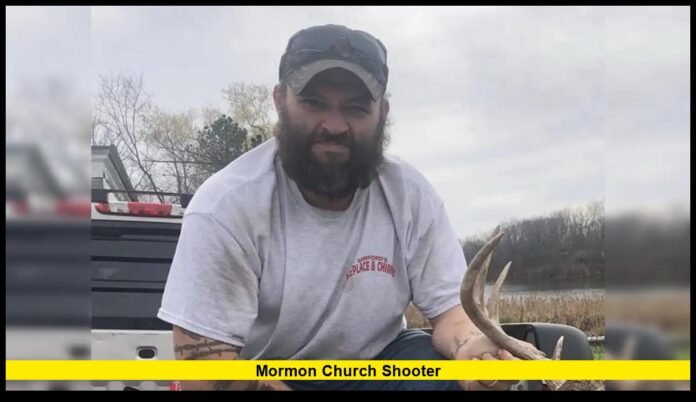

A devastating tragedy unfolded in Grand Blanc Township, Michigan, on September 28, 2025, when a mormon church shooter attacked a local meetinghouse of the Church of Jesus Christ of Latter-day Saints (LDS). The attacker, later identified as a 40-year-old former Marine, left four people dead and at least eight more injured before being stopped by police. The violent incident combined gunfire, arson, and terror, turning a Sunday morning worship service into a scene of chaos.
This attack has not only left families grieving but also raised urgent questions about violence against faith communities in the United States.
Timeline of the Grand Blanc Attack
On the morning of September 28, congregants gathered for Sunday services at the LDS meetinghouse. Around 10:25 a.m., the calm was shattered when the shooter crashed his pickup truck into the church building. The vehicle, loaded with gasoline, ignited flames that spread quickly.
Witnesses reported that within moments, the assailant exited the truck armed with a semi-automatic rifle. He began firing indiscriminately at members of the congregation. Many worshippers scrambled to find safety, some shielding children and elderly members as the smoke from the fire spread through the sanctuary.
Police were called immediately and arrived within minutes. Officers engaged the gunman in a shootout that ended with his death on the scene. By then, however, four members of the congregation had been killed, and at least eight others were rushed to nearby hospitals with varying degrees of injury, ranging from gunshot wounds to smoke inhalation.
The building itself sustained catastrophic fire damage, complicating rescue and recovery operations. Authorities confirmed that two of the deceased victims were found after fire crews searched through the burned remains of the church.
Shooter Identified: Thomas Jacob Sanford
Authorities identified the attacker as Thomas Jacob Sanford, a 40-year-old resident of Burton, Michigan. Sanford had served in the U.S. Marine Corps from 2004 to 2008, including a deployment to Iraq.
Neighbors described him as once quiet and hardworking, but recent reports indicate troubling changes in his behavior. Several locals recalled hearing him speak bitterly about religion, particularly the Mormon faith. Sanford reportedly expressed disdain for LDS practices, including temple “sealing” ceremonies, which he criticized publicly in local conversations and debates.
While investigators have not confirmed a specific motive, the attack is being treated as a targeted assault on a religious institution. Federal agencies, including the FBI and ATF, are assisting local police in uncovering whether Sanford acted alone, whether he had extremist affiliations, or if personal grievances drove him to violence.
Search warrants executed at his home have led to the discovery of electronic devices, writings, and potential evidence that could help piece together his state of mind. Authorities have also confirmed finding improvised explosives at or near the church, further suggesting that Sanford planned the attack in advance.
Impact on Victims and Families
Four victims tragically lost their lives, their identities being released gradually as families are notified. Among the dead are long-standing members of the local LDS community who were deeply involved in church activities. The eight injured range in age and background, and several remain hospitalized in critical condition.
Family members have spoken of unimaginable grief. One relative of a victim said, “They went to church to find peace, and instead, they were met with violence. Our family is broken, but our faith remains.”
Support has poured in from across Michigan and beyond. Community members have organized vigils, bringing flowers, candles, and prayers to the charred remains of the church. Counseling services are being offered to survivors and families as they grapple with the trauma of what they witnessed.
Local and National Reactions
Governor’s Response
Michigan Governor Gretchen Whitmer called the attack “a heartbreaking assault on a community of faith.” She pledged resources for victim support and urged communities to stand together against hatred and violence.
National Leaders Speak Out
Political leaders from both parties expressed outrage and condolences. Former President Donald Trump condemned the incident as a targeted attack on Christians, calling for stronger measures to secure places of worship. Other lawmakers emphasized the broader issue of mass shootings in America and the urgent need for solutions to prevent such tragedies.
Church Leadership
The Church of Jesus Christ of Latter-day Saints issued a statement mourning the loss of life and offering prayers for the families impacted. The church called on members worldwide to join in solidarity with the Grand Blanc congregation.
Investigation Progress
Authorities are piecing together how Sanford executed the attack and why he chose this specific congregation. The ongoing investigation is focusing on:
- Motive: Whether the attack stemmed from personal grievances, ideological beliefs, or mental health struggles.
- Planning: The presence of incendiary devices suggests premeditation. Investigators are reviewing digital evidence for planning details.
- Connections: Law enforcement is probing whether Sanford had links to extremist groups or acted entirely on his own.
- Missed Signs: Officials are reviewing whether Sanford exhibited red-flag behaviors that should have triggered intervention before the attack.
Pattern of Violence at Faith Centers
The attack in Michigan is not an isolated event. In 2025, the U.S. has seen multiple assaults on places of worship. Only weeks earlier, a Catholic church in Minneapolis was attacked, leaving two dead. Across the country, churches, synagogues, mosques, and temples have been forced to confront the reality of increasing risks.
Gun violence statistics show that the United States has surpassed 320 mass shootings this year alone, defined as incidents where at least four people are shot or killed. Sadly, a growing number of these tragedies occur in houses of worship — places traditionally seen as sanctuaries of peace.
Faith leaders nationwide are renewing calls for better security measures, mental health support, and dialogue aimed at reducing hate-driven violence.
Community Resilience in the Face of Tragedy
Despite the shock and grief, the people of Grand Blanc are showing remarkable resilience. Vigils, prayer circles, and volunteer efforts have filled the days since the attack. Local churches of all denominations have opened their doors to provide support.
Counselors are working with survivors and children who were present during the attack. Volunteers are organizing meal trains and financial assistance for families directly impacted.
The community is also discussing how to rebuild the LDS meetinghouse, which was heavily damaged by both fire and gunfire. Church leaders expressed confidence that the congregation will gather again, even stronger than before.
What Remains Unknown
While investigators continue their work, several unanswered questions remain:
- Was Sanford driven purely by religious hostility, or were there personal conflicts involved?
- Could warning signs have been recognized earlier to prevent the attack?
- How did Sanford acquire his firearms and incendiary materials?
- What additional measures can be taken to safeguard places of worship without eroding the openness that defines them?
These questions will take time to answer, but they underscore the importance of addressing both immediate security and long-term social issues.
Looking Forward
The mormon church shooter tragedy in Michigan is now a defining moment for the Grand Blanc community and for discussions nationwide about safety, faith, and violence. While the pain of loss cannot be erased, the determination of survivors and families to heal and rebuild sends a message of resilience.
This incident also highlights a larger national crisis: the frequency of mass shootings and the vulnerability of sacred spaces. As investigators search for answers, Americans are left grappling with how to protect both their communities and their freedoms.
The wounds from this attack will take time to heal, but conversations about unity, safety, and faith are more important than ever. Share your thoughts below and join the dialogue on how communities can move forward together.