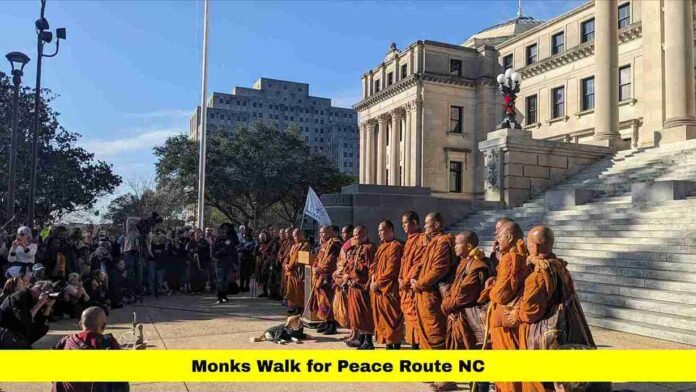

In a powerful display of commitment and compassion, a group of Theravada Buddhist monks currently on a 2,300-mile pilgrimage is making its way into the Carolinas, drawing attention and support as they approach key North Carolina cities along the monks walk for peace route NC. This walk is one of the most remarkable grassroots movements happening in the United States right now, involving daily long-distance trekking, community gatherings, and a deeply symbolic mission that resonates with thousands of Americans from all walks of life.
As the monks make their way toward Washington, D.C., this article takes a detailed look at the latest verified updates, sharing what the journey means, how it unfolds, the route through North Carolina, community engagement, challenges faced, and the larger context of this unique endeavor — all based on confirmed information as of today.
What Is the Walk for Peace and Who Are the Monks?
The Walk for Peace is a cross-country pilgrimage that began on October 26, 2025. A group of Theravada Buddhist monks — originally traveling together with a rescue dog named Aloka — embarked on a barefoot journey starting in Fort Worth, Texas. The walk will span approximately 2,300 miles through multiple states before ending in mid-February 2026 at the U.S. Capitol in Washington, D.C.
This demonstration is not a protest or political march but a deliberate trek intended to promote peace, mindfulness, unity, compassion, and inner healing across the nation. The monks walk slowly and deliberately, embodying their message in physical practice rather than rhetoric, drawing both in-person followers and online audiences as they travel.
Their leader, Venerable Bhikkhu Pannakara, seems to guide the group with a simple but profound directive — peace is a personal practice that must be cultivated from within and shared outward through compassion and mindful presence. Their mission also includes a request to Congress to recognize Vesak — the day celebrating the Buddha’s birth and enlightenment — as a federal holiday, underscoring their emphasis on reflection and unity.
Where the Monks Have Walked So Far
Since leaving Texas, the monks have passed through a series of Southern and Southeastern states. They have drawn crowds and received local honors along the route, especially in places where residents have come out to welcome them during rest stops and roadside gatherings.
After crossing through Georgia and parts of South Carolina, including a notable stop in Columbia where lawmakers recognized their journey, the group continued steadily northward. They have been walking for well over 70 days and have built a rhythm of short daily distances, community interaction, and invitations for local residents to join them for parts of their walk or observe respectfully during scheduled rest periods.
Along the route, thousands of people in multiple states have trekked beside the monks for short stretches, offered food or water, placed flowers along the road, and listened as the monks share their message of compassionate living.
Entering North Carolina: The Current Phase of the Journey
As of today, the monks are entering North Carolina. They were expected to arrive in Charlotte as they continued north from South Carolina. The group has mapped its passage through key locations, with the first significant stop within the state scheduled for Charlotte, where they will rest and welcome visitors during designated hours.
They were expected to arrive in the Charlotte area from nearby Fort Mill and Rock Hill, South Carolina, and cross the state line to continue their trek. Their planned route within and beyond Charlotte includes Pineville, Harrisburg, Concord, Kannapolis, Salisbury, and other communities as they proceed toward Greensboro and eventually Raleigh. While exact stop dates and locations can shift slightly based on pace, weather, and logistical considerations, these cities form the core path for the monks in North Carolina.
At each rest stop, the monks allow visitors to observe quietly, join in meditation or reflection, offer food, and participate in a mindful welcome that reinforces the peaceful purpose of their pilgrimage.
What to Expect on the Monks Walk for Peace Route in North Carolina
As the monks move along their path, local organizers and supporters have shared guidance on how communities can respectfully engage with the peace walkers:
- Observers are encouraged to maintain silence or speak softly during the walk.
- Visitors may place flowers or offer food that aligns with the monks’ vegetarian practice.
- People may walk with the monks behind the group, not in front or beside them, to maintain the intended flow and focus of the pilgrimage.
- Crowds often gather at rest stops or authorized visitation points rather than walking directly alongside the monks on highways or busy roads.
Charlotte and surrounding communities are preparing for larger crowds as the walk progresses. On the day the monks arrive, sections of road and traffic may slow as local law enforcement assists with safety and crowd management to ensure the walk continues smoothly and respectfully.
The Role of Aloka the Peace Dog
The monks’ loyal companion, Aloka, has become an unlikely symbol of the pilgrimage. A rescue dog with a recognizable heart-shaped mark on his forehead, Aloka has walked almost the entire journey with the monks and drawn significant public affection and media attention.
Recently, Aloka suffered a leg injury that required veterinary surgery. Reports indicate that the surgery was successful, and Aloka is currently recovering under medical care. Though his activity has been limited as he regains strength, the monks have shared that he may rejoin the group as he recuperates, continuing to walk alongside them as soon as he is physically able.
His temporary absence has not slowed the monks’ pace significantly, but his return is eagerly anticipated by supporters and onlookers who have followed the pilgrimage.
Community Reactions and Public Engagement
One of the most striking elements of the Walk for Peace has been the organic groundswell of support from communities along the route. Tens of thousands of people have lined highways, participated in moments of silent greeting, offered food and water, and shared warm messages of unity and compassion.
In South Carolina, several towns hosted welcoming gatherings that brought together residents of diverse backgrounds, reflecting a shared desire for healing and connection in times of societal tension. As the monks enter North Carolina, similar gatherings and peaceful public interest are expected, with many local observers considering their presence as a reminder of mindful unity.
Safety and Logistical Considerations
Because this pilgrimage takes place on foot over a long distance with large public interest, safety has been a key consideration. Local law enforcement has been assisting the monks by managing traffic, ensuring crowd safety, and coordinating safe walking paths where possible.
Residents along the monks’ path have reported slower traffic, temporary closures, and enhanced police presence to accommodate the procession. Organizers emphasize the importance of observing quietly, respecting the monks’ pace, and avoiding distraction from the purpose of the walk.
Why This Walk Matters Today
The Walk for Peace has reached national attention not because it is a protest or a political demonstration, but because it resonates on a human level. In a time marked by division, stress, conflict, and unprecedented challenges to mental well-being, a group of individuals walking for peace has struck a chord with people from many walks of life.
The monks’ message emphasizes that peace begins within each person and ripples outward — to families, communities, and the broader society. Their route through North Carolina offers residents an opportunity to connect with that message directly, to pause, reflect, and perhaps find inspiration in the simplicity of their practice.
What Lies Ahead on the Walk for Peace Route
After progressing through North Carolina cities like Charlotte, Harrisburg, Concord, and Greensboro, the monks are expected to continue into Virginia, then Maryland, before ultimately completing their pilgrimage in Washington, D.C., by mid-February.
At the U.S. Capitol, they plan to deliver a short statement and formally request federal recognition of Vesak as a national day honoring peace and enlightenment. The walk’s final days are anticipated to draw even broader public attention, bringing the long and spiritual procession to a powerful close.
How to Follow the Pilgrimage
The monks update followers regularly through their own live maps and social media postings, which provide daily locations, expected rest stops, and opportunities for respectful community interaction. These platforms have helped supporters from across the country — and around the world — track progress and join in spirit if they cannot be there in person.
Have you seen the monks walk through your community or plan to welcome them along the route? Share your experiences and thoughts as this inspiring journey progresses.