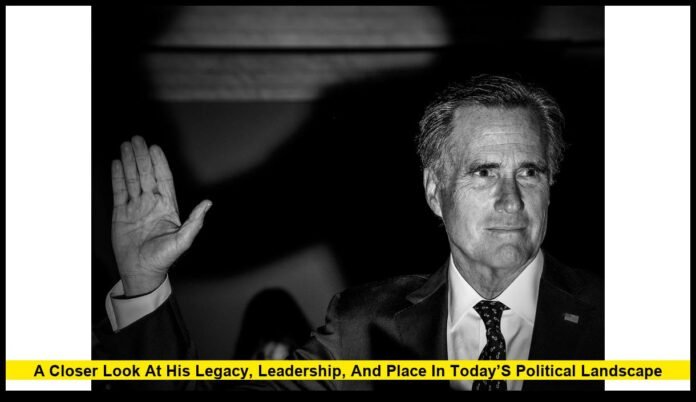

Discussions about Mitt Romney age have taken on new weight in recent years as the nation grapples with the role of older political leaders in shaping the country’s future. Born on March 12, 1947, Romney is 78 years old as of 2025. His age puts him in the same generational bracket as many of the most powerful and well-known figures in American politics, but his approach to leadership and transition sets him apart.
As one of the few prominent Republicans to announce a voluntary step back from elected office while still active and respected, Romney’s decision has sparked conversations about generational change, political legacy, and how age influences leadership.
A Life That Spans Generations of Change
Mitt Romney’s age places him in a unique position. Having grown up in the postwar years, he has witnessed the evolution of America through some of its most transformative periods — from the civil rights movement to the space race, from Cold War tensions to the internet era. His lifetime mirrors the trajectory of the modern United States, giving his political outlook both historical depth and contemporary awareness.
Born in Detroit, Michigan, Romney was raised in a politically active family. His father, George Romney, served as the Governor of Michigan and later as a Cabinet member under President Richard Nixon. Surrounded by politics from an early age, Mitt’s worldview was shaped by dinner-table discussions of governance, business, and public service. By the time he reached adulthood, he had experienced firsthand how public leadership affects communities.
Educational and Early Career Foundations
Before politics, Romney’s path took him through rigorous academic and professional environments. After graduating high school, he spent time at Stanford University before leaving to serve as a missionary in France — an experience that strengthened his communication skills and broadened his worldview. He later completed his undergraduate studies at Brigham Young University and went on to earn both a law degree and an MBA from Harvard University in the mid-1970s.
By the time Romney reached his early thirties, he was already making waves in the business world. His analytical skills and calm, methodical approach set him apart from many peers of his generation. These early professional choices would later shape how he governed and campaigned.
Career Milestones Across the Decades
When examining Mitt Romney age, it’s useful to break down his career across distinct decades, each reflecting how his leadership evolved with the times.
The 1980s–1990s: Business Leadership and Early Political Foray
Romney rose to prominence as a management consultant and later co-founded Bain Capital, where he became known for corporate turnarounds and strategic investments. In 1994, at age 47, he ran for U.S. Senate in Massachusetts against Ted Kennedy. Although he lost, the race established him as a serious political figure.
The 2000s: From Olympics to Governor
In 1999, at age 52, Romney was tapped to lead the troubled Salt Lake City Olympic Committee. His leadership revitalized the 2002 Winter Games, earning bipartisan praise. Shortly after, at 55, he successfully ran for Governor of Massachusetts, serving from 2003 to 2007. His administration focused on fiscal responsibility and health care reform — notably a precursor to federal reforms passed years later.
The 2010s: Presidential Runs and Senate Role
Romney sought the Republican presidential nomination in 2008 at age 60, losing to John McCain. In 2012, at age 65, he became the Republican nominee, running against incumbent President Barack Obama. While he lost the election, his campaign reshaped discussions within the Republican Party about economics and foreign policy. Later, at 71, Romney returned to public service by winning a Senate seat in Utah in 2018.
The 2020s: Senior Statesman Role
Now in his late seventies, Romney’s career has shifted from seeking higher office to offering perspective and critique. His decision not to run for re-election reflects a deliberate choice to make room for the next generation of leaders — a theme that distinguishes him in a political landscape where many cling to power well into their 80s.
Mitt Romney’s Age in Context with Other Political Leaders
Romney’s age places him among a cluster of veteran political figures who continue to shape national debate. To put it in perspective:
| Political Figure | Age (as of Oct 2025) | Position / Role |
|---|---|---|
| Joe Biden | 82 | President of the United States |
| Donald Trump | 79 | Former President |
| Mitt Romney | 78 | U.S. Senator (retiring end of term) |
| Nancy Pelosi | 85 | Former Speaker of the House |
| Mitch McConnell | 83 | Senate Republican Leader |
This table highlights how Mitt Romney age fits into the broader generational picture. However, unlike many peers, Romney has been vocal about the need for new leadership. He has stated that the country is best served when younger generations bring new energy and perspectives to national challenges.
Why Age Has Become a Political Conversation
Romney’s age isn’t simply a biographical fact; it’s a symbol of a broader national debate. In recent years, age has become a flashpoint in discussions about political effectiveness, mental sharpness, and representation. With both major party presidential front-runners in their late 70s and 80s, many Americans are questioning whether the nation’s leadership reflects its demographic reality.
Romney stands out because, at 78, he has voluntarily chosen not to extend his time in office. He argues that experience has value but so does knowing when to step aside. His decision to retire from the Senate at the end of his term has been framed not as withdrawal, but as a conscious step toward generational transition.
How His Age Shapes His Perspective
At 78, Romney brings a long view to contemporary issues. He has lived through multiple political eras — from postwar bipartisanship to modern hyperpolarization — and uses that perspective to comment on today’s challenges.
For example, Romney has often urged fellow lawmakers to think beyond short-term electoral cycles and focus on long-term governance. He frequently references institutional stability, respect for democratic norms, and the importance of truth — themes that resonate deeply with voters looking for steadiness amid volatility.
His age also gives him independence. With no future campaigns to plan, he can speak more freely than many of his younger, more ambitious peers. This has led to moments of bipartisan praise, as well as criticism from within his own party.
Public Perception of Mitt Romney Age
Public opinion on Romney’s age is mixed but notable. Many voters see his age as a source of wisdom and stability, appreciating his decades of experience and his willingness to stand independently on contentious issues. Others view it as a reason to celebrate his decision to step aside, seeing it as an acknowledgment that leadership must evolve.
Polls in Utah leading up to his retirement announcement showed that a majority of voters respected his service, and many agreed with his call for new leadership. Nationally, he remains a respected if polarizing figure, often admired by moderates and centrists, while some conservative factions see him as too willing to break with party lines.
Romney’s Age and Legacy
Ultimately, Mitt Romney age is not just a number — it’s a marker of a lifetime spent at the center of business, politics, and national conversation. His legacy is defined by his willingness to lead in moments of crisis, to chart his own path within a polarized political environment, and to recognize the importance of generational change.
Unlike some peers who are reluctant to leave the political stage, Romney’s decision reflects self-awareness and strategic foresight. He has signaled that while he will no longer hold elected office, he plans to continue contributing through writing, mentoring, and speaking on issues that transcend party lines.
Looking Ahead
As Romney transitions into this new phase of public life, questions about age and leadership will continue to shape American politics. His example provides a model for how elder statesmen can remain influential without holding onto power indefinitely. His career demonstrates that stepping back can be as impactful as stepping forward — especially when done intentionally.
Mitt Romney age offers a lens through which to examine not just one man’s journey, but the broader shifts happening in American politics today. At 78, he stands at the intersection of legacy and change, embodying both the achievements of an older generation and the passing of the torch to new voices.