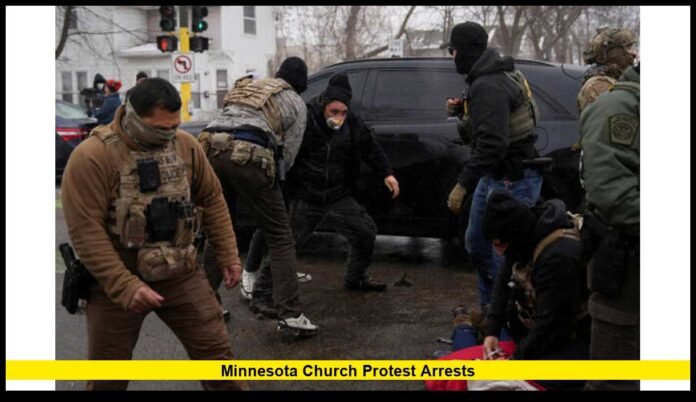

Minnesota church protest arrests have become a major national story this week following the federal detention of three activists for their role in disrupting a worship service at Cities Church in St. Paul, Minnesota. The situation has sparked heated debate over religious freedom, protest tactics, civil rights law, and immigration enforcement.
What Sparked the Protest at Cities Church
On Sunday, January 18, 2026, a group of protesters entered Cities Church during a scheduled worship service, chanting and confronting worshippers and leadership. The demonstration was directed at one of the church’s pastors, who also serves as the acting field office director for U.S. Immigration and Customs Enforcement (ICE) in Minnesota. Protesters voiced deep opposition to ICE enforcement actions and claimed that the pastor’s dual role was incompatible with the congregation’s values.
Videos and eyewitness accounts from inside the church show demonstrators interrupting the service with chants calling for ICE to leave and criticizing aggressive federal immigration tactics. The protest was organized by local activists unhappy with recent federal immigration enforcement in Minnesota, particularly following confrontations between ICE agents and residents in the Twin Cities area. Protesters specifically highlighted concerns about recent ICE activities that have heightened community tensions.
Federal Arrests Announced
On Thursday, January 22, 2026, federal authorities announced the arrest of three individuals in connection with the disruption at the church. Attorney General Pam Bondi and senior law enforcement officials said the arrests were made after a federal investigation determined the protest violated laws meant to protect access to places of worship and the free exercise of religion.
The three activists taken into custody are:
- Nekima Levy Armstrong – A civil rights attorney and well-known activist who helped organize the demonstration.
- Chauntyll Louisa Allen – A member of the St. Paul School Board and community organizer.
- William Kelly – An activist who publicly challenged authorities to arrest him during the protest.
Federal authorities allege that the actions of the protesters constituted interference with worshippers’ rights and violated federal statutes that bar obstructing individuals from participating in religious services. Charges also include conspiracy related to interfering with protected civil rights.
Charges and Court Proceedings
After their arrest, the three individuals appeared before a federal magistrate judge in St. Paul. Prosecutors have charged them under laws that prohibit obstructing access to houses of worship and interfering with others’ constitutional rights during religious services. These laws are designed to ensure that worshippers can participate in services free from intimidation or blockage.
Bond conditions for the two women include travel restrictions and orders that they remain in Minnesota. Federal prosecutors have indicated they intend to appeal some of the bond rulings issued by the magistrate.
In court, the defendants maintained that their protest was motivated by genuine concern over federal immigration policy and practices in the region. However, judges have emphasized that protests that interfere with worship services may incur federal consequences.
Journalist Present at Protest Not Charged
While authorities pursued arrests against the leading activists, a well-known journalist who livestreamed the protest from inside the church was not charged. Federal prosecutors sought to bring charges against him, but a federal magistrate judge refused to approve such action, saying there was insufficient evidence to justify criminal prosecution for newsgathering activity.
The journalist maintained that his presence at the church was purely in a reporting capacity and that his livestream of the protest was protected by the First Amendment. His legal representation stressed that capturing and reporting events inside the church did not amount to participation in unlawful conduct.
Strong Responses From Political Leaders
The Minnesota church protest arrests have drawn sharp commentary from leaders at every level of government:
- Attorney General Pam Bondi stated that the Justice Department would enforce federal laws protecting places of worship and hold accountable those who prevent or disrupt religious services.
- Vice President JD Vance, visiting Minnesota, urged increased cooperation between state and local law enforcement and federal agencies to prevent similar future disruptions.
- Homeland Security Secretary Kristi Noem emphasized that religious freedom is a core American value that must be upheld against protests that cross legal boundaries.
- Some local leaders and community groups have voiced concerns that the federal response may chill legitimate protest and free speech, especially in immigration policy debates.
The political reactions reflect broader national divisions over how to balance free speech and protest rights with respect for religious practices and institutions.
Community and Religious Reactions
The disruption inside Cities Church and the subsequent arrests have also drawn responses from faith leaders and community members. Leaders within the Southern Baptist community defended the congregation’s right to worship without interruption and praised law enforcement for taking action to protect that right.
Supporters of the arrested activists held vigils and gatherings outside the federal courthouse in St. Paul, decrying the arrests as heavy-handed and arguing that protests, especially over immigration issues, are a valid form of civic expression.
Church leadership has emphasized the importance of maintaining spaces dedicated to worship and prayer, and several faith leaders have called for peace and civility in discussing deeply divisive issues like immigration enforcement.
Broader Context of Tension Over ICE in Minnesota
The protest at Cities Church did not occur in isolation. Minnesota has been a focal point for demonstrations and controversy over federal immigration enforcement this month. In one separate incident earlier in January, an ICE agent fatally shot a woman during an enforcement action in Minneapolis, prompting protests across the region.
Those incidents have spurred local activists to amplify their criticism of ICE and federal policy. Some community members have accused federal agencies of using excessive force and engaging in aggressive tactics that harm trust between law enforcement and immigrant communities.
The church protest became a flashpoint in that ongoing dispute, bringing these issues into a religious setting and prompting a robust federal response intended to address perceived legal violations.
Timeline of Key Developments
- January 18, 2026 – Protesters enter Cities Church during a Sunday service, interrupting worship to protest ICE and a pastor’s alleged dual role.
- January 19, 2026 – The Department of Justice opens an investigation into the disruption at the church.
- January 22, 2026 – Federal authorities arrest three individuals over Minnesota church protest arrests.
- January 22, 2026 – A federal judge rejects prosecutors’ effort to charge a journalist who livestreamed the protest.
This timeline illustrates how quickly the situation escalated from an in-service protest to federal criminal charges.
What Happens Next
As legal proceedings continue, all eyes are on upcoming court dates and potential federal actions. Appeals related to bond conditions and charges are likely in the near term. The decision not to charge the journalist is also expected to attract additional legal debate and commentary.
Observers on all sides are watching to see how this case will influence future protest activity, especially where demonstrations intersect with religious institutions. There is also keen interest in how local law enforcement will coordinate with federal authorities to enforce civil rights laws and protect religious gatherings.
Beyond the courtroom, the Minnesota church protest arrests are likely to contribute to ongoing national conversations about the limits of protest, the protection of worship spaces, and how deeply contested issues like immigration enforcement are addressed through civic action.
Engage with this topic by sharing your views below and stay tuned for further developments on Minnesota church protest arrests.