
A tragic confrontation between federal immigration authorities and a Minneapolis resident has left a community in mourning and reignited a national conversation about law enforcement tactics. The ICE agent shooting in Minneapolis claimed the life of 37-year-old Renee Nicole Good on Wednesday morning, January 7, 2026, as she drove through her south Minneapolis neighborhood. The deadly encounter has created a sharp divide between federal officials who insist their officer acted appropriately and local leaders who call the shooting unjustified and demand immediate federal withdrawal from the city.
A Morning That Changed Everything
The fatal encounter unfolded just before 10 a.m. on a winter morning in a residential area near the corner of 34th Street and Portland Avenue. Immigration and Customs Enforcement officers were conducting enforcement activities in the neighborhood when they encountered Good in her burgundy SUV.
Witnesses captured critical moments of the confrontation on their cell phones. The footage shows a gray pickup truck approaching Good’s vehicle, which had stopped in the street. Multiple agents emerged from the truck and moved toward her SUV. One officer reached the driver’s door and attempted to pull it open while shouting commands at Good to exit the vehicle.
What happened next has become the subject of intense dispute. The SUV moved backward briefly before accelerating forward. An agent positioned near the front of the vehicle drew his weapon and fired several rounds through the windshield. The SUV continued moving until it collided with a parked vehicle and crashed into a light pole.
Emergency responders arrived at the scene, but Good was pronounced dead. The shooting lasted only seconds, but its impact continues to reverberate through Minneapolis and beyond.
Two Completely Different Stories
Federal authorities have presented a clear narrative: their agent faced a lethal threat and responded to save his own life. Representatives from the Department of Homeland Security characterized Good’s actions as deliberately weaponizing her vehicle against law enforcement. She attempted to run over officers who were simply doing their jobs, they said.
Homeland Security Secretary Kristi Noem went further, labeling the incident “an act of domestic terrorism.” She defended the agent’s split-second decision to fire, describing it as a defensive action that protected not only the officer but also others in the vicinity.
Minneapolis officials who reviewed the same video footage reached dramatically different conclusions. Mayor Jacob Frey held nothing back during his public remarks Wednesday afternoon. He accused federal authorities of already attempting to manufacture a false narrative about self-defense.
After watching the video evidence himself, Frey used blunt language to reject the federal version of events. He called their self-defense justification false and demanded that ICE agents leave Minneapolis immediately.
Police Chief Brian O’Hara raised professional concerns about the tactics displayed in the video. He emphasized that modern law enforcement training across the country has moved away from shooting at vehicles, particularly when occupants are unarmed. The chief also revealed an important detail: Good herself was not a target of any immigration investigation or enforcement action. She was simply driving through her own neighborhood that morning.
Remembering Renee Nicole Good
Renee Nicole Good lived just a few blocks from where her life ended. She shared a home with her partner in a neighborhood she knew well. Those who knew her describe a woman whose kindness and compassion defined her character.
Her mother, Donna Ganger, spoke through her grief to paint a picture of her daughter. She called Renee one of the kindest people she had ever known, someone who spent her life caring for others. Loving, forgiving, and affectionate were the words Ganger used to describe the daughter she lost.
Good’s identity extended beyond the labels others might use. She saw herself as a poet and writer, expressing herself through words. She was a wife and a mother to a young son from an earlier marriage. Her social media presence reflected someone engaged with her community and the people around her.
The Minneapolis City Council’s statement noted that Good had been out helping her neighbors that morning when she encountered federal agents. This detail has resonated deeply with community members who see her death as the loss of someone who embodied civic care and compassion.
People who witnessed the shooting have disputed the federal government’s characterization of Good’s actions. At least one witness said it appeared she was attempting to escape from the agents rather than attack them when gunfire erupted.
A City Responds to Tragedy
News of the shooting spread rapidly through Minneapolis. By afternoon, hundreds of people had gathered at the intersection where Good died. As evening approached, the crowd swelled to thousands who came to honor her memory and demand answers about what happened.
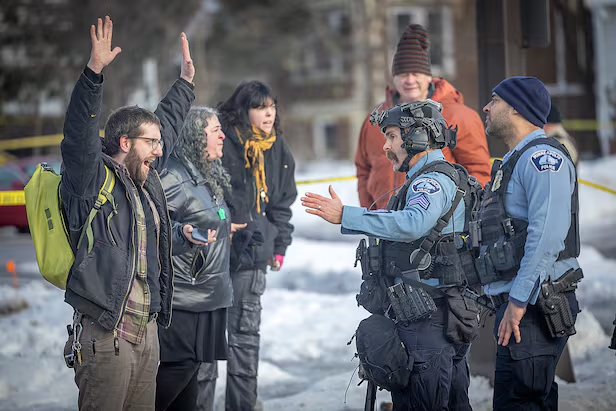
The vigil reflected a community’s pain and anger. Some protesters expressed their frustration by throwing snowballs toward federal agents still present at the scene. Law enforcement responded by deploying tear gas and pepper spray to disperse crowds. Minneapolis police officers found themselves in the middle, erecting metal barriers to separate federal agents from protesters while insisting they were there to maintain peace, not take sides.
Troubling allegations emerged about what happened immediately after the shooting. State Senator Omar Fateh and others reported that a physician at the scene was prevented from attempting to provide emergency medical care to Good. If true, this detail adds another layer of tragedy to an already devastating incident.
The Minneapolis Public Schools made an unprecedented decision in response to the shooting and subsequent unrest. District officials announced the cancellation of all classes for Thursday and Friday, affecting thousands of students across the city. They cited safety concerns and noted that remote learning was not an option under current policies.
Federal Enforcement Reaches New Scale
The shooting did not occur in isolation. It happened during what federal officials have described as their largest enforcement operation ever conducted in Minnesota. More than 2,000 ICE officers and agents have been deployed to the Twin Cities area in recent weeks, representing a massive increase in federal immigration presence.
The numbers tell the story of this escalation. Federal authorities reported approximately 300 arrests in Minneapolis by mid-December. That figure has now jumped to around 1,400 arrests since early December, showing the intensity and scope of current operations.
This aggressive approach has created significant tension between federal agencies and state and local governments. Minnesota officials have criticized both the scale and the tactics of these enforcement operations, arguing they create chaos and fear in communities.
Political Battle Lines Drawn
The shooting has become a political flashpoint with responses breaking along predictable lines. President Donald Trump defended the federal agent, claiming he acted in self-defense against someone who viciously attempted to harm law enforcement officers.
Former Vice President Kamala Harris took the opposite view, calling the shooting shocking and accusing the administration of gaslighting the public about what actually occurred. She praised Governor Tim Walz for committing to a fair investigation.
Illinois Governor JB Pritzker escalated his criticism beyond the incident itself, calling for Secretary Noem’s resignation. He characterized the Department of Homeland Security’s actions as lawless, brutal, unconstitutional, and completely out of control.
Senate Minority Leader Chuck Schumer stated his longstanding opposition to ICE operations in urban areas, saying federal immigration agents do not belong in cities.
Minnesota Governor Walz has placed the National Guard on standby as the situation remains tense. Lieutenant Governor Peggy Flanagan used strong language to describe ICE agents as masked and out of control, creating chaos throughout the state. She joined Mayor Frey in demanding that ICE leave Minnesota before more people get hurt.
Secretary Noem later confirmed she had spoken with Governor Walz but acknowledged they hold fundamentally different viewpoints about what transpired and what should happen next.
Examining Use of Force Policies
The Minneapolis ICE agent shooting has brought renewed attention to a contentious issue in law enforcement: when, if ever, is it appropriate to shoot at someone in a moving vehicle?
Many police departments have revised their policies over the years to restrict or prohibit shooting at vehicles. The reasoning is straightforward: officers standing in front of a vehicle are often in that position by choice, shooting at a driver may not stop the vehicle and could actually make it more dangerous, and the tactic raises serious questions about whether the threat justifies deadly force.
Federal use-of-force guidelines state that deadly force must be objectively reasonable based on the specific circumstances. Officers cannot use deadly force solely to prevent someone from fleeing. However, the policy does permit deadly force when an officer reasonably believes their life or someone else’s life faces imminent danger.
This shooting bears uncomfortable similarities to another ICE shooting last September in the Chicago area. Federal agents shot and killed 38-year-old Silvero Villegas-Gonzalez during a traffic stop. Authorities initially claimed he tried to drive into agents, but surveillance footage from nearby businesses showed him backing up and driving away with agents positioned beside his vehicle rather than in front of it.
What Comes Next
Multiple investigative agencies, including the FBI, are now examining the circumstances of Good’s death. Local officials continue to emphasize that video evidence contradicts the federal narrative, while federal authorities maintain their agent acted properly under threatening circumstances.
The Minneapolis City Council has established a fundraising effort to support Good’s family, including her young son and her wife, as they navigate this unimaginable loss.
This tragedy has crystallized broader questions about immigration enforcement, federal authority in local communities, and the use of deadly force. The stark disagreement between federal and local officials about basic facts has eroded trust and raised concerns about accountability when federal agents operate in American cities.
Good’s death has become more than a local tragedy. It represents a collision between competing visions of law enforcement, immigration policy, and the rights of communities to have a say in how federal power is exercised within their boundaries.
Share your perspective on immigration enforcement and community safety in the comments section.