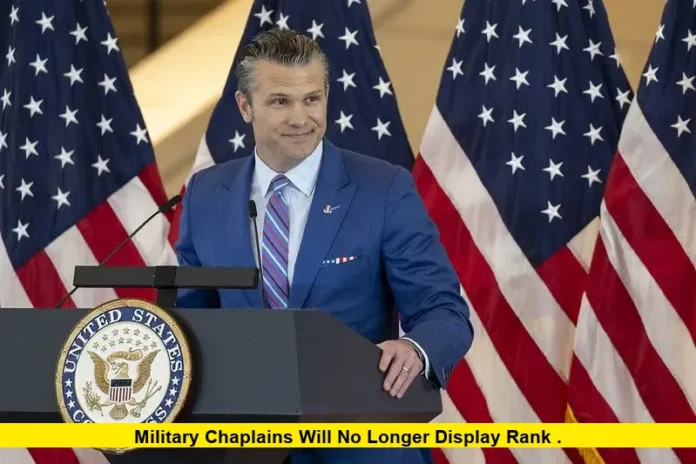

Hegseth says military chaplains will no longer display rank — a major policy change that is drawing national attention and reshaping how faith leaders serve within the U.S. military. The announcement marks a significant shift in military tradition, altering how chaplains present themselves while maintaining their official standing as commissioned officers.
The move comes as part of a broader overhaul of the military’s Chaplain Corps, led by Defense Secretary Pete Hegseth. His changes aim to redefine the role of chaplains, emphasizing religious leadership over administrative or symbolic military hierarchy.
This decision is already sparking conversations across the armed forces, veteran communities, and religious organizations nationwide.
If you’re following changes inside the U.S. military, this update could directly impact how service members interact with chaplains moving forward.
Read Also-Pete Hegseth military record: A full look at his verified service history
What Exactly Changed?
The new directive removes the requirement for military chaplains to display rank insignia on their uniforms.
Instead of traditional officer rank symbols, chaplains will now wear insignia representing their religious affiliation. This means a chaplain’s faith background — not their rank — will be the most visible identifier.
Despite this visible change, chaplains still retain their official rank and status within the military structure. They continue to serve as commissioned officers and maintain the same authority, responsibilities, and pay grade.
This distinction is key: the change affects appearance, not authority.
Why Hegseth Made This Decision
The policy is part of a larger effort to reshape the identity and mission of military chaplains.
Hegseth has repeatedly emphasized that chaplains should primarily function as spiritual leaders rather than blending into broader support roles. He has argued that, over time, the chaplaincy has shifted away from its core religious purpose.
In previous statements, he criticized modern approaches that focus heavily on emotional wellness frameworks instead of traditional faith-based guidance.
By removing rank insignia, the goal is to visually reinforce that chaplains are distinct from other officers — set apart for spiritual service rather than command authority.
A Break From Long-Standing Tradition
This change marks a notable departure from decades of military practice.
For nearly a century, U.S. military chaplains have worn rank insignia just like other officers. While their role has always been unique, their uniforms reflected standard military hierarchy.
Historically, there have been periods when chaplains did not display rank, but modern policy had firmly established rank insignia as part of their uniform identity.
Now, that tradition is being reversed.
How This Affects Service Members
For active-duty personnel, the change could subtly reshape everyday interactions with chaplains.
Without visible rank, chaplains may appear more approachable to some service members, especially those seeking confidential guidance or spiritual counseling.
Chaplains already operate outside the chain of command in many respects, particularly when providing religious support. This update reinforces that separation.
However, in formal settings — such as ceremonies or advisory roles — their rank still applies, even if it is not displayed.
Impact Across Military Branches
The policy applies across all branches of the U.S. military, including:
- Army
- Navy
- Air Force
- Marine Corps
- Space Force
Each branch will implement the change within its own uniform guidelines, but the core directive remains consistent: rank insignia will no longer be worn by chaplains.
This creates a unified approach across the entire Department of Defense.
Part of a Larger Chaplain Corps Overhaul
The decision does not stand alone. It is one piece of a broader restructuring effort targeting the Chaplain Corps.
Recent actions tied to this overhaul include:
- Eliminating certain training materials focused on modern “spiritual fitness” concepts
- Simplifying how religious affiliations are categorized within the military
- Reemphasizing traditional religious roles and responsibilities
Hegseth has described these changes as a “cultural shift” aimed at restoring what he sees as the original mission of military chaplains.
Reactions and Ongoing Debate
The policy has sparked a wide range of reactions.
Supporters argue that the change strengthens the religious identity of chaplains and removes unnecessary military symbolism from a spiritual role.
They believe it helps clarify that chaplains are not commanders but faith leaders dedicated to supporting troops.
Critics, however, have raised concerns about how the shift could affect perceptions of neutrality and inclusivity within the military’s diverse religious environment.
Some also question whether removing rank visibility could create confusion in formal military settings.
Why Visibility of Rank Matters in the Military
In the U.S. military, rank is more than a symbol — it plays a critical role in structure, authority, and communication.
Uniform insignia help service members quickly identify leadership roles, especially in high-pressure environments.
By removing rank from chaplain uniforms, the military is making a deliberate exception to this system.
The decision underscores how the chaplaincy operates differently from traditional command roles, even while remaining part of the officer corps.
What Stays the Same
While the visual presentation is changing, many core aspects of the chaplain role remain unchanged:
- Chaplains are still commissioned officers
- They continue to advise commanders on religious matters
- They provide spiritual support to service members of all faiths — or none
- They maintain confidentiality in counseling settings
This ensures continuity in how chaplains function within the military structure.
Historical Context of Military Chaplains
Military chaplains have been part of U.S. forces since the nation’s founding.
Their role has always balanced two identities:
- Religious leader
- Military officer
Over time, policies have shifted to reflect changing cultural and operational priorities.
The removal of rank insignia represents one of the most visible adjustments in that long history.
What Comes Next
The Department of Defense is expected to roll out implementation guidance across all branches.
This includes updates to uniform regulations, training materials, and internal communications to ensure consistency.
Service members will likely begin seeing the changes reflected in uniforms in the near future.
Additional reforms to the Chaplain Corps may also follow, as leadership continues its broader restructuring efforts.
Why This Story Matters Now
The decision arrives at a time when the military is undergoing wider changes in leadership priorities and internal culture.
Policies affecting service members’ daily experiences — including how they access spiritual support — can have lasting effects across the force.
For many troops, chaplains are a critical resource during deployments, crises, and personal challenges.
Changes to their role and identity therefore carry real-world significance beyond policy discussions.
Final Takeaway
The directive that chaplains will no longer display rank is more than a uniform update — it reflects a deeper shift in how the military defines spiritual leadership within its ranks.
As the policy takes effect, its impact will become clearer across bases, deployments, and military communities nationwide.
What do you think about this change to military tradition? Share your thoughts or stay tuned for more updates as this policy rolls out.