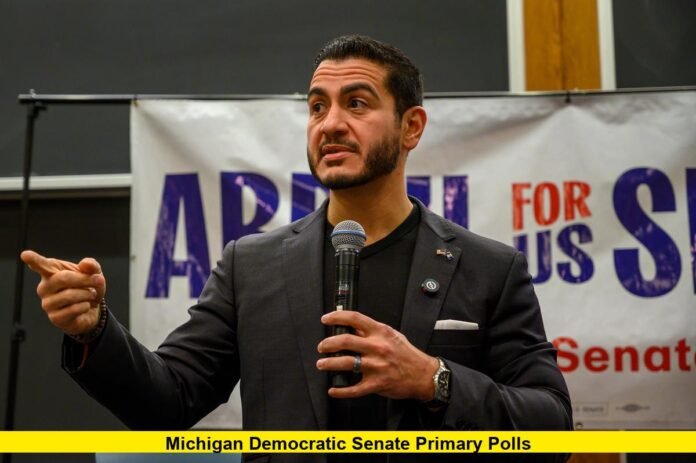

Michigan Democratic Senate primary polls have pointed to a tight and closely watched contest heading into Tuesday’s statewide primary election, as voters across the state decide who will represent the party in November’s battle for a critical open U.S. Senate seat. The race, one of the most closely monitored Democratic primaries in the country this cycle, pits U.S. Rep. Haley Stevens against former Wayne County health director Abdul El-Sayed in a contest that has come to symbolize the broader tug-of-war between the Democratic Party’s center and its progressive wing.
The seat became open after Sen. Gary Peters, first elected in 2014, announced he would not seek a third term. That decision set off a crowded scramble among Michigan Democrats, and while the field has since narrowed to two major candidates, the primary has remained unpredictable, expensive, and nationally significant. With polls closing Tuesday evening, both campaigns and outside observers are watching turnout, late-deciding voters, and demographic splits that could determine who advances to face the Republican nominee in the fall.
A Two-Way Democratic Showdown
For much of the spring, the Democratic primary field included three notable contenders: Stevens, El-Sayed, and state Sen. Mallory McMorrow, who had positioned herself as a moderating voice between the party’s establishment and progressive flanks. That dynamic shifted in early July when McMorrow suspended her campaign, citing a mix of factors that had complicated her run in the final stretch. Her exit effectively narrowed the primary to a head-to-head contest between Stevens and El-Sayed, intensifying the spotlight on the two remaining candidates and their competing visions for how Democrats can win back a seat in a state former President Donald Trump carried in 2024.
Stevens, a congresswoman from Birmingham, has cast herself as the candidate best positioned to appeal to swing voters and flip the seat in November, emphasizing manufacturing jobs, cost-of-living concerns, and her record opposing what she describes as overreach from the Trump administration. El-Sayed, a physician and former Wayne County health official who previously ran for governor, has run as the clear progressive choice in the race, drawing enthusiastic support from younger voters, independents, and national progressive figures.
What the Polling Has Shown
Michigan Democratic Senate primary polls conducted in the final weeks before the election generally showed El-Sayed with a notable lead over Stevens among likely Democratic primary voters. One widely cited survey found El-Sayed ahead by double digits, with the gap widening further once undecided voters were pushed to indicate which candidate they leaned toward. That same polling highlighted a pronounced generational divide in the race, with younger voters breaking heavily for El-Sayed while voters over 60 tended to favor Stevens. Independents who planned to vote in the Democratic primary also leaned toward El-Sayed by a wide margin, while self-identified Democrats showed a narrower but still notable preference for him over Stevens.
It is worth noting that primary polling, particularly in lower-turnout August contests, can carry more uncertainty than general election surveys, since predicting exactly who will show up to vote is inherently difficult. Analysts have cautioned that turnout composition, especially among older, more reliable primary voters, may end up mattering more than the polls suggest, since that group has historically shown up more consistently in Michigan’s summer primaries. Some poll aggregators and forecasting sites tracking the race throughout the summer described the primary as “far more competitive” than the top-line numbers alone might indicate, given the volatility that can accompany a race that narrowed from three candidates to two with just weeks remaining.
Endorsements and National Attention
The Michigan Senate primary has drawn attention well beyond the state’s borders, in part because of the array of high-profile endorsements each candidate has collected. El-Sayed has been backed by prominent progressive figures and organizations, including groups focused on voting rights, labor, and grassroots mobilization, reflecting his standing as the clear progressive choice in the race. Stevens, meanwhile, has emphasized support from party leaders and groups who argue her more centrist profile gives Democrats the best chance of holding the seat against a well-funded Republican opponent in November.
The primary has also featured sharp exchanges between the two campaigns in its closing weeks, with each side questioning the other’s ability to win a general election in a state that has trended competitive in recent cycles. Michigan Gov. Gretchen Whitmer, whose approval rating among Democratic primary voters has remained relatively strong even as it has softened somewhat over the summer, has stayed largely on the sidelines of the Senate primary, focusing instead on her final months in office as she is term-limited and cannot seek reelection.
Why This Race Matters Nationally
Michigan sits among a handful of Senate battlegrounds that may help decide which party controls the chamber after November’s election. Whoever wins the Democratic primary is expected to face Republican Mike Rogers, a former congressman who narrowly lost Michigan’s other Senate seat in 2024 and is considered the clear favorite to win the GOP nomination. Given how close that earlier race was, both parties view Michigan as a genuine toss-up in the fall, which has fueled heavy spending and national scrutiny of the Democratic primary well beyond what a typical August primary might normally attract.
Democratic strategists in Washington have watched the Stevens-El-Sayed contest closely, with some worrying that a bruising primary could leave the eventual nominee with less time and fewer resources to consolidate the party before the general election. Others argue that the contested primary has actually raised the race’s profile and energized volunteers and small-dollar donors on both sides, which could benefit whichever candidate emerges as the nominee.
Other Key Races on Tuesday’s Michigan Ballot
While the Senate primary has drawn the most national attention, Michigan voters faced several other consequential decisions on Tuesday’s ballot. Chief among them is the race for governor, since Gov. Whitmer is term-limited and cannot run again. On the Democratic side, Secretary of State Jocelyn Benson faced Genesee County Sheriff Chris Swanson for the party’s nomination, with Benson widely regarded as the frontrunner throughout the campaign. Republicans chose among a Republican field that included U.S. Rep. John James and businessman Perry Johnson, after former Michigan Attorney General Mike Cox suspended his campaign roughly two weeks before the primary, though his name remained on the ballot.
Other statewide offices, including attorney general and secretary of state, will not appear on the August primary ballot, since Michigan’s major parties selected their nominees for those posts at endorsement conventions earlier in the year. The Democratic nominee for attorney general is Washtenaw County Prosecutor Eli Savit, who will face Eaton County Prosecutor Doug Lloyd in November. For secretary of state, Lt. Gov. Garlin Gilchrist is the Democratic nominee, set to face Macomb County Clerk Anthony Forlini in the general election. Michigan voters also weighed in on numerous state legislative primaries, since all 110 seats in the state House and all 38 seats in the state Senate are up for election in November, along with a variety of local ballot measures across the state.
Voting Details and Timeline
Michigan’s primary operates as an open primary, meaning voters do not need to be registered with a political party to participate. However, voters must choose either the Democratic or Republican section of the ballot and vote entirely within that section, since splitting a ballot between parties invalidates the partisan portion. Nonpartisan races and local ballot questions are counted regardless of which party’s section a voter selects.
Polls across Michigan opened at 7 a.m. and were scheduled to close at 8 p.m. on Tuesday, with early in-person voting having taken place in the days leading up to Election Day. As of Tuesday, there is no official confirmation of final results in the Democratic Senate primary, since vote counting was still underway as polls closed statewide. Michigan’s Bureau of Elections and county clerks are expected to release updated results throughout Tuesday night and into Wednesday morning, and any reported outcome should be treated as unofficial until certified.
Final Thoughts
The Michigan Democratic Senate primary has emerged as one of the defining intraparty contests of the 2026 midterm cycle, testing whether Democrats will nominate a candidate who leans into the party’s progressive energy or one who emphasizes a more centrist, swing-district appeal. Pre-election polling suggested an advantage for Abdul El-Sayed heading into Tuesday, though the race’s volatility, the compressed timeline following Mallory McMorrow’s withdrawal, and the historic unpredictability of August primary turnout all left room for a closer outcome than surveys alone might suggest. Whoever wins may inherit a well-funded, high-profile general election campaign against Mike Rogers in a state both parties consider central to the fight for Senate control.
As results come in Tuesday night, voters and political observers nationwide will be watching not just who wins, but by what margin and among which groups of voters, since those details may shape how each party approaches Michigan’s general election campaign over the next three months.
Stay tuned for the latest updates as results are confirmed, and share your thoughts on Michigan’s Senate primary in the comments below.