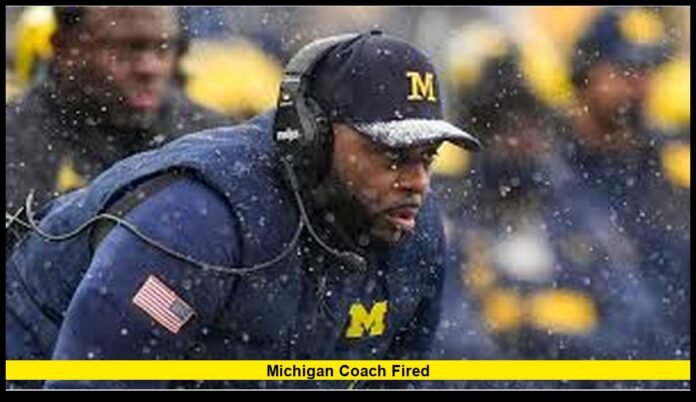

The University of Michigan has officially announced that Michigan coach fired — head football coach Sherrone Moore — is no longer part of the program. The decision follows an internal investigation that found credible evidence Moore engaged in an inappropriate relationship with a staff member, a violation of campus misconduct policy. The university terminated Moore with cause, effective immediately, and appointed associate head coach Biff Poggi as interim head coach.
What Michigan’s athletic department revealed
According to the athletic department’s statement, a comprehensive internal review concluded that credible evidence existed of misconduct by Moore. The investigation determined that the conduct violated university standards and warranted termination. In light of these findings, Michigan made the decision to fire Moore, emphasizing its commitment to maintaining a safe and professional environment across its athletics programs.
The department named Biff Poggi as interim head coach. Poggi, previously associate head coach, will assume leadership for all football operations and preparations for the postseason bowl game. The move is effective immediately.
Timing matters: Amid bowl season and postseason window
The timing of this move is especially significant. Michigan coach fired during a critical period: the Wolverines are scheduled to face Texas in the Cheez-It Citrus Bowl on December 31, 2025. With bowl-week arrangements, game strategy, and team morale already sensitive this time of year, the leadership shuffle adds complexity to an already high-pressure environment.
Players, staff, and fans must adapt quickly to a new leadership structure. The coaching change comes during final game preparations — a time when discipline, consistency, and stability matter most. The university has acknowledged the disruption but committed to keeping operations on track under interim leadership.
A quick look at Moore’s recent track record
Sherrone Moore finished the 2025 regular season with a 9–3 record. His promotion to head coach in 2024 followed years of service in various coaching roles within Michigan’s football program. Under his supervision, the team delivered solid performances and maintained a competitive edge in a demanding conference.
However, off-field behavior now overshadowed on-field success. While Moore enjoyed wins and progress on the field, the internal investigation uncovered behavior that crossed ethical lines and violated campus conduct policies. Because of that, performance records became secondary to accountability and integrity.
Immediate leadership changes and staffing implications
With Moore’s dismissal, Biff Poggi steps up as interim head coach and will lead all football operations through the upcoming postseason and beyond. The athletic department has initiated administrative processes required to formalize Moore’s termination, evaluate possible contract and payment consequences, and implement any related changes.
Coaching transitions often lead to personnel reshuffling. Staff assignments might shift, practice plans may adjust, and game-day responsibilities could be redistributed. Interim leadership will need to quickly steady operations and ensure the program remains focused and disciplined.
Impact on players, staff and program morale
A mid-December coaching change reverberates through a team’s foundation. Players must recalibrate expectations under a new coach. Staff — especially positional coaches, support staff, and administrative personnel — may experience uncertainty as roles and responsibilities shift. The change could affect training schedules, travel plans, and final bowl-week logistics.
Still, the athletic department’s decision shows prioritization of professional conduct over short-term performance. The public action aims to reinforce trust within the program and among supporters. For players and staff, it signals that personal conduct holds as much weight as win-loss records.
Legal status and law-enforcement involvement
According to law enforcement reports, the local Saline Police Department detained Moore following the university’s announcement. Authorities transferred him to Pittsfield Township for further investigation and questioning. At present, no formal charges have been publicly filed.
The investigation by law enforcement is separate from the university’s internal review. While the school acted based on its findings and concluded termination was necessary, police involvement could lead to further inquiries depending on what emerges from their investigation. As of now, the legal process remains ongoing, with no confirmed charges or court filings.
What this means for Michigan’s postseason plans
With the Cheez-It Citrus Bowl just weeks away, Michigan’s football program faces a crucial transition. Interim coach Biff Poggi must quickly step in, establish authority, and align the team around game strategy and readiness. The late-season disruption represents a test of resilience for players, coaches, and administrative leadership.
Bowl preparation involves more than playbooks — it includes travel details, media appearances, team meetings, and community events. Poggi and his staff will likely reorganize many aspects of preparation, from last practices to locker room culture. The pressure is on to maintain stability, focus, and execution amid a turbulent backdrop.
Program integrity vs. competitive ambition
This decision underscores the university’s commitment to upholding institutional standards, even when it means disrupting a competitive season. By taking decisive action, Michigan signaled that ethical behavior and professional responsibility remain top priorities.
Athletic departments operate under intense scrutiny — not only from fans and media, but from students, staff, alumni, and stakeholders. Ensuring a safe and respectful environment can shape a program’s long-term reputation. In this case, Michigan chose to prioritize institutional values over short-term success.
What to watch in coming days
As the story develops, several unfolding aspects deserve attention:
- Whether Michigan reveals further details about Moore’s contract termination, including any financial terms or consequences tied to a dismissal for cause.
- Whether law enforcement moves forward with formal charges, and what those charges might entail.
- How effectively the team adapts to interim leadership under Biff Poggi during bowl practices and routines.
- Whether additional administrative or staffing changes follow within the athletic department.
Tracking these developments will shed light on how the program navigates both legal and athletic challenges.
Observations on program culture and accountability
The removal of Moore reflects a broader shift in college athletics — one where off-field conduct, ethics, and accountability carry as much significance as on-field results. Universities and athletic departments face growing pressure to address misconduct swiftly and transparently. In doing so, they aim to protect the welfare of their community and maintain trust among fans, alumni, and broader stakeholders.
For players, staff, and rising recruits, such actions send a clear message: respect, integrity, and compliance matter. For fans and supporters, accountability— even at the highest levels — reinforces confidence in the program’s values. For the wider college sports world, the move underscores an evolving expectation that behavior off the field can influence leadership tenure just as much as wins and losses.
Conclusion: A pivotal moment in Michigan football history
The decision to fire Moore marks a turning point for Michigan football. The program is now under interim leadership heading into a postseason bowl, with key staff changes and uncertainty over future personnel stability. Beyond immediate consequences, the action emphasizes institutional values and highlights accountability as core to the program’s identity.
Michigan now faces the challenge of balancing competitive ambitions with cultural integrity. As the football community watches closely, the upcoming weeks will test the resilience of players, staff, and leadership under new circumstances. The Michigan coach fired situation stands as a stark reminder: in college athletics, character and compliance remain non-negotiable.