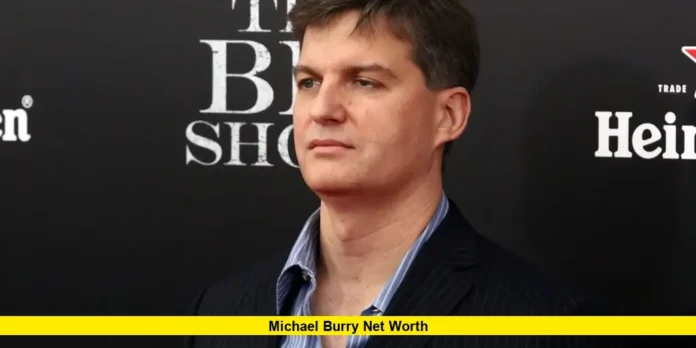

Michael Burry, the hedge fund manager who famously predicted the 2008 housing market collapse, is back in the headlines as of July 26, 2026 — this time for warning that today’s AI-driven stock market rally looks eerily similar to the final months of the 1999-2000 dot-com bubble. As his warnings gain traction across financial media, many readers want to know exactly how much the legendary investor is worth today, and how his latest bearish calls tie into his overall fortune.
What Is Michael Burry’s Net Worth in 2026?
Michael Burry’s net worth is estimated to be around $300 million as of 2026, according to multiple financial and biography outlets. Some estimates place his fortune slightly higher, at approximately $350 million, though exact figures are difficult to verify since Burry’s personal wealth is not publicly disclosed in full and can fluctuate significantly with market cycles, given his active, high-conviction trading style.
Burry built his fortune primarily through hedge fund management fees, personal investment gains, and the profits generated from his contrarian, research-driven trading strategy. Unlike many high-profile investors, Burry maintains a relatively private, low-key lifestyle, avoiding the media spotlight outside of his periodic market commentary on X (formerly Twitter) and his Substack newsletter, “Cassandra Unchained.”
How Michael Burry Built His Fortune
Burry was born on June 19, 1971, in San Jose, California. He studied economics and pre-medical sciences at UCLA before earning his M.D. from Vanderbilt University School of Medicine. While completing a neurology residency at Stanford Hospital, he began trading part-time, applying value-investing principles inspired by Benjamin Graham and Warren Buffett.
In 2000, Burry left medicine to found his first hedge fund, Scion Capital. The fund earned a reputation for disciplined, deep-research investing, and Burry famously used credit default swaps to bet against subprime mortgage-backed securities in the mid-2000s. When the housing market collapsed in 2008, that bet paid off enormously, netting his fund and investors hundreds of millions of dollars and inspiring his portrayal by Christian Bale in the 2015 film “The Big Short.”
Burry closed Scion Capital in 2008 and launched a new firm, Scion Asset Management, in 2013, which he has used to run a long-short equity portfolio focused on undervalued and misunderstood investment opportunities.
Scion Asset Management: A Major Shift in Late 2025
In a significant development, Burry de-registered Scion Asset Management with the Securities and Exchange Commission, with the termination effective November 10, 2025. Scion had reported roughly $155 million in regulatory assets under management as of March 2025. Because investment advisers managing more than $100 million must remain SEC-registered, deregistering freed Scion from mandatory public disclosure requirements, including its closely watched quarterly 13F filings.
Burry later clarified to Bloomberg News that Scion was “not closing” outright, describing it as essentially a “friends and family fund” that would remain active in the markets, just without the compliance obligations of a registered investment adviser. He said he was “glad” to shed what he called the “compliance burden” of being a registered fund manager.
Michael Burry Signals Market Trouble Ahead: The Dot-Com Bubble Comparison
Throughout 2026, Burry has repeatedly warned that the artificial intelligence-driven stock rally mirrors the final, euphoric stages of the dot-com bubble of 1999-2000. In posts on Substack and X, Burry has argued that investors have largely stopped paying attention to jobs data, consumer sentiment, or broader economic conditions, focusing almost exclusively on AI-related narratives.
On July 23, 2026, Burry posted on X pointing to a widening set of risks beyond stock valuations alone. He highlighted that the 30-year Treasury yield had traded above 5% for 27 consecutive days in 2026, a stretch he compared to conditions last seen in 2007, shortly before the global financial crisis. He also noted that oil prices approaching $100 a barrel, combined with heavy debt-funded spending by technology companies on AI infrastructure and data centers, was adding inflationary pressure and competing with high Treasury bond supply, pushing long-term borrowing costs even higher.
Burry has specifically pointed to the Philadelphia Semiconductor Index, which tracks chipmakers such as Nvidia, Broadcom, and Intel, as a key warning sign. The index surged more than 10% in a single week and is up roughly 65% for 2026, a pace of appreciation Burry says closely resembles semiconductor stock behavior in the months immediately before the dot-com peak in March 2000. He has also noted that the Shiller CAPE ratio has climbed above 40, a level historically associated with poor long-term returns and previously seen only in the final stages of the internet bubble.
Notably, Burry is not alone in drawing these comparisons. Veteran investor Paul Tudor Jones has separately told CNBC that today’s market “feels a lot like 1999,” though he suggested the rally could still run for another year or two before any serious correction takes hold.
Despite his bearish public commentary, reports indicate Burry has continued “patiently acquiring” stocks he considers overlooked and undervalued amid the AI-driven frenzy, a strategy he says mirrors his approach after the dot-com bubble began unwinding in the early 2000s. He has also urged investors to reduce positions “almost entirely” in any stocks experiencing parabolic, momentum-driven price moves.
Michael Burry’s Track Record: Hits and Misses
Burry’s public warnings date back years, and his record is a genuine mix of prescient calls and predictions that took longer to materialize than expected:
- 2000 and 2007: Correctly identified the dot-com bubble and the subprime mortgage crisis, respectively.
- 2019: Warned about a “passive investing bubble” tied to massive index fund inflows distorting market pricing.
- 2021: Called current conditions the “greatest speculative bubble of all time” and warned of looming inflation, which subsequently reached multi-decade highs in 2022.
- 2022-2024: Warned of a broader market crash that did not immediately occur, with markets instead rallying strongly through 2023 and 2024.
This mixed track record is frequently cited by both supporters and critics as evidence of the genuine difficulty of precisely timing market corrections, even for a sophisticated, research-driven investor like Burry.
Michael Burry’s Personal Assets
Beyond his investment portfolio, Burry’s known personal assets include a roughly 6,300-square-foot mansion in Saratoga, California, purchased in 2004 for $3.8 million and now estimated to be worth around $7 million, along with a 6,000-square-foot estate in Nashville, Tennessee, purchased in 2021 for $2.55 million and now valued at approximately $4 million.
FAQs
How much is Michael Burry worth in 2026? Michael Burry’s net worth is estimated at approximately $300 million, with some estimates ranging up to $350 million.
Is Michael Burry still running a hedge fund? Scion Asset Management deregistered with the SEC effective November 10, 2025, but Burry has said the firm remains active in the markets, operating more like a private “friends and family” investment vehicle rather than a publicly disclosed hedge fund.
What is Michael Burry warning about in 2026? Burry has repeatedly warned that the AI-driven stock market rally mirrors the final months of the 1999-2000 dot-com bubble, citing elevated valuations, a soaring Shiller CAPE ratio, rising long-term bond yields, and heavy debt-funded AI infrastructure spending.
How did Michael Burry become famous? Burry gained international fame for predicting and profiting from the 2008 U.S. housing market collapse by betting against subprime mortgage-backed securities, a story chronicled in the book and film “The Big Short.”
What was Michael Burry’s biggest investment win? His bet against the subprime mortgage market in the mid-2000s remains his most famous and lucrative trade, netting his fund and investors hundreds of millions of dollars.
What do you think — is Michael Burry right that markets are repeating the dot-com bubble, or has he cried wolf one too many times? Share your take in the comments and follow us for the latest updates on Michael Burry’s net worth and market calls.