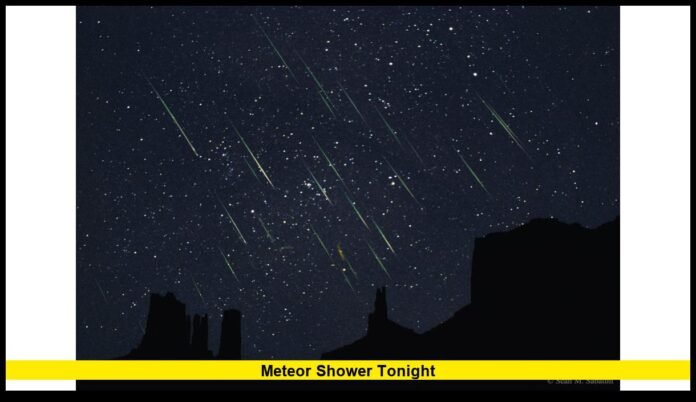

Meteor shower tonight is expected to captivate stargazers across the United States as the Geminid meteor shower reaches its dazzling 2025 peak. Recognized as one of the most spectacular and dependable meteor events of the year, the Geminids promise a breathtaking show with up to 120 meteors per hour visible under dark skies.
As of Saturday, December 13, 2025, the Geminids will illuminate the night sky from coast to coast. The best time to watch will be between 10 p.m. and 2 a.m. local time, with the constellation Gemini positioned high above the eastern horizon. With favorable weather forecasts for most regions, millions of Americans are preparing to witness one of nature’s grandest light shows.
What Is the Geminid Meteor Shower?
The Geminid meteor shower occurs each December when Earth passes through debris left by the rocky asteroid 3200 Phaethon. As these particles collide with Earth’s atmosphere at tremendous speeds — nearly 78,000 miles per hour — they burn up, producing bright, colorful streaks of light that appear across the night sky.
Unlike most meteor showers, which originate from comets, the Geminids come from an asteroid. This gives their meteors a slightly slower, denser, and brighter appearance, often with a distinct golden or green hue. Because of their intensity and frequency, the Geminids are widely regarded as the most impressive meteor shower of the year.
When and Where to Watch
The Geminids will peak on Saturday night, December 13, 2025, and continue into the early hours of Sunday, December 14.
For the best viewing experience, skywatchers should plan to head outside after 10 p.m. when the radiant point in the constellation Gemini rises higher in the sky. Meteor activity usually intensifies after midnight and remains strong until dawn.
Here’s a breakdown of the ideal viewing times by region:
| Region | Best Time to Watch | Expected Meteor Rate (per hour) |
|---|---|---|
| East Coast (ET) | 10 p.m. – 2 a.m. | 100–120 |
| Central U.S. (CT) | 9 p.m. – 1 a.m. | 90–110 |
| Mountain U.S. (MT) | 8 p.m. – 12 a.m. | 90–100 |
| West Coast (PT) | 9 p.m. – 2 a.m. | 80–100 |
The waning crescent moon will set early in the evening, providing dark skies for ideal meteor visibility across much of the country.
Where to Look in the Sky
The Geminids appear to radiate from the constellation Gemini, which rises in the east shortly after sunset.
To locate the radiant point:
- Face east after the sky turns fully dark.
- Find the constellation Orion, known for its distinct “belt” of three stars.
- Look slightly above and to the left — that’s where Gemini is located.
While the meteors seem to originate from Gemini, they can appear anywhere in the sky. The best viewing method is to lie back and look at a wide section of the heavens. Avoid staring directly at the radiant point — meteors seen farther away tend to have longer, more dramatic trails.
Weather Outlook Across the U.S.
Clear skies are crucial for seeing the meteor shower tonight. Current forecasts indicate mostly favorable weather conditions across large parts of the U.S.
Here’s a quick regional forecast for visibility on December 13, 2025:
- Northeast: Skies will be partly cloudy with clear breaks overnight, especially inland from coastal regions.
- Midwest: Excellent visibility is expected with mostly clear skies and cool temperatures.
- South: Ideal conditions across Texas, Florida, and the Gulf states, with mild nighttime temperatures.
- West: Clear skies in California, Nevada, and Arizona, though northern areas may experience patchy fog or clouds.
- Pacific Northwest: Cloudy with possible rain, making visibility limited for stargazers in Oregon and Washington.
If skies are cloudy in your area, you can still tune into live streams offered by astronomy organizations and observatories that broadcast meteor showers in real-time.
How to Watch the Meteor Shower Tonight
Watching the Geminids requires no telescope or binoculars — just a clear view of the night sky and patience. Follow these simple steps for the best experience:
- Find a Dark Location: Choose a spot far from city lights, such as rural areas, parks, or beaches.
- Get Comfortable: Bring a reclining chair, blanket, and warm clothing. Temperatures can drop quickly after sunset in December.
- Avoid Artificial Light: Give your eyes at least 20 minutes to adjust to the darkness. Avoid using phone screens or flashlights.
- Be Patient: Meteors often appear in bursts. Stay outside for at least an hour for the best chance to see several bright streaks.
- Bring a Friend: Watching a meteor shower is more enjoyable with others — and you’ll have more eyes scanning the sky!
For photographers, a wide-angle lens and long exposure settings (10–30 seconds) can capture stunning images of multiple meteors streaking across the sky.
What Makes the Geminids Stand Out
The Geminid meteor shower is widely regarded as the most spectacular meteor event visible from Earth. Several factors make it stand out from others throughout the year:
- High Meteor Rate: The Geminids can produce more than 100 visible meteors per hour under dark conditions.
- Brightness and Color: Many meteors appear in shades of yellow, green, or red due to their mineral composition.
- Slow, Long Trails: Unlike other showers, Geminid meteors move slowly and often leave glowing trails that linger for a few seconds.
- Wide Viewing Window: While the peak occurs on December 13–14, the shower is active from December 4 to December 17, offering several nights of viewing opportunities.
These factors combine to make the Geminids an annual favorite for amateur astronomers and casual skywatchers alike.
The Science Behind the Geminids
Most meteor showers come from comets, but the Geminids are unique because they come from an asteroid — 3200 Phaethon.
This asteroid orbits the Sun every 1.4 years and sheds a trail of rocky debris. When Earth crosses this trail, fragments enter our atmosphere and ignite, creating a stunning display of shooting stars.
Scientists classify Phaethon as a “rock comet,” meaning it behaves like both an asteroid and a comet. Its unusual orbit brings it close to the Sun, where intense heat causes fragments to break away — replenishing the Geminid debris stream each year.
Because of this stable orbit and dense debris, the Geminid shower has remained strong and consistent for over a century.
Safety and Light Pollution Tips
To enjoy the meteor shower at its fullest, minimizing light pollution is key. Here are some quick tips:
- Leave the city: Drive at least 30–50 miles away from bright urban areas.
- Avoid streetlights: Find an open area such as a field, desert, or lakeshore.
- Turn off headlights: Once parked safely, avoid artificial light sources.
- Use red lights: If you need light, use a red flashlight, which won’t ruin your night vision.
For city dwellers unable to travel, rooftops, open parks, or beaches can still offer partial views if the horizon is clear.
Other Upcoming Meteor Showers
If clouds block your view or you miss tonight’s event, don’t worry — more celestial displays are on the way. Here’s what’s next on the 2025–2026 meteor calendar:
| Meteor Shower | Peak Date | Average Meteors per Hour |
|---|---|---|
| Ursids | December 22, 2025 | Up to 10 |
| Quadrantids | January 3–4, 2026 | Up to 110 |
| Lyrids | April 22, 2026 | 20–25 |
| Perseids | August 12–13, 2026 | 60–80 |
The Ursids will be a smaller follow-up later this month, while the Quadrantids in early January will kick off the 2026 stargazing season with another impressive show.
Why the 2025 Geminids Are Especially Exciting
This year’s Geminid meteor shower is expected to be one of the best in recent years. Several factors contribute to its exceptional visibility:
- Minimal Moonlight: The crescent moon will set early, leaving a dark sky backdrop.
- Clear Weather: Much of the U.S. will experience stable, cloud-free conditions overnight.
- Strong Activity: The shower’s intensity remains consistently high, ensuring bright and frequent meteors.
For many skywatchers, the Geminids are a perfect opportunity to disconnect from the noise of everyday life and experience one of nature’s most peaceful yet awe-inspiring events.
A Night to Remember
Whether you’re watching from a quiet desert, a mountain cabin, or your own backyard, the meteor shower tonight offers a moment to reflect on the vastness of the universe. The Geminids remind us how small we are in the grand scale of space — and how beautiful it can be to simply look up.
So grab a blanket, step outside, and take in the show — the Geminid meteor shower is set to make tonight one of the most magical nights of 2025.