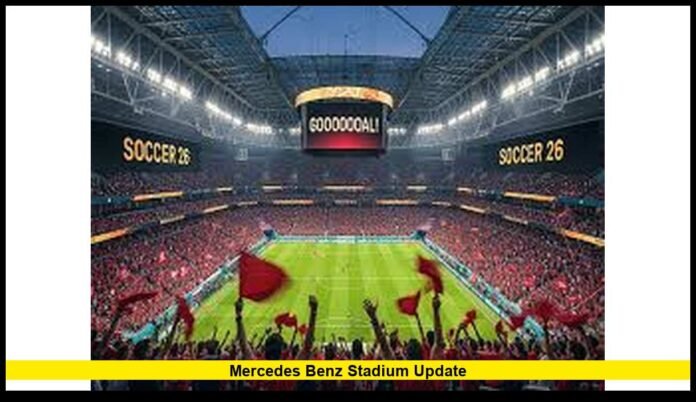

The mercedes benz stadium update confirms that Atlanta’s flagship sports and entertainment venue is operating at full strength in 2026, with confirmed global events, steady downtown development, upgraded fan experiences, and year-round community use shaping its current and future role.
Mercedes-Benz Stadium’s Current Role in Atlanta
Mercedes-Benz Stadium stands at the center of downtown Atlanta’s sports, tourism, and event economy. Entering 2026, the stadium is not transitioning or retooling but executing a packed calendar anchored by professional sports, international competitions, and large-scale civic events.
No closures, capacity reductions, or operational pauses are in place. The stadium remains fully open and actively scheduled, reinforcing its status as one of the most reliable large venues in the United States.
World Cup 2026 Positions the Stadium on a Global Stage
One of the most defining elements of this mercedes benz stadium update is its confirmed role as a host venue for the 2026 FIFA World Cup. The stadium is set to host eight official tournament matches, including group-stage games and a semifinal. During the tournament, the venue will operate under the name “Atlanta Stadium,” in line with FIFA naming requirements.
Rather than requiring major reconstruction, preparations focus on execution. Field management, broadcast systems, international security coordination, and fan-flow logistics are being finalized using the stadium’s existing infrastructure. The retractable roof, seating capacity, and media facilities already meet tournament standards, allowing planners to focus on operations rather than structural change.
The World Cup will bring sustained international attention to Atlanta, with Mercedes-Benz Stadium acting as a primary anchor for visitor traffic, global broadcasts, and citywide economic activity.
Professional Sports Remain the Stadium’s Backbone
Mercedes-Benz Stadium continues to serve as the full-time home venue for Atlanta’s professional teams.
The Atlanta Falcons play all home games at the stadium, supported by NFL-level broadcast infrastructure, premium seating, and one of the league’s largest video boards. Prime-time matchups and nationally televised games remain a regular feature of the calendar.
The stadium is also home to Atlanta United FC, a club known for strong attendance and high-profile matches. Mercedes-Benz Stadium continues to host marquee MLS games, rivalry matchups, and postseason contests that require expanded seating and advanced production capabilities.
The ability to transition quickly between football and soccer configurations allows the venue to maintain dense scheduling without disruption.
College Football and Postseason Events
College football remains a major driver of annual stadium traffic. Mercedes-Benz Stadium continues to host postseason games, conference championships, and high-profile bowl matchups tied to the College Football Playoff rotation.
These events attract national audiences and significant visitor volume, reinforcing the stadium’s importance beyond professional leagues. Hotels, restaurants, and downtown businesses experience measurable economic impact during these weekends, strengthening the venue’s role in Atlanta’s broader economy.
International Soccer and Global Exhibitions
Beyond domestic leagues, international soccer exhibitions and competitions remain a growing component of the stadium’s schedule. Global clubs and national teams continue to select Mercedes-Benz Stadium for U.S. appearances due to its seating capacity, pitch adaptability, and broadcast readiness.
These matches also serve as operational benchmarks ahead of the World Cup, allowing staff to refine crowd management, international media coordination, and multilingual services under real-event conditions.
Fan Experience and Premium Seating Enhancements
Fan experience remains a top priority. The stadium has expanded its premium seating portfolio with new club-level offerings, including additional social spaces in the upper seating bowl.
These areas feature:
- Cushioned seating options
- Climate-controlled club access
- Full-service bars and upgraded dining
- Flexible layouts for private events
Rather than catering only to luxury buyers, these enhancements are designed to improve comfort and circulation for large crowds, supporting smoother game-day operations across all seating levels.
Technology and Venue Operations
Mercedes-Benz Stadium continues to operate as a fully cashless venue, with mobile ticketing and digital payments standard across concessions and merchandise locations.
Operational systems emphasize speed and efficiency, including:
- High-capacity Wi-Fi and mobile connectivity
- Real-time crowd monitoring
- Advanced security screening
- Digital signage and wayfinding
These systems are active during both major events and smaller gatherings, ensuring consistency regardless of crowd size.
Community Programming and Year-Round Use
The community role of Mercedes-Benz Stadium continues to grow well beyond ticketed sports and major headline events. The Home Depot Backyard has become a consistently activated public space, hosting a steady calendar of fitness sessions, wellness activations, cultural celebrations, and open-access community gatherings throughout the year.
Recent programming has placed a stronger emphasis on health, inclusion, and local engagement. Large-scale fitness events, instructor-led workouts, and wellness days regularly bring thousands of Atlanta residents onto the stadium grounds, many of whom are not attending a game. These events are designed to be accessible, family-friendly, and welcoming to a wide range of age groups and fitness levels.
Cultural programming has also expanded, with the outdoor space being used for music, local celebrations, and community-focused events that reflect Atlanta’s diverse population. Food-based gatherings, seasonal festivals, and civic events have increased in frequency, reinforcing the stadium’s position as a shared public venue rather than a closed, event-only facility.
Importantly, these activities are not limited to peak sports seasons. Community use is spread across weekdays, weekends, and off-peak months, keeping the area active even when no major sporting event is scheduled. This consistent activation supports nearby small businesses, increases foot traffic downtown, and strengthens the stadium’s connection to surrounding neighborhoods.
Sustainability and Environmental Performance
Mercedes-Benz Stadium maintains its position as one of the most environmentally advanced stadiums in the country. Its retractable roof design supports natural lighting and ventilation when conditions allow, reducing reliance on artificial systems.
Energy usage is managed through intelligent building controls that adjust lighting, HVAC, and power consumption based on occupancy and event scale. LED lighting is used throughout the facility, supporting broadcast needs while minimizing energy demand.
Water conservation remains a defining feature. Rainwater capture systems collect and reuse water for irrigation and cooling, while low-flow fixtures and efficient landscaping reduce overall consumption.
Waste reduction programs continue to operate across concourses and service areas, with composting and recycling integrated into daily operations. These systems remain active year-round, not just during marquee events.
Downtown Atlanta Development Around the Stadium
Redevelopment activity continues to reshape the blocks surrounding the stadium. Older residential and commercial structures south and southwest of the venue have been cleared following approved permits, marking a transition toward future mixed-use development.
While no single project has been formally announced, planning activity reflects strong interest in hospitality, residential, and entertainment-focused uses tied to sustained stadium traffic. Proximity to transit, walkability, and event-driven demand make the area attractive for long-term investment.
Rather than short-term speculation, redevelopment reflects coordinated planning aligned with the stadium’s confirmed event calendar and Atlanta’s broader downtown revitalization strategy.
Transportation and Accessibility
Mercedes-Benz Stadium remains one of the most transit-accessible major venues in the U.S. Downtown rail stations, pedestrian corridors, and highway access points support efficient crowd movement before and after events.
Transportation planning emphasizes:
- Public transit usage
- Pedestrian safety
- Traffic flow coordination
- Event-specific routing
These systems are already in place and are being optimized for periods of peak attendance tied to global events.
Economic Impact and Tourism
The economic impact of Mercedes-Benz Stadium extends far beyond the venue’s gates. As one of the busiest stadiums in the country, it continues to drive substantial domestic and international tourism that fuels downtown Atlanta’s hospitality and service sectors.
Major events at the stadium bring waves of visitors who stay in local hotels, dine in area restaurants, shop in retail districts, and attend cultural attractions throughout the city. For marquee occasions like NFL games, major MLS fixtures, College Football Playoff bowls, and especially international competitions such as the 2026 FIFA World Cup, visitor numbers surge, generating measurable influxes in tourism revenue. These events attract out-of-state and global attendees who spend on accommodations, local transportation, dining, and entertainment.
This visitor activity also supports employment across key industries. Hospitality jobs in hotels and restaurants expand around high-demand periods, while transportation services including rideshare drivers, MARTA staff, and parking operations see increased work volume. Event security personnel, venue staff, and local vendors similarly benefit from consistent event scheduling.
Perhaps uniquely, Mercedes-Benz Stadium’s year-round calendar helps convert what many cities experience as seasonal tourism spikes into a more predictable economic rhythm. Instead of revenue peaking only during one or two sports seasons, Atlanta enjoys continuous economic contribution tied to a spectrum of events — from winter bowl games to spring soccer exhibitions, summer international competition, and fall football schedules.
Beyond direct spending on lodging, food, and retail, the stadium’s influence extends to broader tourism promotion. International events spotlight the city on global broadcast platforms, encouraging future travel and destination interest even after the events conclude. Local tourism partners leverage these high-profile moments to promote extended stays, partner attractions, and multi-day experiences that keep visitors exploring beyond event day.
Moreover, secondary spending patterns emerge as tourists often extend their stays before or after stadium events to visit museums, parks, nightlife districts, and cultural festivals. This broader engagement supports small businesses and creative industries that benefit from increased foot traffic tied to stadium scheduling.
In total, the economic impact underscores Mercedes-Benz Stadium’s role as an engine of downtown Atlanta’s economy — boosting revenues, sustaining jobs, and promoting tourism in a way that reinforces the city’s standing as a premier national and international destination.
Long-Term Outlook
This mercedes benz stadium update makes one thing clear: the venue is not preparing for transition or uncertainty. Instead, it is executing a defined strategy centered on confirmed events, operational reliability, and integration with downtown growth.
Key realities shaping the outlook include:
- Global events already locked into the calendar
- Active professional and collegiate sports schedules
- Ongoing community use
- Stable operations with no announced disruptions
- Continued investment interest around the venue
Mercedes-Benz Stadium remains a cornerstone of Atlanta’s sports, entertainment, and tourism identity, positioned for sustained relevance well beyond 2026.
What upcoming event at Mercedes-Benz Stadium are you most excited about? Join the conversation and keep following for the latest developments.