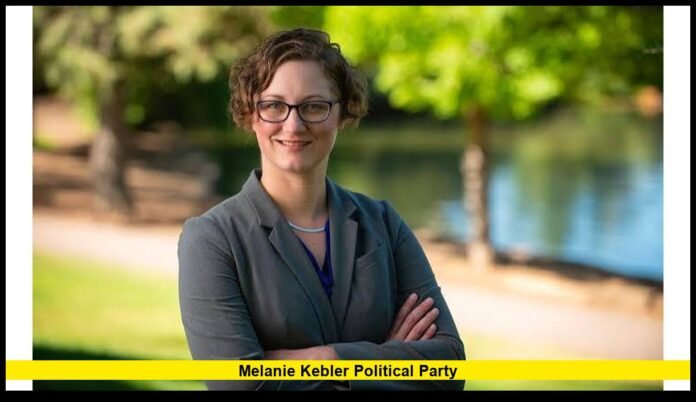

The Melanie Kebler political party question centers on her identification as a Democrat and her role as the mayor of Bend, Oregon. As of October 16, 2026, Kebler remains the incumbent mayor and a certified candidate in the November 3 municipal election. Although the Deschutes County Democratic Party identifies her as a Democrat, Bend elects its mayor through a nonpartisan process.
This distinction is important for understanding Kebler’s political identity, public service, and current campaign. Her party affiliation provides context for her political relationships, while her record in city government offers a more direct view of her priorities. With voters preparing to choose Bend’s next mayor, her political background remains relevant to the local election.
What Is Melanie Kebler’s Political Party?
Melanie Kebler is identified as a Democrat by the Deschutes County Democratic Party. This identification answers the central question about her political affiliation.
However, her position as mayor of Bend is officially nonpartisan. The city does not organize its mayoral contest as a Democratic-versus-Republican election. Instead, candidates qualify through the municipal election process, and voters choose among the eligible candidates.
These two facts can coexist without contradiction. A politician may identify with a political party, receive support from party organizations, and participate in political activities while holding an office that does not carry an official party designation.
Kebler’s public political profile includes support from Democratic organizations and elected officials. Her 2026 reelection campaign also features endorsements from individuals and organizations associated with different areas of public policy, including housing, environmental protection, labor, and public safety.
For readers seeking a straightforward answer, Kebler is identified as a Democrat, but the mayoral office she holds is nonpartisan.
Is Melanie Kebler a Democrat or a Republican?
Kebler is identified as a Democrat, not a Republican, in the Deschutes County Democratic Party’s political representation directory.
That identification helps explain her political connections, but it should not replace an examination of her actual positions. Party affiliation alone does not establish how a mayor will approach every local issue or how the full city council will vote on a proposal.
Local government in Oregon addresses practical matters that affect residents directly. These include housing development, transportation, public safety, emergency preparation, homelessness, infrastructure, and land-use planning. Candidates may share broad political principles while disagreeing over specific policies or implementation.
Kebler’s campaign emphasizes housing affordability, safer transportation, environmental protection, and community development. Readers interested in her political outlook can consider those stated priorities alongside her record in office.
It is also important to distinguish between a party’s support for a candidate and the candidate’s official election classification. The Democratic Party’s identification of Kebler does not turn Bend’s mayoral election into a partisan contest.
Why Bend’s Mayoral Election Is Nonpartisan
Bend uses a nonpartisan system for its city council elections, including the mayoral race. The city council consists of six council members and a mayor, and Bend voters elect all seven officials at large.
An at-large election allows eligible voters across the city to vote for the positions rather than restricting each seat to a separate geographic district.
The mayor’s position is listed as Position No. 7. The 2026 election also includes contests for council Positions No. 5 and No. 6.
Bend’s nonpartisan approach means candidates do not compete for the mayor’s office under official Democratic or Republican ballot labels. The process focuses on municipal candidacies rather than party nominations.
This structure does not prevent political parties from expressing preferences or endorsing candidates. It simply separates political affiliation from the formal classification of the office.
For anyone researching the Melanie Kebler political party question, this distinction is essential. Calling Kebler a Democrat describes her political identification, while calling her mayoral office nonpartisan describes the city’s election rules.
Melanie Kebler’s Background in Local Government
Kebler’s career in public service began before she became mayor. She joined the Bend City Council in 2020 and won election as mayor in 2022. She began serving as mayor in January 2023.
Before entering municipal leadership, she worked in the legal field. Her professional experience includes service as a prosecutor and work as an attorney representing crime victims. She also practiced estate and probate law.
Her legal background gave her experience with public institutions, individual rights, and the practical consequences of government decisions. Her move into local elected office placed that experience within a different setting: municipal policymaking.
Kebler grew up in Bend and attended Bend High School. Her connection to the city provides personal context for her interest in its development and long-term future.
As a city council member and later as mayor, she has worked on issues involving housing, homelessness, transportation, climate concerns, and economic development.
Her political background therefore includes both an identified Democratic affiliation and a record of participation in local government. Those elements help explain her public profile without suggesting that party membership alone determines her policies.
Melanie Kebler’s First Term as Mayor
Kebler took office in January 2023 after winning the 2022 mayoral election. Her first term has included work on several issues that affect Bend’s growth and quality of life.
Housing affordability has been a major focus. Like many growing communities, Bend faces questions about the availability of homes, the cost of living, development patterns, and the needs of residents with different incomes.
Homelessness has also featured in her public priorities. Addressing homelessness requires coordination among municipal departments, service providers, community organizations, and other levels of government. No mayor can resolve the issue through a single decision.
Transportation is another part of her record. As Bend grows, the city must consider how residents move between neighborhoods, employment centers, schools, businesses, and public spaces. Street safety, transit connections, and infrastructure planning all affect those decisions.
Environmental protection and emergency preparedness have also appeared in Kebler’s stated priorities. Bend’s planning decisions influence the city’s long-term resilience and the way new development fits into the surrounding environment.
These issues provide a practical framework for assessing her tenure. Rather than relying exclusively on a political label, voters can evaluate specific decisions, the results achieved, and the challenges that remain.
Melanie Kebler’s 2026 Reelection Campaign
Kebler announced on June 8, 2026, that she would seek a second term as mayor. Her campaign presents the election as an opportunity to continue work on housing, homelessness, public safety, infrastructure, and city planning.
The City of Bend’s election information lists her as eligible, qualified, and certified for the November 3, 2026, general election.
Her listed opponents include Bernadette Strome, who is also certified for the ballot, and Ron (Rondo) Boozell, whose filing is listed as eligible and qualified. The city’s published classifications distinguish between candidates whose names are certified for the ballot and those whose filings have not reached that same status.
The election will determine who serves as mayor for the next four-year term.
The main election details are:
- Office: Mayor of Bend, Oregon.
- Incumbent: Melanie Kebler.
- Election date: November 3, 2026.
- Term length: Four years.
- Election classification: Nonpartisan.
- Kebler’s status: Certified candidate seeking reelection.
As of October 16, 2026, Election Day has not arrived. Kebler remains the incumbent and a candidate, but the result of the contest is not yet known.
Her current campaign gives voters an opportunity to compare her record and proposals with those of her opponents. The final decision belongs to Bend’s electorate.
Political Endorsements and Democratic Support
Political endorsements can reveal which organizations and public figures support a candidate. They can also help voters understand the networks that surround a campaign.
Kebler’s reelection campaign identifies the Deschutes County Democratic Party among its supporters. Her campaign also lists endorsements from public officials, former mayors, labor organizations, environmental groups, and organizations focused on issues such as gun safety and housing.
These endorsements indicate that her campaign has support from several constituencies. They do not change the nonpartisan status of the mayor’s office.
An endorsement also does not establish that every supporter agrees with every position a candidate holds. Organizations and individuals may support a candidate because of a particular policy area, an assessment of their performance, or their approach to local leadership.
For voters, endorsements are one source of information rather than a substitute for reviewing a candidate’s record and stated priorities.
Kebler’s Democratic identification is therefore relevant to her political profile, but her campaign coalition extends beyond a single party organization. The local election remains open to eligible voters regardless of their political affiliation.
Housing Affordability and Community Development
Housing is one of the central subjects in Kebler’s reelection platform. Her campaign emphasizes increasing the availability of homes, supporting affordable housing initiatives, and encouraging planning that connects residents with everyday services.
Housing policy involves multiple decisions at the municipal level. Local officials consider zoning, development standards, infrastructure capacity, and the relationship between residential growth and public services.
Cities also work with housing providers and other agencies to support homes for residents who cannot afford market-rate options. These efforts may include income-restricted housing and partnerships designed to increase supply.
Kebler’s campaign argues for continued work on affordability and development. Voters evaluating that position can examine the city’s existing policies, completed projects, and remaining housing needs.
Community development is closely related to those questions. Neighborhood planning can influence access to schools, shops, employment, parks, and transportation. The goal is to manage growth while maintaining the features that residents value about Bend.
These priorities help explain the practical issues at the center of her campaign. They are also examples of why understanding a mayor’s record requires more than knowing the politician’s party.
Public Safety, Transportation, and Environmental Priorities
Kebler’s campaign also emphasizes public safety and emergency preparedness. These responsibilities include planning for emergencies, maintaining effective municipal services, and preparing for risks such as wildfires.
Public safety policy involves choices about staffing, budgets, emergency response, prevention, and cooperation among local agencies. The mayor and city council help establish policy direction, while city departments carry out their assigned responsibilities.
Transportation is another important part of the campaign. Bend’s growth creates demand for safe streets, reliable connections between neighborhoods, and infrastructure that accommodates different ways of traveling.
Kebler has highlighted improved transit and stronger connections across the city. Her campaign also supports planning that allows residents to reach jobs, schools, businesses, and community amenities more easily.
Environmental protection remains another stated priority. Decisions about development, transportation, infrastructure, and emergency preparation can affect the city’s long-term environmental resilience.
These topics overlap with concerns often discussed in Democratic politics, but individual proposals must be judged on their specific details. A party identification does not establish whether a policy will succeed or how much it will cost.
Residents can assess these priorities by considering the proposals, their potential local effects, and the record of decisions made during Kebler’s first term.
What the 2026 Election Means for Kebler’s Political Future
The November 3 election represents a decision about Bend’s next four years of municipal leadership. For Kebler, reelection would mean continuing in office for another term. Defeat would mean that voters had selected another candidate.
Neither outcome can be assumed before the election.
The mayoral contest also provides a broader opportunity for residents to consider how the city should manage growth, housing costs, transportation, public safety, and environmental challenges.
Because the office is nonpartisan, voters do not need to select a candidate based on a formal party label on the ballot. They can consider experience, policy proposals, public performance, endorsements, and their own priorities.
Kebler’s Democratic identification remains a relevant part of her political background. However, her future as mayor depends on the election result rather than on that affiliation.
Readers following the race should distinguish confirmed information from campaign claims and predictions. Her candidacy is established, the election date is set, and the outcome remains pending as of October 16, 2026.
Frequently Asked Questions
What political party does Melanie Kebler belong to?
Melanie Kebler is identified as a Democrat by the Deschutes County Democratic Party.
Is Melanie Kebler a Democrat or a Republican?
She is identified as a Democrat, not a Republican, by the local Democratic Party organization.
Is the mayor of Bend a partisan position?
No. Bend’s mayoral office is nonpartisan. Candidates do not run for the office under official Democratic or Republican ballot labels.
When did Melanie Kebler become mayor of Bend?
Kebler began serving as mayor in January 2023 after winning the 2022 mayoral election.
Is Melanie Kebler running for reelection in 2026?
Yes. She announced her reelection campaign on June 8, 2026, and is certified for the November 3 general election.
Who is running against Melanie Kebler?
The city’s candidate information lists Bernadette Strome as another candidate certified for the ballot and Ron (Rondo) Boozell as eligible and qualified.
What issues does Melanie Kebler emphasize?
Her campaign highlights housing affordability, homelessness, public safety, transportation, environmental protection, infrastructure, and community development.
Does the Democratic Party’s support make the mayoral election partisan?
No. Political organizations may endorse candidates, but Bend’s mayoral election remains nonpartisan under the city’s election rules.
Has Melanie Kebler won reelection?
No result can be established as of October 16, 2026, because Election Day is November 3, 2026. She remains a candidate seeking another term.
How should voters evaluate Melanie Kebler’s political record?
Voters can consider her municipal decisions, campaign proposals, public statements, endorsements, and performance during her first term, rather than relying on party affiliation alone.
Conclusion
Melanie Kebler is identified as a Democrat, while her position as mayor of Bend remains nonpartisan. Her legal background, city council experience, first mayoral term, and 2026 reelection campaign provide the broader context for understanding her political role. With Election Day approaching, her housing, transportation, public safety, and community development priorities remain central to her campaign.
What do you think should be Bend’s top priority in the next mayoral term? Share your views and follow the latest confirmed developments in the 2026 election.