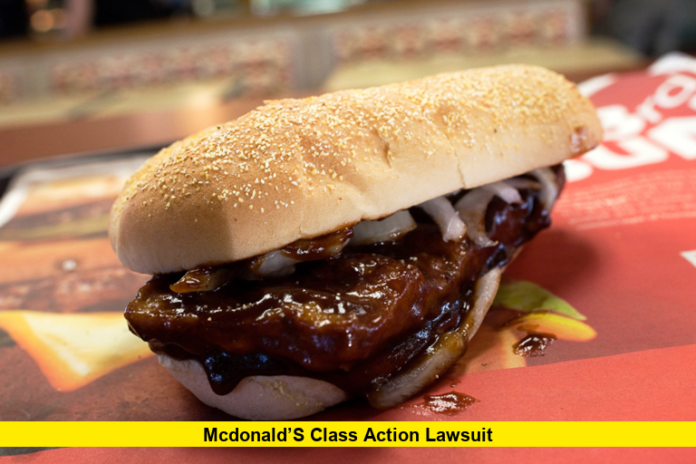

A mcdonalds class action lawsuit has emerged as a major consumer case in the United States, challenging how one of the world’s most recognizable fast-food brands markets its products. The lawsuit centers on the McRib sandwich and claims that customers were misled about what they were actually buying. At issue is whether McDonald’s product naming, design, and advertising created false expectations about the sandwich’s ingredients, leading millions of consumers to pay for something they believed was different from what they received.
As the case moves through the early stages of the federal court system, it is drawing attention not only because of the McRib’s popularity, but also because of what it may signal for food marketing standards across the fast-food industry.
How the Lawsuit Began
The lawsuit was filed in federal court in late 2025 by a group of consumers who say they were deceived by the way the McRib is presented. The plaintiffs argue that McDonald’s used a combination of product naming, shape, and promotional imagery that led reasonable customers to believe the sandwich contained actual pork rib meat.
According to the complaint, the McRib’s name and its rib-like form strongly suggest a traditional rib product. The plaintiffs claim that they relied on this impression when purchasing the sandwich, often at a price higher than many other items on the menu. They allege that this belief turned out to be incorrect and that McDonald’s failed to clearly correct that assumption.
The lawsuit seeks to represent a nationwide group of customers who purchased the McRib over a defined period, along with additional groups in certain states where consumer protection laws are particularly strong.
What the Plaintiffs Say Is Misleading
The core argument of the lawsuit focuses on consumer expectations. The plaintiffs do not claim the McRib is unsafe or unfit for consumption. Instead, they argue that it is marketed in a way that misrepresents what it actually is.
Their claims focus on several factors:
- The word “rib” commonly refers to a specific cut of pork
- The sandwich’s shape resembles a rack of ribs
- Promotional images reinforce the idea of a rib-based product
- Many consumers associate ribs with higher-quality meat
The plaintiffs say that while the McRib is made from pork, it is not made from rib meat. They argue that this distinction matters, especially when customers believe they are paying a premium for a specific type of product.
Understanding the Product at the Center of the Case
The McRib has been part of McDonald’s menu off and on for decades. Known for its limited-time availability, the sandwich has built a loyal following. It consists of a pork patty shaped like a rack of ribs, topped with barbecue sauce, onions, and pickles, served on a bun.
According to the lawsuit, the pork used in the McRib is seasoned boneless pork that is processed and formed into a uniform shape. The plaintiffs argue that while this information may be technically available, it is not presented in a way that clearly counters the impression created by the product’s name and appearance.
This gap between technical accuracy and consumer perception is a major theme in the case.
Legal Claims Raised in the Case
The mcdonalds class action lawsuit includes several legal claims commonly seen in consumer protection cases. These include allegations of misleading advertising, breach of warranty, breach of contract, negligent misrepresentation, and violations of state consumer protection statutes.
The plaintiffs argue that McDonald’s effectively promised one thing through its branding while delivering something else. Even if the product met food safety standards, they claim the mismatch between expectation and reality caused financial harm.
From the plaintiffs’ perspective, the issue is not whether the sandwich tasted good, but whether consumers were given accurate information at the point of sale.
McDonald’s Position and Defense
McDonald’s has rejected the accusations made in the lawsuit. The company maintains that the McRib is made from seasoned boneless pork and that this information is not hidden from consumers. McDonald’s argues that it does not promise a specific cut of meat and that the product name does not constitute a guarantee of rib meat content.
The company has indicated that it believes the lawsuit mischaracterizes both the product and consumer understanding. McDonald’s has also emphasized its broader commitment to ingredient transparency and compliance with food labeling regulations.
As the case progresses, McDonald’s is expected to challenge the legal sufficiency of the claims and oppose efforts to certify the lawsuit as a class action.
The Role of the “Reasonable Consumer”
A key legal standard in this case is how a reasonable consumer would interpret the McRib’s name and presentation. Courts often evaluate whether an average buyer, exercising ordinary care, would likely be misled.
The plaintiffs argue that most consumers are not experts in meat processing and should not be expected to question whether a rib-shaped sandwich labeled “McRib” contains actual ribs. They claim that the burden should fall on the company to clearly state otherwise if the product differs from what its name implies.
McDonald’s, on the other hand, is expected to argue that consumers understand fast-food marketing conventions and do not reasonably assume that product names always describe exact ingredients.
Who May Be Affected by the Lawsuit
If the court allows the case to proceed as a class action, it could involve a very large number of consumers. Anyone who purchased a McRib during the specified time frame could potentially be included.
The lawsuit also identifies specific state-level groups, which could matter because consumer protection laws vary by state. These differences can affect what remedies are available and how damages are calculated.
For most consumers, participation would not require taking any action unless a settlement is reached or the court orders notice to be sent to class members.
What Happens Next in the Legal Process
The lawsuit is still in its early stages, and several important steps remain. McDonald’s may file motions asking the court to dismiss some or all of the claims. The judge will also need to decide whether the case meets the requirements to move forward as a class action.
If the lawsuit survives these early challenges, the case would move into discovery, where both sides exchange documents, marketing materials, and internal communications. This phase often provides deeper insight into how products are developed and promoted.
Settlement discussions could take place at any point, though there is no indication yet that such talks have begun. If no settlement occurs, the case could eventually proceed to trial.
Why the Case Matters to the Food Industry
While the lawsuit focuses on a single sandwich, its implications reach far beyond McDonald’s. Food companies across the industry closely monitor cases like this because they can influence how products are named, shaped, and advertised.
If courts determine that product names must more closely align with ingredient composition, companies may need to rethink long-standing branding strategies. The outcome could also affect how limited-time or novelty items are introduced and promoted.
For consumers, the case highlights ongoing debates about transparency, expectations, and trust in large brands.
Consumer Awareness and Expectations
The lawsuit has sparked renewed discussion about how much responsibility falls on consumers versus corporations. Some argue that buyers should read ingredient lists carefully. Others believe companies should avoid names or designs that could reasonably be misunderstood.
Regardless of where the legal line is drawn, the case reflects growing consumer interest in understanding what is in their food and how it is marketed. As processed and engineered foods remain common, these questions are unlikely to disappear.
Current Status of the Lawsuit
As of now, the lawsuit remains active, and no final decisions have been made. The McRib continues to appear as a limited-time offering, and McDonald’s has not announced any changes to the product or its branding related to the case.
The legal process is expected to continue through motions and preliminary hearings before any outcome becomes clear.
Do you believe food marketing should be more specific, or is brand tradition enough? Share your thoughts and follow the story as it develops.