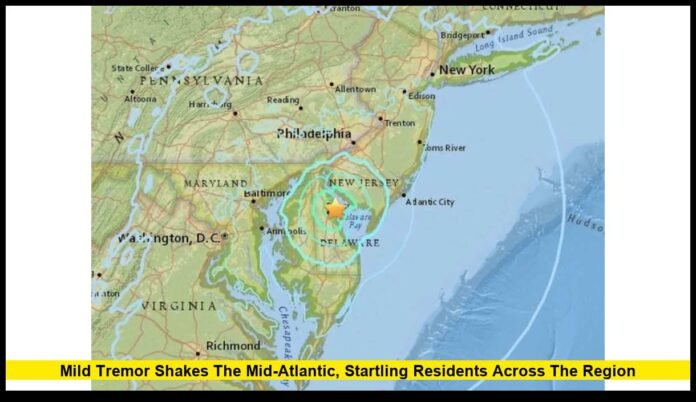

Many Marylanders awoke to an unexpected surprise this morning as a Maryland earthquake today rattled homes, offices, and nerves across the state. The mild tremor, recorded early Tuesday, was felt from Annapolis to Baltimore, with reports even coming in from parts of Washington, D.C., northern Virginia, and southern Pennsylvania.
Though small in magnitude, the quake caught many off guard — a reminder that even states not known for seismic activity can still feel the earth move beneath their feet.
Details Confirmed by the U.S. Geological Survey
According to the U.S. Geological Survey (USGS), the earthquake struck at 6:41 a.m. Eastern Time on October 28, 2025, near Annapolis, Maryland. It registered a preliminary magnitude of 3.2 on the Richter scale and had a depth of 5 kilometers (about 3 miles).
While considered minor, the shallow depth allowed the tremor to be felt widely across the Mid-Atlantic region. The shaking lasted only a few seconds but was enough to wake residents and cause minor rattling of windows and objects inside homes.
Within minutes, the USGS’s “Did You Feel It?” platform received over 10,000 responses from Maryland, Washington, D.C., and nearby states. The reports described light vibrations, rumbling sounds, and a brief jolt — similar to a passing heavy truck.
Areas Most Affected
The Maryland earthquake today was centered northwest of Annapolis in Anne Arundel County, but tremors were reported across a wide area.
Communities that felt noticeable shaking included:
- Baltimore City and County
- Annapolis
- Prince George’s County
- Howard County
- Montgomery County
- Frederick
- Northern Virginia suburbs like Alexandria and Arlington
Residents in Delaware and southern Pennsylvania also confirmed feeling light tremors. In most areas, the shaking was classified as Intensity III (Weak) on the Modified Mercalli Intensity Scale, meaning it was noticeable indoors but caused no damage.
No aftershocks have been recorded so far.
Local Officials Respond Quickly
The Maryland Emergency Management Agency (MEMA) issued a statement shortly after confirming the event. According to the agency, no reports of damage, injuries, or service disruptions have been received.
“This morning’s earthquake serves as a reminder that even here in Maryland, earthquakes can occur,” MEMA officials said. “Residents should always know how to respond safely in case of shaking.”
Governor Wes Moore addressed the event later in the morning, reassuring citizens that emergency crews had reviewed key infrastructure systems, including bridges, tunnels, and transit lines.
“Thankfully, this was a small quake,” Moore said. “Our state remains fully operational, and this serves as an opportunity to practice emergency preparedness.”
Fire departments in Baltimore and Anne Arundel County reported a surge in non-emergency 911 calls, as residents sought confirmation of what they had experienced.
Why Earthquakes Happen in Maryland
Maryland sits far from major fault lines like California’s San Andreas Fault, but small earthquakes still occur occasionally due to intraplate stress — pressure that builds up within the Earth’s crust away from plate boundaries.
Dr. Karen Blackwell, a seismologist at the University of Maryland, explained that these events are natural and relatively harmless.
“The Mid-Atlantic region is part of a very old geologic zone,” she said. “Over millions of years, small cracks and stress points can occasionally slip, producing minor earthquakes.”
Unlike major quakes in the western United States, intraplate quakes in the East can be felt across wider distances because of the denser, more solid bedrock. That’s why even a 3.0 earthquake in Maryland can be felt in several neighboring states.
Maryland’s History of Seismic Activity
Though rare, earthquakes are not unheard of in Maryland. Several minor quakes have shaken the state and surrounding areas in the past two decades.
Notable events include:
- July 16, 2010: A 3.6-magnitude quake near Gaithersburg startled the Washington, D.C., area. It was one of the strongest recorded in the region in decades.
- August 23, 2011: The 5.8-magnitude Mineral, Virginia earthquake was felt across the East Coast, including Maryland, and caused damage to the Washington National Cathedral.
- November 30, 2017: A 2.7-magnitude tremor near Rising Sun, Maryland, caused mild shaking but no damage.
- December 2023: A 2.9-magnitude quake near the Chesapeake Bay area briefly made headlines after residents mistook it for construction activity.
These incidents show that while large earthquakes are unlikely, mild to moderate tremors can occur every few years.
How Residents Reacted
When the Maryland earthquake today hit, thousands of residents turned to X (formerly Twitter), Facebook, and Instagram to share their experiences.
The phrase “Maryland Earthquake” quickly became one of the top trending topics regionally. Many described confusion as the brief shaking occurred during early morning routines.
One Baltimore resident wrote, “I thought it was my washing machine until I realized it wasn’t running.” Another user from Annapolis joked, “Maryland just tried to become California for 10 seconds.”
While most posts were lighthearted, others used the moment to encourage preparedness and awareness. The USGS praised citizens for submitting real-time “Did You Feel It?” responses, which help scientists map the impact of small quakes.
Earthquake Preparedness: What to Do Next Time
Even small quakes serve as a reminder that preparedness matters everywhere. Experts recommend practicing the “Drop, Cover, and Hold On” method whenever shaking occurs.
Here’s what to remember:
- Drop to the ground immediately to prevent losing balance.
- Cover your head and neck under a sturdy table or desk.
- Hold On until the shaking stops.
Additional safety steps include:
- Stay indoors if possible.
- Keep away from windows and heavy objects that could fall.
- If outside, move away from buildings, trees, and power lines.
- After the shaking stops, check for hazards such as gas leaks or damaged wiring.
Dr. Blackwell emphasized that preparedness is key.
“Even though Maryland’s earthquakes are small, they’re unpredictable. Knowing what to do can make all the difference.”
Infrastructure and Safety Checks Underway
Following the tremor, transportation officials conducted routine inspections on key Maryland infrastructure. The Maryland Transportation Authority confirmed that bridges, including the Chesapeake Bay Bridge and Francis Scott Key Bridge, showed no signs of damage.
Public utilities, including BGE (Baltimore Gas and Electric), also ran standard safety checks to ensure there were no disruptions to service. Metro, Amtrak, and MARC train systems reported normal operations after verifying that tracks were unaffected.
Local schools and businesses opened on schedule, though several principals used the opportunity to remind students about earthquake safety drills.
Why Even a Small Earthquake Matters
Some residents may wonder why a small quake like today’s event makes headlines. According to experts, the significance lies not in the magnitude, but in public awareness.
Small tremors highlight the need for preparedness in regions where earthquakes aren’t expected. They also allow emergency agencies to test communication systems and update regional response plans.
The Maryland Emergency Management Agency regularly uses these minor events to remind citizens to keep emergency kits on hand — complete with flashlights, water, batteries, and first-aid supplies.
Preparedness, officials say, isn’t just for earthquakes. It applies to all natural disasters, including hurricanes, floods, and severe winter storms, which affect the state more frequently.
Scientific Monitoring Continues
The USGS National Earthquake Information Center and local universities continue to monitor for any aftershocks or additional seismic activity in the area. So far, none have been detected, and scientists believe the event is isolated.
Sensors across Maryland and nearby states record hundreds of microseismic events each year, most too weak to feel. Data from today’s quake will help researchers improve understanding of the Appalachian Seismic Zone, a geologic feature that occasionally produces small tremors.
Dr. Blackwell noted,
“Each event gives us valuable data. Even small quakes help refine our models and improve early warning systems for the East Coast.”
A Wake-Up Call for Awareness
While earthquakes like today’s event are minor, they serve as important reminders that the ground beneath us is never completely still. Maryland’s residents, though unaccustomed to shaking, reacted calmly — and that’s exactly what emergency experts hope to see.
For most people, the quake will be remembered as a brief and surprising moment, quickly followed by curiosity and conversation. Yet, as the data shows, even a small tremor can offer big lessons about preparedness and resilience.
Conclusion: A Gentle Tremor, A Powerful Reminder
The Maryland earthquake today was minor in strength but significant in impact. It reminded residents that natural events can happen anywhere — even far from major fault lines.
No damage or injuries occurred, and the state’s infrastructure remains sound. Still, experts encourage Marylanders to take this as an opportunity to learn, prepare, and stay alert.
Earthquakes in the region may be rare, but awareness is the best form of readiness.
Did you feel the quake this morning? Share your experience below and join the conversation with others across the Mid-Atlantic who felt Maryland’s latest surprise.