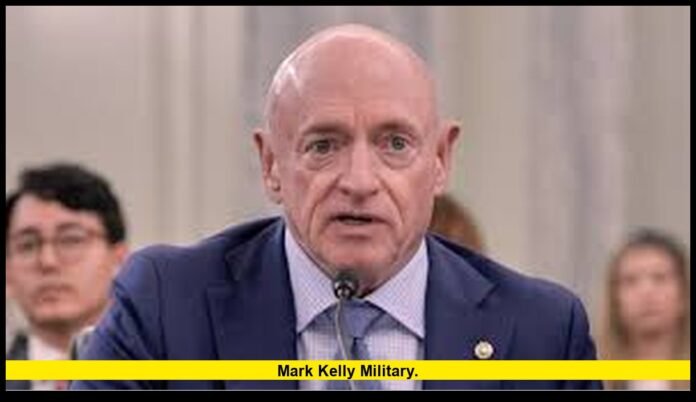

Mark Kelly military refers to his more than 25 years of U.S. Navy service as a combat aviator, test pilot, and captain, now under Pentagon review related to post-retirement conduct.
Mark Kelly military history stands as one of the most substantial service records ever carried into modern American public office. Long before his role in national politics, Kelly built a career defined by combat aviation, elite flight testing, and senior naval leadership. As of early 2026, that military legacy has reentered public focus, drawing attention not only to his past service but also to how retired officers remain connected to military institutions long after active duty ends.
This article examines Kelly’s confirmed military career, his rise through naval aviation, his command experience, and the current review tied to his retired status, all while keeping the focus strictly on verified facts and established records.
Early Path Into Military Service
Mark Edward Kelly entered military life through the United States Merchant Marine Academy, graduating in 1986 with a degree focused on engineering and maritime operations. Upon graduation, he accepted a commission in the United States Navy, beginning what would become a multi-decade aviation career.
His early assignments reflected strong technical aptitude. Within a short period, Kelly was selected for naval flight training, a competitive pipeline that prepares officers for carrier-based aviation under demanding conditions.
In 1987, he earned his naval aviator wings, officially qualifying to fly operational Navy aircraft.
Naval Aviation and Combat Deployment
Kelly was assigned to fly the A-6E Intruder, a two-seat attack aircraft used extensively during late-Cold War and Gulf War operations. The aircraft was designed for long-range strike missions and required precision flying under high stress.
Gulf War Combat Record
During the Persian Gulf War, Kelly flew 39 confirmed combat missions from an aircraft carrier operating in hostile airspace. These missions involved:
- Strike operations against military targets
- Support of coalition ground forces
- High-risk carrier launch and recovery cycles
Combat aviation from aircraft carriers is widely regarded as one of the most technically demanding roles in military aviation, combining operational danger with narrow margins for error.
Kelly’s Gulf War record became a defining element of his military résumé.
Advanced Training and Technical Leadership
After combat service, Kelly was selected to attend the U.S. Naval Test Pilot School, an institution reserved for experienced aviators trusted to evaluate aircraft systems, safety limits, and flight performance.
Test pilots serve a critical role in military aviation. They assess aircraft behavior at the edge of operational limits and provide data used to protect future pilots.
During this phase of his career, Kelly accumulated:
- More than 5,000 total flight hours
- Experience flying over 50 aircraft types
- Over 375 aircraft carrier landings
These numbers place him among the most experienced aviators of his generation.
Military Awards and Professional Recognition
Kelly’s service was recognized through a series of confirmed military decorations. These awards reflect both sustained excellence and specific acts of performance.
His honors include:
- Defense Superior Service Medal
- Legion of Merit
- Two Distinguished Flying Crosses
- Multiple Air Medals
- Navy Commendation Medal
- Navy Achievement Medal
Each award corresponds to documented service milestones rather than ceremonial recognition.
Selection as a NASA Astronaut
While still serving as a naval officer, Kelly was selected as a NASA astronaut in 1996. The selection process evaluates military pilots for leadership, engineering skill, and stress performance.
Kelly went on to fly four Space Shuttle missions. Across these missions, he spent more than 50 days in space and participated in complex orbital operations.
His final spaceflight assignment carried special significance. In 2011, Kelly commanded the final mission of Space Shuttle Endeavour, marking the end of one of NASA’s most iconic spacecraft programs.
Retirement From Active Duty
Later in 2011, Kelly retired from both NASA and the U.S. Navy with the rank of Captain. This rank represents senior command authority and typically reflects decades of consistent leadership and service.
Upon retirement, Kelly transitioned to civilian life but remained on the retired list of the Navy, receiving retirement pay based on his final rank.
Life After Uniformed Service
After leaving active duty, Kelly remained involved in public issues, eventually entering national politics. He was elected to the United States Senate and later won re-election, becoming one of the few senators with extensive combat aviation experience.
Throughout his public career, Kelly has continued to reference his military background when discussing defense readiness, national security, and veterans’ affairs.
Recent Military-Related Developments
In late 2025, Kelly participated in a public message directed at U.S. service members that quickly drew national attention. The message focused on a foundational principle of U.S. military law: service members are legally obligated to refuse orders that are unlawful. This principle is embedded in military training, codes of conduct, and long-standing legal standards governing armed forces behavior.
The message was framed as a reminder of constitutional obligations and ethical responsibilities rather than an instruction to disobey lawful command. It emphasized adherence to the rule of law and the supremacy of the Constitution, concepts that are consistently taught within military education systems and leadership doctrine.
Despite aligning with established legal standards, the message prompted scrutiny from Pentagon leadership due to Kelly’s unique status. Although he no longer serves on active duty, Kelly remains a retired Navy captain who receives military retirement pay tied to his rank. That status places him within a limited category of individuals who remain subject to certain military regulations even after leaving uniformed service.
Pentagon officials expressed concern that statements made by senior retired officers can carry significant weight among active-duty personnel. From an institutional perspective, such influence raises questions about whether public messaging, even when legally grounded, could be interpreted as guidance that bypasses the formal chain of command.
The scrutiny did not center on the legality of refusing unlawful orders, which is widely accepted, but rather on the context, timing, and perceived impact of the message when delivered by a retired senior officer now serving in a civilian leadership role. This distinction has become a central factor in the administrative review process now underway.
These developments marked a turning point in the broader discussion surrounding Kelly’s military status, transforming a public statement into a formal examination of how retired officers engage with military-related issues in the public sphere.
Pentagon Administrative Review
As of January 2026, the Department of Defense issued a formal administrative censure connected to Kelly’s participation in that message. The action triggered a retirement grade determination review, a process that evaluates whether a retired officer should retain the rank under which they receive benefits.
Key aspects of the review include:
- Examination of conduct under existing military regulations
- Assessment of whether actions align with expectations of senior officers
- Evaluation of retired rank eligibility
This review does not involve criminal charges. It is administrative in nature but carries potential professional and financial consequences.
Understanding Retired Officer Authority
Under U.S. military regulations, retired officers remain in a distinct category. While no longer on active duty, they are still subject to limited oversight tied to retirement pay and rank.
This framework exists to preserve institutional standards and maintain public trust in military leadership, even after service concludes.
Cases involving such reviews are uncommon, particularly when applied to individuals who have transitioned into elected civilian office.
Civil-Military Boundaries in Focus
Kelly’s situation has renewed broader discussion about how military authority intersects with civilian leadership in the United States, particularly in cases involving retired officers who later assume prominent public roles. The case has brought renewed attention to the unique legal and institutional space retirees occupy, positioned between full civilian status and continued affiliation with the armed forces.
At the center of the debate is the scope of Pentagon authority over retirees. While military regulations allow for limited oversight tied to retired rank and benefits, critics question how far that authority should extend when an individual is no longer subject to daily command structures or operational responsibilities. Supporters of the existing framework argue that senior retired officers retain symbolic influence and therefore remain accountable to certain standards.
Another key issue involves the balance between constitutional speech rights and military discipline. Retired officers, particularly those in public office, operate within democratic systems that rely on open debate and political participation. At the same time, the military places a premium on unity, hierarchy, and apolitical conduct. Kelly’s case illustrates the challenge of reconciling these principles when speech touches on military law, command authority, or service obligations.
The role of military experience in public service is also under renewed examination. Many view military service as a valuable qualification for leadership, bringing discipline, operational insight, and crisis management skills into civilian governance. Others caution that unresolved boundaries between military identity and civilian authority can create friction, especially when former officers speak on issues directly connected to military conduct.
Taken together, these discussions extend well beyond one individual. They reflect evolving civil-military norms in a modern democracy, where veterans increasingly participate in public life while institutions continue to define how military authority, accountability, and civic engagement coexist.
Public and Institutional Response
Reactions to the Pentagon’s actions involving Mark Kelly military status have varied widely across political institutions, military leadership circles, and the broader public. The differing responses reflect long-standing tensions between maintaining military discipline and protecting the civic engagement of those who have completed their service.
Within military and defense institutions, some current and former leaders stress that order, discipline, and respect for established command structures are essential to the effectiveness of the armed forces. From this perspective, statements made by senior retired officers can carry significant influence among active-duty personnel, regardless of whether those statements are delivered in a civilian capacity. Supporters of this view argue that maintaining institutional boundaries is necessary to preserve trust, cohesion, and the non-political nature of the military.
At the same time, others within the national security community have raised concerns about potential chilling effects on public participation by retired service members. They argue that veterans bring valuable experience to public debate and that overly broad use of administrative authority could discourage former officers from engaging in civic life, policy discussions, or elected service. These concerns have been especially prominent among retired officers who have transitioned into public leadership roles.
Within veteran communities, the situation has prompted renewed focus on the legal and professional status of military retirees. Many veterans are revisiting questions about what obligations continue after retirement, how military benefits intersect with public speech, and where the boundary lies between personal expression and institutional responsibility.
Beyond military circles, the case has captured public attention as an example of the complex relationship between service, citizenship, and democratic participation. As the review process continues, reactions are likely to evolve, with ongoing discussion about how best to balance respect for military institutions with the rights and responsibilities of those who once served within them.
A Career Defined by Service
Regardless of the outcome of the ongoing administrative review, Mark Kelly military service continues to be defined by a record of verifiable accomplishments that span multiple domains of national defense. His career reflects sustained performance in some of the most demanding roles within the U.S. military, each requiring advanced technical skill, disciplined leadership, and operational judgment.
Kelly’s combat aviation experience during wartime placed him in active operational theaters where decision-making carried immediate consequences. Flying carrier-based strike missions under combat conditions required precision, adaptability, and the ability to operate effectively within complex command structures. These missions formed the foundation of his operational credibility as a naval aviator.
Beyond combat, Kelly’s selection as a test pilot marked a transition into elite technical evaluation roles. Test pilots are entrusted with assessing aircraft performance at operational limits, identifying risks, and contributing directly to aviation safety and effectiveness. His extensive flight hours across dozens of aircraft types reflect a career centered on both innovation and risk management.
Kelly’s military service further extended into spaceflight command, an area that combines military discipline with advanced aerospace operations. Commanding a Space Shuttle mission, particularly the final flight of a historic spacecraft, required coordination across military, civilian, and international teams. This role underscored his capacity to lead in environments where failure was not an option.
At the senior leadership level, Kelly retired with the rank of Navy Captain, a position earned through decades of consistent service and responsibility. This rank reflects not only time in uniform, but also trust placed in him to represent the values and standards of the naval profession.
Taken together, these elements form a career that spans air, sea, and space operations. Few modern public officials bring a service record that includes frontline combat, technical flight testing, and command-level aerospace missions. Regardless of current proceedings, Kelly’s military career remains a comprehensive example of long-term national service across multiple operational frontiers.
Why This Case Matters
Kelly’s situation highlights the enduring connection between military service and national responsibility, even long after an officer leaves active duty. His case illustrates how retirement from uniform does not always mark a complete separation from military institutions, particularly for senior officers whose rank, benefits, and public influence remain tied to their service record.
The review underscores how actions taken in a civilian capacity can still intersect with established military frameworks. For retired officers, especially those who move into public leadership roles, this connection creates a complex balance between individual expression, constitutional rights, and the expectations associated with prior military authority.
As the administrative process continues, the outcome may shape how future retirees engage in civic life, political leadership, and public debate. A decision affecting Kelly’s retired status could encourage greater caution among former military leaders when speaking on issues related to command, legality, and national security.
Beyond the individual circumstances, the case has broader significance for civil-military relations in the United States. It raises important questions about how long military accountability extends, how institutional authority should be applied in modern contexts, and how democratic participation coexists with the discipline and structure of the armed forces.
The resolution of this review will likely influence not only Kelly’s legacy, but also how retired service members navigate public responsibility, leadership, and civic engagement in the years ahead.
What are your thoughts on how military service should intersect with public leadership after retirement? Join the conversation and stay informed as this story continues to develop.